As the demand for clean energy continues to surge nationwide, finding suitable parcels of land for solar development has become one of the industry’s most complex challenges. While renewable energy is increasingly popular among consumers and businesses alike, physical space is tightly limited by community opposition, regulatory hurdles, and competing commercial or residential land uses. Even in jurisdictions where local and state governments maintain a welcoming regulatory environment for clean energy projects, urbanized areas and inner-ring suburbs face steep land constraints.
To overcome these physical and spatial barriers, solar developers are increasingly turning to design innovation and creative engineering. A prime example of this rising trend can be found in the city of Elgin, Illinois, where the renewable energy firm Cultivate Power has successfully brought a sprawling clean energy vision to life inside a heavily restricted, irregular urban parcel.
Making Space For Solar Power
Developing utility-scale or community-scale solar on constrained parcels is rapidly becoming a primary focus for the renewable energy sector. As competition for real estate drives solar developments onto smaller and smaller plots of land, the ability to maximize every square foot has transitioned from a nice-to-have feature into an absolute necessity.
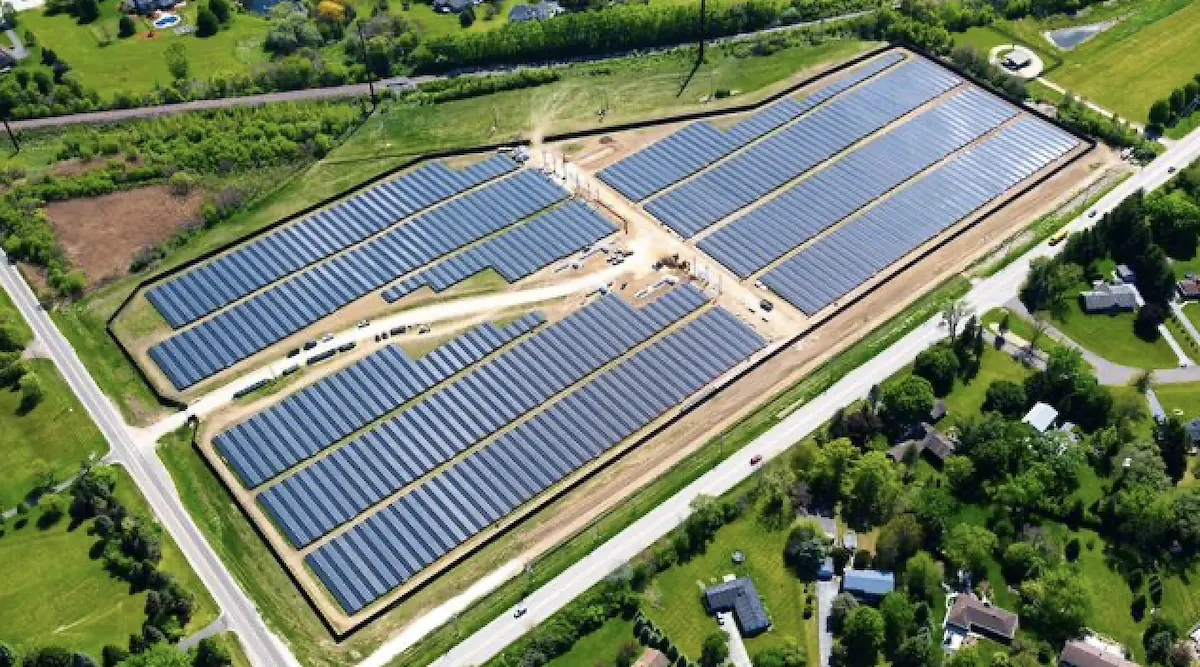
Cultivate Power’s latest endeavor, the Bowes Solar array, vividly illustrates how developers are navigating these tight footprints. Situated on a 22-acre site in Elgin, the project presents a textbook study in spatial complications. The property is tightly wedged between two established residential subdivisions and is further encumbered by a network of high-voltage overhead power lines and active train tracks. To compound the challenge further, a protected wetlands area occupies one corner of the property, entirely ruling out conventional, uniform solar development layouts.
Faced with these multi-layered obstacles, the engineering team at Cultivate Power approached the project from several distinct angles to balance energy generation with physical constraints. To accommodate the irregular boundaries and physical barriers of the site, the team divided the total installation into two distinct arrays, achieving a combined capacity of 11 megawatts of direct current (DC). By splitting the project into two operational sections, Cultivate gained the crucial layout flexibility needed to strictly adhere to local setback requirements while steering completely clear of the sensitive wetland ecosystem.
To truly unlock the high-power potential of a remarkably small footprint, Cultivate integrated an advanced, high-density racking system engineered by the specialized firm Planted Solar.
Additionally, the Planted Solar racking architecture is designed to sit exceptionally low to the ground. This low-profile design played a critical role in mitigating potential friction related to community aesthetics and neighborhood pushback. By pairing the low-profile panels with the installation of an opaque security fence and robust vegetative screening, the solar array remains completely hidden from view outside the boundaries of the property, seamlessly blending the industrial installation into its suburban surroundings.
Solar Power And Community Engagement
Small-scale clean energy projects rarely capture national headlines, but the Bowes Solar array has drawn significant local attention for demonstrating how modern solar developers can successfully build neighborhood consensus. By focusing heavily on the framework of small-scale community solar, the project has established a blueprint for delivering tangible, localized economic benefits.
Community solar programs are specifically structured to directly benefit surrounding residents and local institutions through reduced electricity bills and bolstered municipal tax revenues. According to regional coverage by Chronicle Media, the Bowes array is designed to directly lower utility rates for subscribers within the Commonwealth Edison (ComEd) distribution territory. This expansive coverage area includes 580 low- and moderate-income households that historically have been priced out or structurally excluded from participating in rooftop solar markets.
Reporting from the region notes that the initiative is structured to save participating customers approximately 20 percent on their monthly energy charges. Beyond individual households, the economic advantages extend outward to several larger local entities, encompassing three small businesses, two municipal entities, and a local church. Cultivate Power officials project that over the next four decades, participating subscribers will collectively save roughly $13.9 million on their ComEd utility bills.
Lower electricity rates serve as a powerful tool for community integration, but they represent only one facet of the project’s local impact. Property tax revenues generated by the formerly underutilized site are projected to reach $2.1 million over the span of 40 years. These incoming funds will directly support the local school district and other civic agencies, transforming a piece of real estate that previously resisted conventional commercial development—largely due to its wetland constraints—into a productive economic asset.

Furthermore, Cultivate Power has supplemented its infrastructure investments with substantial philanthropic contributions directed toward regional institutions. Financial support has been channeled to Elgin Community College, Food for Greater Elgin—a member agency of the Northern Illinois Food Bank—alongside organizations such as Friends of the Fox River, We Care Solar, and the Evolve Foundation.
High Density Solar Arrays Are Coming For Your Fossil Fuels
While robust community engagement and localized economic benefits laid the groundwork for public acceptance, the specialized technology provided by Planted Solar was the technical linchpin of the Bowes project.
Planted Solar was founded with the explicit mission of maximizing energy output per square foot in constrained environments. Traditional community solar installations typically demand between five and seven acres of land for every megawatt-peak (MWp) of theoretical maximum output under ideal conditions. Under those conventional spatial rules, an 11-megawatt array like the Bowes project would be physically impossible to construct inside a restrictive 22-acre parcel.
Faced with such spatial limitations, developers in the past might have opted to build a drastically smaller array, risking the viability of the project entirely under the law of diminishing returns. Alternatively, they would have abandoned the site altogether.
Planted addresses this dilemma through a software-enabled racking system that shrinks the land footprint down to approximately two acres per MWp. This high-density architecture provides developers with the structural flexibility necessary to fill in awkward, irregular pockets of land that are usually left entirely undeveloped in standard solar installations. Under this optimized model, a five-megawatt community solar project can occupy roughly 15 acres of land instead of swallowing 40 to 50 acres under conventional design parameters.
Another standard hurdle in solar development involves topography. Traditional rules of thumb dictate that any parcel featuring a slope greater than 10 percent requires extensive, expensive land grading. Such uneven sites are frequently disqualified automatically from community solar consideration due to the exorbitant costs of earthwork, which can easily derail tight project timelines or trigger cancellation during the lengthy permitting phase.
The Planted system bypasses this obstacle by utilizing a terrain-following engineering strategy capable of accommodating existing slopes of up to 27 percent. According to the technology provider, this flexibility opens up land parcels where landowners wish to preserve natural pastures or existing vegetation, or where municipal authorities enforce strict low-disturbance criteria as a condition for land-use approval. While sites must still meet baseline slope and overall acreage thresholds, strict grading restrictions alone are no longer an automatic disqualifier.
The Power Of Community Solar
While the Elgin project highlights how urban and suburban spaces can successfully host clean energy infrastructure, the underlying financial and development models are equally applicable to rural landscapes. Cultivate Power’s primary equity investor, Generate Capital, emphasizes that community solar assets serve as vital economic engines in agricultural settings as well.
In rural farming communities, utility-scale or residential solar savings are frequently out of reach for renters and lower-income families who cannot install personal rooftop arrays. At the same time, rural landowners face constant economic pressure to keep every available acre productive. Community solar bridges this dual gap by extending direct utility savings to local subscribers while offering working farms a stable, diversified source of long-term income alongside traditional crop yields.
Generate Capital points to initiatives like Cultivate’s Goldenrod Solar project, which was successfully commissioned in Mercer County. Although scaled at five megawatts, that installation supplies enough clean energy to serve 850 local subscribers, delivering projected savings of 10 to 20 percent on electricity bills, with low- and moderate-income families comprising more than half of the subscriber base. Much like the Elgin installation, the Mercer County project incorporated direct local investments supporting educational foundations and regional agricultural education programs, cementing the role of modern solar development as an integrated community partner.