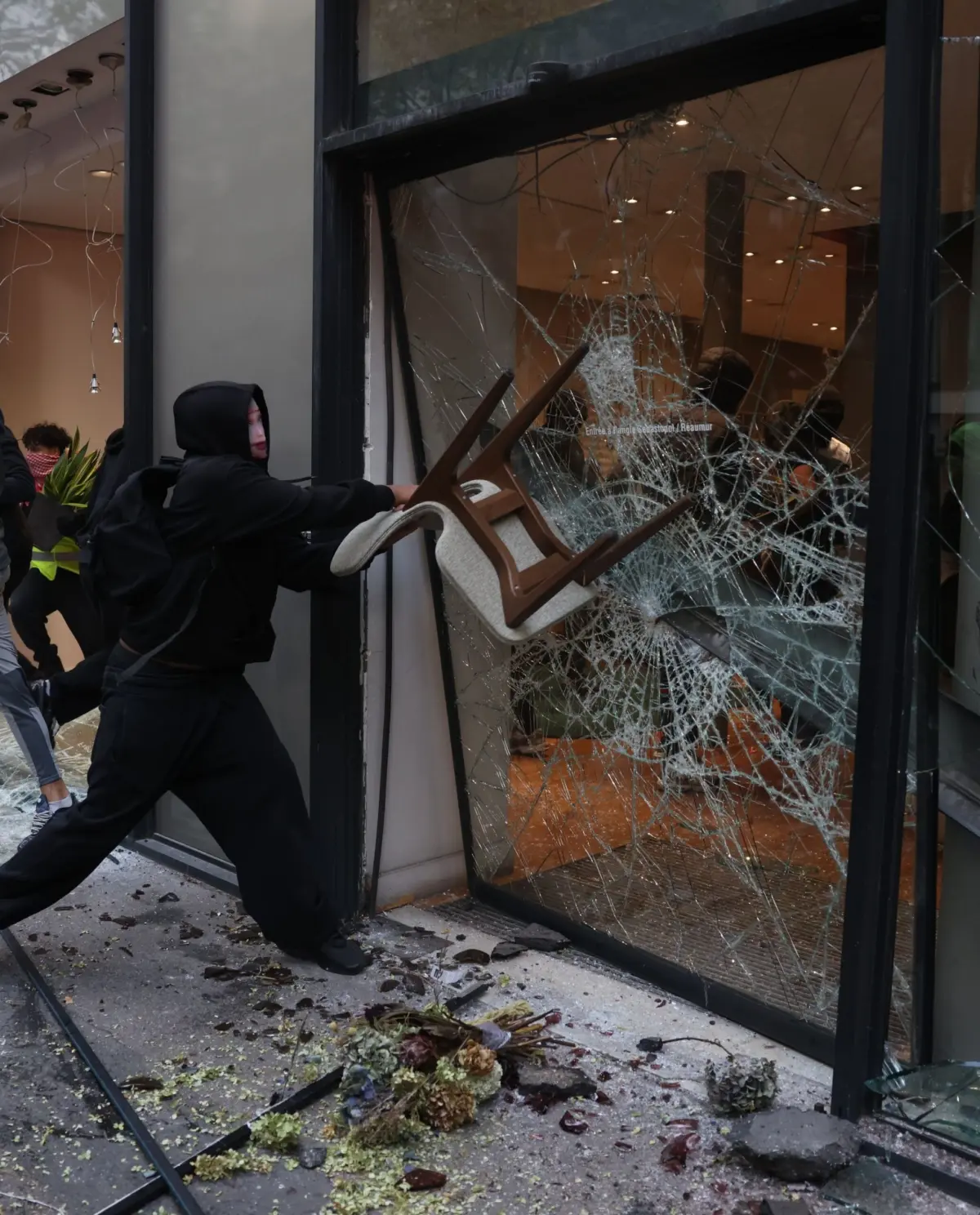
Stores across Paris and other major cities in France were looted, ransacked, and heavily vandalized on Saturday as demonstrations against the rising cost of living spiraled into widespread civil unrest. The protests, which brought together university students and members of the enduring Yellow Vests movement—a grassroots mobilization that first emerged in late 2018 to protest soaring fuel prices, high living costs, and deepening economic inequality—devolved into intense acts of property destruction.
According to figures released by the Fédération du commerce et de la distribution (FCD), approximately 1,500 shops and retail locations across the country were affected by the weekend violence. The hardest-hit areas included premier shopping districts in the French capital, where iconic luxury boutiques and global fashion flagships were targeted. Among the high-end stores that suffered damage, looting, or targeted attacks were Burberry, Christian Dior Parfums, and Louis Vuitton located on the prestigious Rue Saint-Honoré. Similar scenes unfolded along the Boulevard de la Madeleine, where Kenzo, Salomon, and Arc’teryx stores were vandalized, as well as the Lacoste boutique on the Boulevard des Capucines and the Celine flagship on Avenue Montaigne.
The violent outbursts sent shockwaves through the French fashion and retail industries, prompting immediate condemnation from business leaders and trade groups. Pierre-François Le Louët, co-president of the Union Française des Industries Mode-Habillement (UFIMH), or the French Union of Fashion and Clothing Industries, addressed the destruction in a LinkedIn post. He wrote that the industry had witnessed scenes of looting that painfully targeted many beloved clothing brands.
By Sunday morning, a semblance of calm had returned to the luxury shopping arteries of Paris. Many stores that had closed their doors late Saturday afternoon in response to the escalating violence reopened for business. However, establishments that bore the brunt of the looting remained shuttered, shielded behind newly erected wooden boards. Passersby could see the aftermath of the chaos as workers busily made repairs inside damaged interiors, while spray-painted graffiti tags marred the building facades. Slogans left behind by vandals included phrases such as "tax the rich," "capitalism kills," and "Fauchés mais en Lacoste," a colloquial French expression translating to "Broke but in Lacoste."
The extent of the disruption forced major retail networks to take unprecedented safety measures. Sephora kept almost its entire network of stores across France closed on Sunday after suffering significant damage during Saturday’s protests. Catherine Spindler, president of Sephora Europe and the Middle East, shared a detailed account of the ordeal on LinkedIn, emphasizing the psychological toll the events took on retail staff. She noted that several stores in France were ransacked and, even more seriously, members of the retail teams were confronted with situations involving intense violence, fear, and extreme tension.
Spindler explained that the company made the proactive decision to close all its stores from 5 p.m. onward on Saturday and to keep the entire retail network closed through Sunday. She stressed that no commercial consideration would ever outweigh the safety of employees and customers, adding that a company’s true strength lies not in its physical stores or shop windows, but in the women and men who bring it to life, whose safety, dignity, and well-being remain non-negotiable.
Nicolas Houzé, executive chairman of the Galeries Lafayette group, also paid tribute to frontline retail workers and expressed deep concern over the unprecedented wave of destruction. Writing in his own LinkedIn post, Houzé stated that since the peak of the Yellow Vests movement, the country had not experienced such an outburst of violence, which severely impacted department stores nationwide. He noted that nearly all of the group’s stores were affected by the day of violence, with a particularly severe impact felt in Bordeaux, as well as in regional hubs such as Nantes, Rennes, Tours, Perpignan, and Chambéry. Houzé warned that beyond the physical destruction and significant financial losses suffered by retail stakeholders, the very image of France, its international economic attractiveness, and its capacity to welcome visitors in optimal conditions had been profoundly damaged.

Thierry Guibert, CEO of Lacoste parent company Maus Frères, took to social media platform X to voice his outrage and concern. When Lacoste and Aigle stores are looted, alongside numerous other businesses across France, it is not merely shop windows that are being smashed, Guibert wrote. He emphasized that jobs, years of hard work, specialized expertise, and the daily commitment of thousands of women and men are being put at risk. Guibert called directly on the French government to mobilize, without delay, all legal means at its disposal to put a definitive end to the violence.
Echoing these demands, UFIMH co-president Le Louët called for immediate state intervention and institutional solidarity. He stated that the organization was actively seeking the support of the government, its various administrations, and all political forces in the country to unequivocally condemn the looting and property damage, bring the culprits to justice, and provide financial and administrative assistance to the victimized companies. Le Louët confirmed that the UFIMH and its constituent organizations would act in unison to mitigate the already considerable economic fallout of the disastrous events that marked the weekend.
The sudden escalation in street protests comes during a critical autumn cultural and commercial calendar in Paris. Student-led demonstrations had previously gained momentum during Paris Fashion Week, though they did not significantly disrupt the high-profile runway shows. However, the weekend’s widespread violence arrived just as the French capital prepared to welcome international art collectors, curators, and gallerists for Art Basel Paris, which is scheduled to open to the general public on Thursday.
Despite the tense security climate, organizers indicated that the prestigious art fair and its surrounding satellite events would proceed as planned. A spokesperson for Art Basel Paris stated that at this stage, cancellation was not being considered, though very significant security measures were being rapidly put in place across the city to safeguard venues and attendees.
Underlying anxieties remain palpable as labor unions and activist groups maintain pressure on the government. Several labor organizations have already called for a nationwide day of general strikes and public demonstrations scheduled for November 5, raising concerns that further disruptions could lie ahead.
The timing of the unrest coincides with a critical financial reporting window for the European luxury sector. Several major luxury conglomerates, including Moncler, Kering, Hermès, Zegna, and Prada, are scheduled to announce their third-quarter earnings throughout the week. Analysts and investors anticipate that executives may address the potential dampening impact of the French domestic retail performance during the fourth quarter in upcoming earnings calls. France remains a vital market within Europe alongside Italy, serving as a significant revenue generator for top-tier luxury houses. For instance, France accounted for 8 percent of LVMH’s total revenue during the first nine months of 2026, and 9.2 percent of Hermès’s total revenue during the first half of the same year.
Addressing the nation on Sunday evening, French President Emmanuel Macron strongly condemned the violence. He placed the blame squarely on troublemakers originating from far-left fringe groups who had been joined by numerous opportunistic criminals, stating that they had engaged in unrestrained violence in cities across the country.