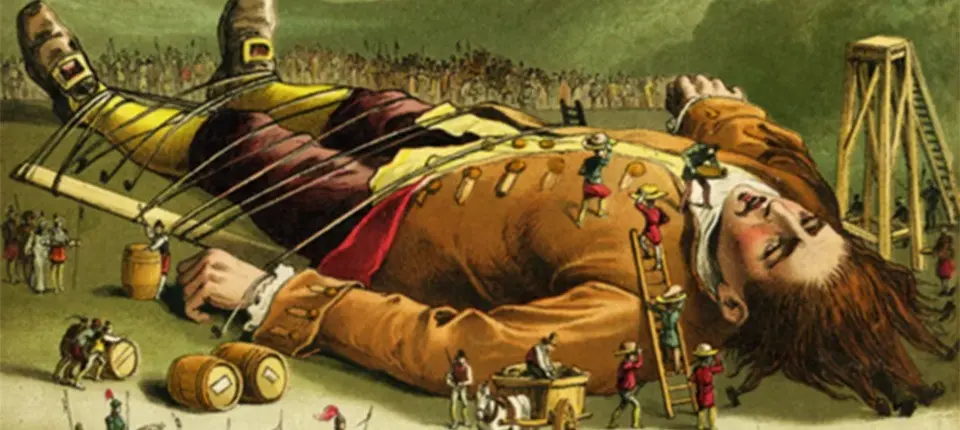
Welcome to today’s daily digest of the finest literary corners across the digital landscape, where we bring you the most engaging discussions, historical milestones, and cultural reflections shaping the world of books.
Today marks a monumental anniversary in the history of world literature and satirical fiction. On this exact day in 1726, Jonathan Swift’s timeless masterwork, Gulliver’s Travels, was first published, forever changing the landscape of speculative fiction, political satire, and imaginative storytelling.
As readers and literary enthusiasts across the globe reflect upon the enduring legacy of Swift’s creation, the digital literary sphere is alive with commentary, historical retrospectives, and deep dives into the multilayered brilliance of the novel. From academic circles to contemporary book reviews, the adventures of Lemuel Gulliver continue to provoke thought, spark debate, and inspire creators nearly three centuries after the ink first dried on its initial printing.
Originally published anonymously under the title Travels into Several Remote Nations of the World. In Four Parts. By Lemuel Gulliver, First a Surgeon, and then a Captain of Several Ships, Swift’s novel quickly captured the public imagination. What initially appeared to be an entertaining travelogue of fantastic voyages soon revealed itself to be a biting, profound critique of human nature, European politics, and the Enlightenment-era obsession with reason divorced from empathy.
Throughout the literary internet today, critics and historians are examining how Swift’s biting wit manages to remain remarkably relevant in the modern era. The novel’s distinct sections—taking readers from the diminutive world of Lilliput to the towering giants of Brobdingnag, the flying island of Laputa, and ultimately the unsettling society of the rational horses, the Houyhnhnms—offer a panoramic view of human folly that has lost none of its edge over the centuries.
In digital essays and cultural commentary published this week, scholars note how Swift utilized fantasy not merely as a form of escapism, but as a mirror to hold up against the political corruption, scientific hubris, and social injustices of eighteenth-century Britain. Yet, the work’s remarkable versatility has allowed it to transcend its historical context. While it is frequently adapted into children’s adventure stories or cinematic spectacles, adult readers continually rediscover the darker, more cynical philosophical undercurrents that define the latter halves of Gulliver’s journeys.
As the literary community commemorates this significant anniversary, online platforms are filled with recommendations for the best editions, discussions on Swift’s complex biography, and explorations of how subsequent generations of writers have borrowed from his satirical playbook. Whether through academic reappraisals or casual reader reviews shared across social media networks, the conversation proves that great literature does not merely endure through time; it actively engages with each new era that encounters it.
Stay tuned as we continue to track the best discussions, essays, and literary features circulating online, bringing you closer to the stories and historical milestones that define our reading lives today.