
Cryptocurrency markets faced a turbulent week following the largest exchange hack in history, which saw North Korean hackers drain $6.3 billion from Binance’s hot wallets. Despite the unprecedented scale of the breach, Binance has successfully resumed withdrawal services across 15 blockchain networks, reporting manageable net outflows as the vast majority of its user base chose to remain on the platform.
The security breach occurred late last week when attackers belonging to North Korea’s notorious TraderTraitor group gained access to delegated wallet permissions through a compromised laptop. While security experts debated the exact mechanisms that allowed the breach to unfold—including discussions around account abstraction protocols like EIP-7702—Binance leadership pushed back against the narrative that the incident was the result of a simple oversight. Binance co-CEO Richard Teng clarified during the investigation that the attacker did not merely rely on a single engineer’s permissions or a basic one-click action, emphasizing that the multifaceted intrusion remains under active investigation without individual responsibility attributed so far.
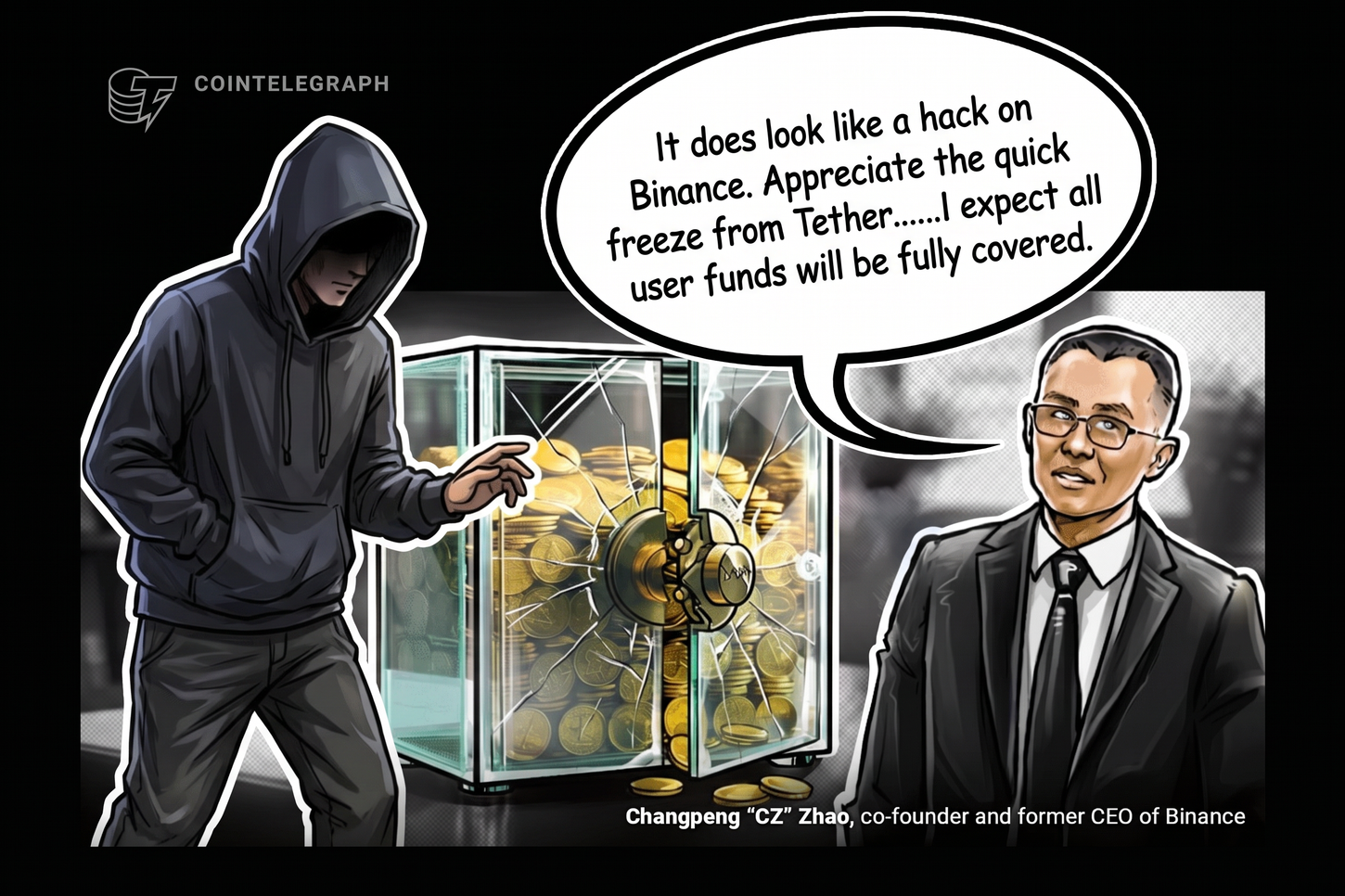
Following the reopening of withdrawal channels, Binance reported processing approximately $4.65 billion in withdrawals while simultaneously taking in $1 billion in incoming deposits. Founder Changpeng Zhao shared figures indicating that over the initial 12-hour recovery window, the platform experienced a net outflow of just 2.1%, prompting him to remark that 98% of users chose to stay with the platform. Although external tracking tools such as DeFi Llama recorded higher gross movement—peaking at $4.54 billion over a 24-hour period—analysts noted that such figures frequently account for internal wallet restructuring or transfers into newly established hot storage.

Remarkably, Binance moved swiftly to mitigate the financial damage, replenishing roughly 95% of the stolen cryptocurrency almost immediately. The rapid recovery was made possible through a strategic combination of the exchange’s corporate reserves, internal insurance policies, and utilizing 50% of the funds held within the Secure Asset Fund for Users (SAFU).
FBI and Secret Service Swoop in to Help Save Billions
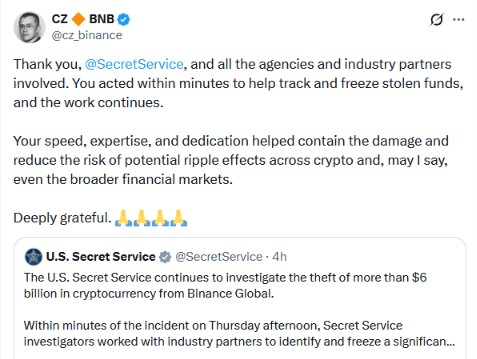
The aftermath of the breach triggered a massive international response, with U.S. law enforcement agencies mobilizing within minutes to assist in tracking and recovering the stolen funds. Binance founder Changpeng Zhao publicly thanked the U.S. Secret Service for its swift intervention, noting that rapid expert action played a vital role in containing the overall damage.
On-chain analytics firm Elliptic estimated that law enforcement and issuing authorities successfully froze approximately $2.84 billion of the stolen assets—predominantly stablecoins such as USDC and USDT—leaving the hackers with an estimated $3.33 billion in accessible funds. In a desperate race against time to bypass impending stablecoin blocks, the attackers reportedly borrowed roughly $44.6 million in Ether against stablecoins on the Aave decentralized lending protocol.
The U.S. Federal Bureau of Investigation formally attributed the cyberattack to the TraderTraitor collective, a faction linked to North Korea’s Lazarus Group that has previously been implicated in multibillion-dollar thefts targeting other major platforms such as Bybit and Bitget. President Donald Trump briefly addressed the situation, indicating that diplomatic channels would be utilized to discuss the incident with North Korea. Additionally, the FBI published a comprehensive directory of wallet addresses tied to the hack, directing THORnode operators, remote procedure call node providers, instant exchanges, decentralized finance services, and blockchain analytics firms to block any transactions connected to or derived from the compromised addresses.
THORChain Founder Rejects Freeze Request Amid Decentralization Debate
The North Korean hackers increasingly turned to decentralized cross-chain liquidity protocols to launder their ill-gotten gains, attempting to leverage platforms like THORChain for permissionless cryptocurrency swaps. Ironically, the protocol’s native token, RUNE, experienced a 13% price surge driven by market expectations of increased network fees generated by the massive transaction volume.
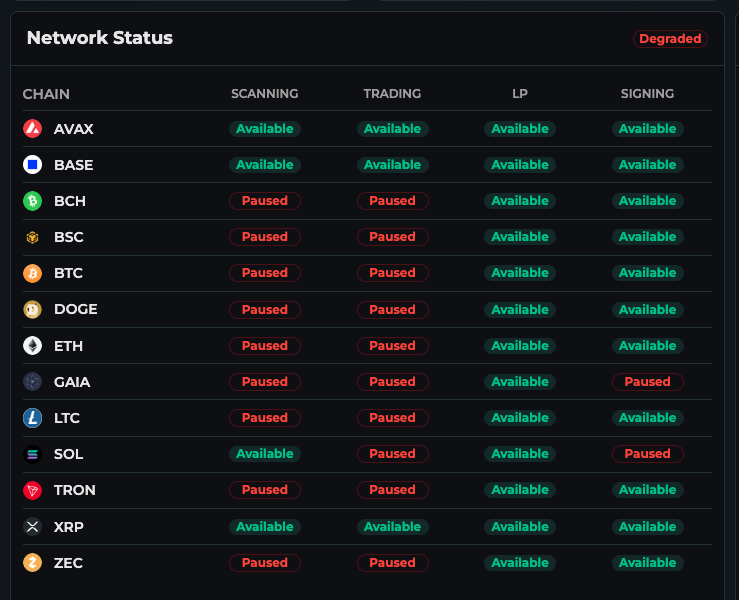
However, the attackers faced immediate friction as automated safety systems had already paused nine major chains on THORChain—including Bitcoin, Ethereum, and Tron—due to unrelated operational issues shortly after the Binance breach occurred. This technical standstill reignited a fierce philosophical debate within the decentralized finance community regarding censorship resistance and node governance.
Chad Barraford, a prominent THORChain developer, noted on a podcast appearance that approximately 50 individuals operate the network’s 100 validator nodes. Given the unprecedented scale of the theft and direct pressure from U.S. agencies like the FBI and Secret Service, node operators faced severe legal and regulatory risks if they chose to process transactions linked to the hackers. Conversely, THORChain founder JP Thor, who maintains he is no longer involved with the project’s daily operations, strongly argued that node operators must resist calls to censor addresses, asserting that doing so would compromise the core tenets of decentralization. He warned that if validators chose to take the protocol offline, the permissionless settlement experiment would effectively fail, leaving no unencumbered financial venues intact.
Under THORChain’s governance rules, a supermajority of one-third plus one of the node operators is required to halt network activity, though individual validators retain the freedom to disconnect if they refuse to process contested funds. Independent trackers like Lookonchain also reported that the attackers funneled roughly half of $95.9 million in stolen Solana into Bitcoin using alternative cross-platform routing services like Relay.
Ramifications of the Hack and Broader Market Impact
The unprecedented scale of the Binance breach sent immediate shockwaves across traditional and digital asset markets. Shares of major crypto-related entities, including Coinbase, Circle, and MicroStrategy, suffered sharp sell-offs as broader crypto market valuations dipped. Despite the panic, industry analysts suggested that the foundational thesis for major assets remained intact. Strive CEO Matt Cole observed that Bitcoin held up notably better than historical precedent might suggest during major systemic crises, bottoming out near $76,500 before recovering toward $77,745.
Nevertheless, institutional sentiment showed signs of caution. Nasdaq-listed firm Next Technology Holding announced that its board of directors approved the total liquidation of its corporate Bitcoin treasury, consisting of 5,833 BTC valued at approximately $450 million. Market participants expressed growing anxiety over the sheer volume of assets controlled by the hackers, who reportedly amassed between 18,000 and 18,270 Bitcoin alongside hundreds of thousands of Ether through subsequent laundering operations. Analysts warned that any sudden liquidation of these holdings could introduce significant downward price pressure on major cryptocurrencies.
Legislative pressure also intensified in Washington. Senator Cynthia Lummis and advocacy group The Digital Chamber renewed their calls for comprehensive federal cryptocurrency legislation designed to preemptively safeguard digital asset infrastructure and mitigate the fallout from future cyberattacks.
Compounding security anxieties across the broader ecosystem, hardware wallet manufacturer Trezor issued an urgent advisory warning customers who purchased devices through former authorized reseller CryptoBilis since March to transfer their funds immediately. The warning followed a customer report from Indonesia detailing a suspected unauthorized circuit board implant inside a Trezor Safe 5 device. This development closely mirrored security warnings issued in October regarding compromised Ledger hardware wallets distributed through the same regional reseller, highlighting ongoing vulnerabilities within global supply chains.

At the close of the trading week, major digital assets remained slightly subdued, with Bitcoin down 3% at $77,745, Ethereum declining 3.5% to $2,260, and XRP dropping 3.9% to $1.02, bringing the aggregate cryptocurrency market capitalization to $2.21 trillion. Notable altcoin outperformers included Hyperliquid, Midnight, and Pepe, each securing double-digit gains, while Curve DAO, VeChain, and Worldcoin registered the steepest weekly corrections.
Market analysts at Standard Chartered suggested that the historic breach could permanently accelerate the migration of trading volume away from centralized exchanges toward decentralized alternatives. Geoffrey Kendrick reiterated a long-term price target of $100 for Uniswap’s UNI token by 2030, emphasizing that decentralized exchanges have historically avoided major security exploits and that the Binance incident reinforces the structural shift toward non-custodial trading environments.
Meanwhile, regulatory authorities continued to grapple with emerging technological risks. Commodity Futures Trading Commission Chairman Mike Selig cautioned that the rapid integration of autonomous artificial intelligence agents into financial markets could soon challenge compliance frameworks traditionally designed around human traders. While advanced AI systems offer retail participants institutional-grade risk management capabilities, Selig warned that automated trading loops, correlated algorithmic behavior, and high-speed execution present new complexities for market surveillance and systemic stability.
In the cybersecurity and legal sectors, blockchain analytics firm Chainalysis confirmed it was targeted in an unrelated cyber incident. The company stated that a security review found no evidence of unauthorized access to investigative content, authentication credentials, or session tokens, though limited non-sensitive customer data—including names, email addresses, and user identifiers—was exposed. In a separate legal development, a federal court sentenced two Texas brothers to more than 15 years in prison each for their involvement in a violent armed robbery and kidnapping scheme in Minnesota, where they targeted a family to extort millions of dollars in cryptocurrency.