The wind energy industry has spent decades pushing turbines to unprecedented heights to capture stronger, more consistent winds. However, this vertical race has collided with a stubborn physical and economic bottleneck: the massive, expensive, and logistically nightmarish crawler cranes required to lift massive turbines into place. Transporting these giant specialized cranes to remote sites accounts for a significant portion of project capital expenditures, while high winds often halt lifting operations entirely, causing costly delays.
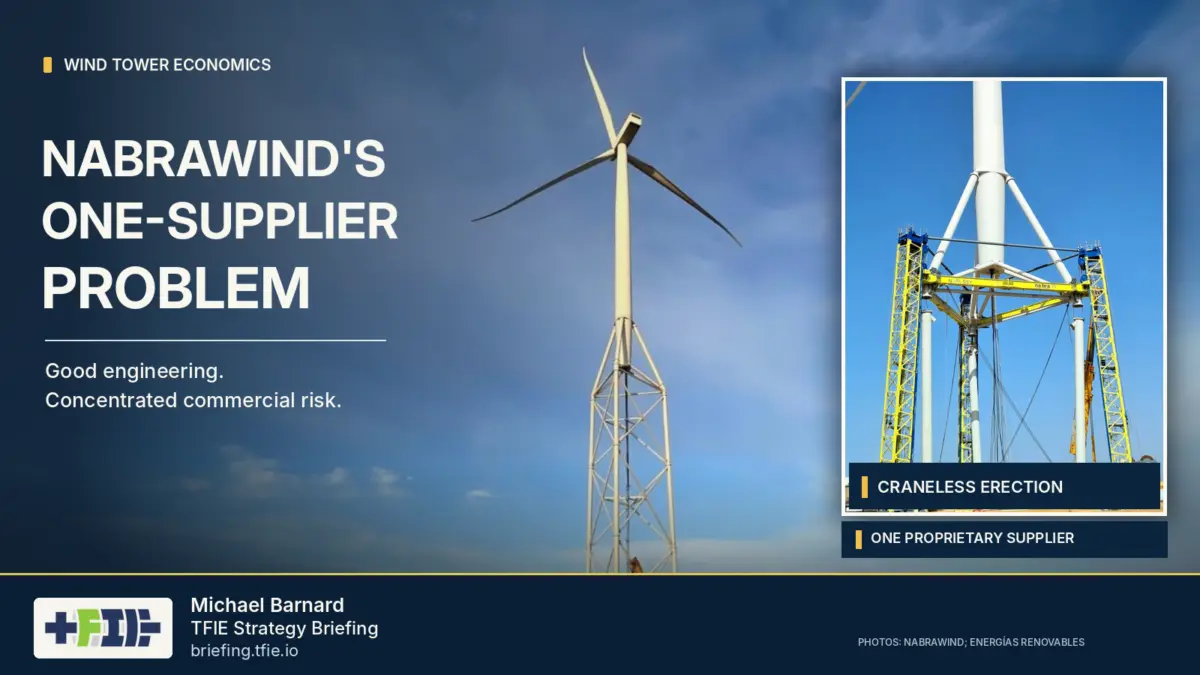
Enter Spain-based Nabrawind, a firm that has developed an innovative approach to installing exceptionally tall wind turbine towers without ever bringing a traditional giant crawler crane to the project site. Its proprietary Nabralift system relies on a tubular upper tower supported by an ingenious three-legged steel structure. Using integrated hydraulic equipment, the system raises the fully assembled turbine upward while modular sections are systematically inserted below it near ground level. Once the tower reaches its target height, the lifting frame is removed and transported to the next installation site, completely bypassing the need for heavy external lifting machinery.
This engineering feat addresses genuine logistical and construction challenges that have long plagued the wind sector, particularly in remote regions where transporting specialized infrastructure is economically unviable and volatile weather frequently stalls standard construction.
Moving Beyond the Demonstration Phase
Nabrawind has steadily progressed past prototype-scale hardware into commercial validation. A major milestone arrived in September 2026, when UL Solutions officially issued type certification for Envision’s 7.8 MW turbine mounted atop Nabrawind’s towering 188-meter tower configuration. This certification provides vital technical validation that the combined tower and turbine assembly meets stringent international engineering and safety standards.
Practical deployment is already underway on an international scale. Mining and green energy giant Fortescue is actively utilizing 17 of these specialized tower configurations at its 133 MW Nullagine wind project, situated in the remote Pilbara region of Western Australia. Prior to this, Nabrawind successfully erected a 160-meter prototype in Spain in less than two weeks, following smaller commercial tower installations in Morocco and France.
These deployments highlight the technology’s readiness for harsh operating environments, but they also underscore the unique commercial structures currently driving its adoption.

Quantifying the Engineering Benefits
The theoretical and practical advantages of the Nabralift system are credible and compelling for developers seeking to optimize energy yields. According to Nabrawind’s technical data, the three-legged tower design utilizes roughly 20% less steel than comparable conventional tubular designs. Furthermore, the system can reduce foundation concrete requirements by as much as 80%, depending heavily on the specific engineering design and local geotechnical conditions at the site.
While these figures represent supplier-reported metrics rather than independently verified savings across every conceivable wind farm deployment, the broader operational impacts are difficult to dismiss. The potential to eliminate the need for large crawler cranes, simplify heavy transport logistics, and safely raise turbines during periods of higher wind speeds can dramatically alter total installed costs and construction schedules. In the wind industry, high hub heights only earn their long-term keep when the initial capital expenditures and ongoing operational risks are thoroughly justified by the cumulative electricity generated over a project’s multi-decade lifecycle.
Ownership, Procurement, and Supply Chain Realities
Despite the promising engineering metrics, the current commercial deployment of Nabrawind’s technology reveals a distinctive corporate structure. Fortescue acquired Nabrawind outright in September 2025, and it is deploying the Nabralift system at Nullagine primarily to power its own heavy mining operations. As a well-capitalized industrial titan with internal electricity demand and a direct strategic incentive to advance decarbonization, Fortescue possesses the financial muscle and internal synergies to support a technology it owns.
However, successful execution within this captive corporate context does not automatically establish that an unrelated, third-party wind developer can easily finance, procure, and maintain the exact same system under ordinary commercial arrangements.
The proprietary nature of Nabralift introduces complex procurement considerations for standard independent power producers. Conventional tubular wind towers can typically be sourced from multiple qualified manufacturers, allowing developers to run competitive bidding processes and engage experienced third-party contractors for most of the construction phase. In contrast, a developer choosing to utilize the Nabralift system currently remains dependent on a single supplier for the core tower structure, specialized lifting expertise, and ongoing technical support.
While wind turbine original equipment manufacturers already create certain supplier dependencies, concentrating another critical component of the balance of plant into a proprietary installation system requires rigorous contract structuring and meticulous risk assessment.

The Hurdles of Long-Term Lenders and Insurers
Securing a type certification is an essential step that provides robust technical assurance regarding the structural integrity of the certified turbine-and-tower configuration. Even so, project lenders, equity investors, and insurers demand much more than a technical stamp of approval before backing a multi-million-dollar infrastructure project.
Financial stakeholders require enforceable delivery schedules, comprehensive long-term warranties, clear provisions for operations and maintenance, guaranteed access to replacement parts, and a workable legal remedy in the event that the supplier’s operational capacity or commercial priorities shift over time. These requirements become exponentially more critical when a modern wind farm is designed to operate reliably for 25 years or longer, especially in scenarios where there is no readily available, qualified alternative provider capable of servicing the same proprietary system.
The Path Forward for Self-Erecting Towers
Nabrawind’s next vital proof point will not come from captive corporate deployments, but rather from an independently developed and financed large-scale wind farm willing to accept these operational risks on standard commercial terms.
If the company can foster a broader network of qualified installation partners, establish credible long-term service arrangements, and build greater competitive capacity within the supply chain, its distinct engineering advantages will become much easier for mainstream developers to procure. The 188-meter tower has successfully captured the technical attention of the global wind energy community; whether it can achieve widespread market dominance will ultimately depend on whether financing practices and procurement confidence can catch up with the innovative machinery.