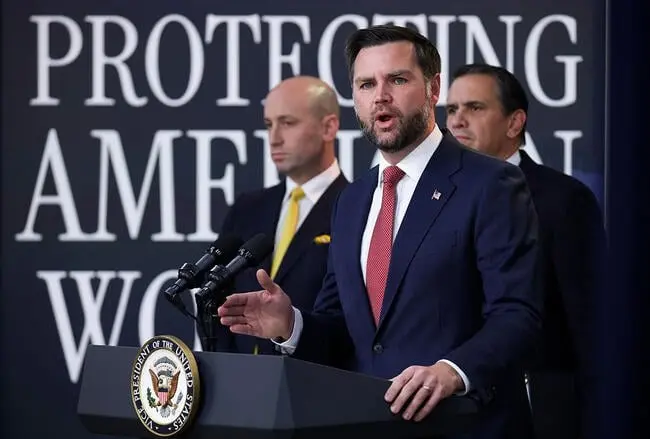
Vice President JD Vance announced on Thursday that nine prominent American universities are currently under active investigation by the federal government for allegedly abusing the J-1 visa program. The federal inquiry, which is being spearheaded by the Department of Labor, focuses on whether higher education institutions have improperly utilized the exchange visitor program to bring foreign nationals into the country in a manner that allegedly undercuts the wages and opportunities of American researchers and graduate students.
During a press conference dedicated to addressing visa fraud, administration officials revealed that subpoenas have already been formally served to the targeted academic institutions. Vance, who serves as the chair of the administration’s fraud task force, laid out the administration’s core concerns regarding how these institutions handle federally funded grants and academic staffing. He singled out nine specific universities: Arizona State University, Brown University, Harvard University, Yale University, Stanford University, the California Institute of Technology, the Massachusetts Institute of Technology, the University of California, Davis, and the University of Pittsburgh.
The J-1 visa program is a federal initiative designed to promote cultural and educational exchange. It allows noncitizens to temporarily enter the United States to teach, lecture, conduct research, or participate in graduate medical education, among other authorized activities. However, the administration’s recent scrutiny suggests that the program may be facing systemic exploitation by some of the nation’s wealthiest and most prestigious institutions of higher learning.
According to data cited by Vance during his remarks, the institutions under investigation rely heavily on J-1 visa holders for work tied to federally funded grants. Vance pointed out that these nine universities employ J-1 visa holders for federally funded grants at a rate of approximately 61 percent, which stands in stark contrast to the national average of roughly 38 percent.
"Something weird is going on at these universities," Vance said at the press conference, accusing the institutions of overutilizing the visa program. "They’re using them to undercut the wages of American grad students and American researchers."
To illustrate the economic disparity, Vance stated that American graduate students and domestic researchers typically earn approximately $20,000 more annually than individuals working under J-1 visas within similar roles. The administration argues that this wage gap creates an unfair market disadvantage for domestic students who are seeking graduate assistantships, research positions, and entry-level academic careers within major research institutions.
The Department of Labor’s inspector general, Anthony D’Esposito, strongly echoed Vance’s sentiments during the briefing, characterizing the inquiry as a historic and comprehensive investigation into J-1 visa fraud. D’Esposito pledged that his agency would relentlessly "follow the money and uncover the schemes" operating behind closed doors in higher education. He emphasized that American taxpayers deserve absolute transparency regarding where federal money allocated for research and innovation is ultimately directed. Furthermore, D’Esposito noted that the investigation will deliberately explore whether foreign influence, improper financial relationships, or widespread visa abuse are actively compromising federally funded research, specifically highlighting ongoing concerns related to foreign nations such as China.
Drawing upon his previous professional background as a New York Police Department detective, D’Esposito delivered a sharp warning to university administrators and leadership, signaling that the federal government does not intend to back down due to the institutional prestige or financial power of the targets.
"I don’t care how prestigious a university thinks it is," D’Esposito said. "Break the law and screw the American people, and I will personally cuff you in the university square. I don’t care how large your endowment is, how powerful your alumni are or how many politicians you have on speed dial."

In the wake of the announcement, several of the targeted universities responded by defending their employment practices, asserting their full compliance with federal laws, and emphasizing the vital contributions that international scholars and students bring to their respective campuses.
A spokesperson for Brown University confirmed that the institution has been formally notified by the government. In an email statement, the spokesperson underscored the indispensable role that international talent plays in driving academic excellence and economic growth.
"Brown’s international scholars, students and employees make essential contributions on our campus, including to teaching and research that advances American innovation, competitiveness and economic vitality," the Brown spokesperson wrote. "We have received a subpoena from the government for various records pertaining to foreign labor programs administered by the U.S. government, and we will respond promptly and directly to the government."
Representatives for Arizona State University similarly defended their institutional record, pointing out the vast scale of their educational and research operations. An ASU spokesperson highlighted that the university educates a larger population of STEM majors than any other university in the country and maintains one of the largest technical and scientific workforces nationwide.
"This benefits both the Arizona and the United States economies and in doing so, ASU has hired the talent needed to perform these functions and done so in complete compliance with existing United States policy and law," the ASU spokesperson said.
Similarly, Stanford University released a brief statement affirming its commitment to the rule of law. A university spokesperson stated that Stanford complies with all applicable visa regulations and will fully cooperate with the ongoing Labor Department investigation.
At the Massachusetts Institute of Technology, leadership is currently evaluating the scope of the federal inquiry. Kimberly Allen, the executive director of media relations at MIT, described the Labor Department’s subpoena as "very broad" while noting that the university is actively reviewing the document. Allen also reminded the public that every individual J-1 visa holder undergoes thorough vetting by the United States government before entering the country.
"We value international students and scholars on our campus," Allen said. "America’s ability to attract top talent from world-class institutions while protecting U.S. economic and security interests is a national strength, and that competitive advantage should be supported."
The investigation marks a significant escalation in federal oversight regarding foreign labor programs within American higher education, placing some of the most celebrated universities in the country directly in the crosshairs of federal law enforcement and labor regulators. As the Department of Labor continues to examine financial records and grant utilization data, the targeted institutions prepare to hand over requested documentation while maintaining that their use of the J-1 visa program remains entirely lawful and beneficial to the national interest.