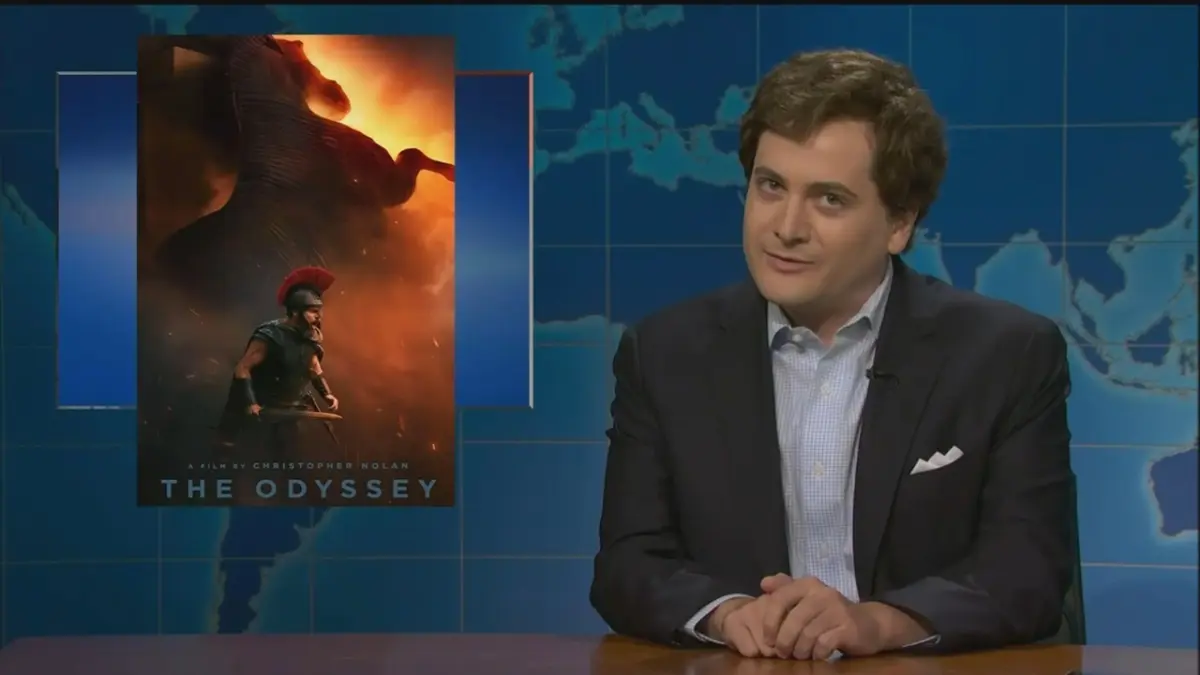
The long-running sketch comedy staple Saturday Night Live officially kicked off its historic 52nd season this past weekend, signaling a return to the political satire and pop-culture commentary that has defined the program for over half a century. Among the most anticipated segments of the season premiere was the return of the fan-favorite "Weekend Update" desk, which featured a recurring guest appearance that has quickly become a highlight of the show’s modern era: Jeremy Culhane’s biting impression of political commentator Tucker Carlson.
Culhane, who first introduced his take on the former cable news host during Season 51, stepped back into the role with renewed vigor. His performance, which marked the third time the character has graced the SNL stage, focused heavily on the commentator’s signature rapid-fire, rhetorical questioning style and his penchant for turning seemingly mundane cultural topics into exercises in ideological grievance. Throughout the segment, Culhane’s Carlson analyzed the cinematic landscape of the past summer, offering his distinctively cynical take on a variety of major motion pictures.
The satirical riff began with a critique of the technical specifications of modern cinema. Turning his focus to the film The Odyssey, Culhane’s character zeroed in on the use of the Imax 70mm format, a technical hallmark of prestige filmmaking that has become a point of obsession for cinephiles. In true Carlson fashion, the character framed this technical choice through a lens of conspiracy and culture-war outrage. "The Hollywood cabal shoots its filth with millimeters," he declared, before coining the phrase "the gay inch" to describe the format. Transitioning briefly to the film’s subject matter, he added, "I like The Odyssey. It’s so nice to see Greek people do something other than make women feel uncomfortable."
The segment quickly moved toward the year’s most discussed box-office successes. When the conversation turned to the latest iteration of the Spider-Man franchise, Culhane’s Carlson immediately pivoted to a manufactured controversy regarding the film’s title. "Everybody loves Spider-Man: Brand New Gender," he remarked, prompting anchor Colin Jost to clarify that the film’s title was, in fact, nothing of the sort. Undeterred by the correction, the character leaned further into his bit, spontaneously composing a theme song: "Spider-They, Spider-Them uses whatever bathroom it feels like."
The bit served as a quintessential example of the character’s SNL incarnation, which relies on the contrast between the commentator’s intense, serious delivery and the absurd, provocative nature of his arguments. The comedy in the segment relied heavily on the interaction between the character and Jost, who served as the straight man, tasked with attempting to keep the segment on track while the persona spiraled into increasingly bizarre rhetorical traps.
The tension between the two continued when the conversation shifted toward the real-life personal lives of the film’s stars. After attempting to offer a begrudging congratulatory message to the actors for their recent marriage, the character was derailed by a perceived grievance regarding naming conventions. "I now pronounce you Mr. and Mrs.—huh? She refused to take his last name," he said, feigning genuine confusion and outrage at the modern professional choice of actress Zendaya.
When Jost reminded him that the performer is mononymous—noting that Zendaya does not, in fact, have a traditional last name—the character’s frustration only deepened. "But where did it go? And who took it? And why?" he demanded. "Sorry kids, you don’t get two names anymore. You only get one name, like a dog. That’s the rule. That’s the goal now." This exchange highlighted the character’s recurring theme of "the decline of tradition," using trivial pop-culture occurrences to illustrate his broader, often hyperbolic, worldview.
The commentary continued with a look at the film Obsession. Framing the plot through a satirical political lens, the character described the movie as "the left’s idea of a horror movie—that a woman is forced to love a man." He continued the monologue by questioning the implications of the film’s premise, asking the audience, "Oh, no, help! I’m being chased by a heterosexual relationship! Is this what we want? I don’t. Do you? You shouldn’t. But you do. Why? Is that allowed? Maybe."
In one of the segment’s most surreal moments, the character shifted his sights toward a fictional or thematic concept he dubbed "Minions and Monsters," drawing a direct, if nonsensical, parallel between the animated characters and the political landscape of the United States. He compared the entities to "Trump’s cabinet," before pausing for a moment of deadpan reflection. "That’s right," he said, maintaining a stoic, somber expression. "I’ve turned on Trump. I’m so brave." The punchline served as a meta-commentary on the nature of political punditry and the performative bravery often associated with high-profile media shifts.
The segment concluded with a characteristically raunchy joke regarding the Toy Story franchise. Referencing the film’s iconic theme song, the character asked, "You’ve got a friend in me? And his name is Woody?" The double entendre brought the segment to an abrupt close, reinforcing the character’s penchant for slipping into suggestive or provocative territory even while discussing family-friendly intellectual properties.
Jeremy Culhane’s recurring impression has become a significant fixture of the "Weekend Update" desk, providing a specific flavor of political satire that complements the show’s broader coverage of current events. By focusing on the persona of the cable news host—the intense eye contact, the dramatic pauses, and the escalation of minor cultural shifts into moral crises—Culhane provides a comedic mirror to the polarization often found in modern American media.
As Saturday Night Live continues its 52nd season, the return of such segments underscores the show’s ongoing commitment to using its platform to engage with the figures and trends that dominate the public consciousness. The segment, which can be viewed in full on the show’s digital platforms, serves as a reminder of the enduring power of parody to distill complex cultural anxieties into sharp, memorable television moments. With three successful appearances under his belt, it is clear that the character has found a permanent place in the current iteration of the show’s ensemble.