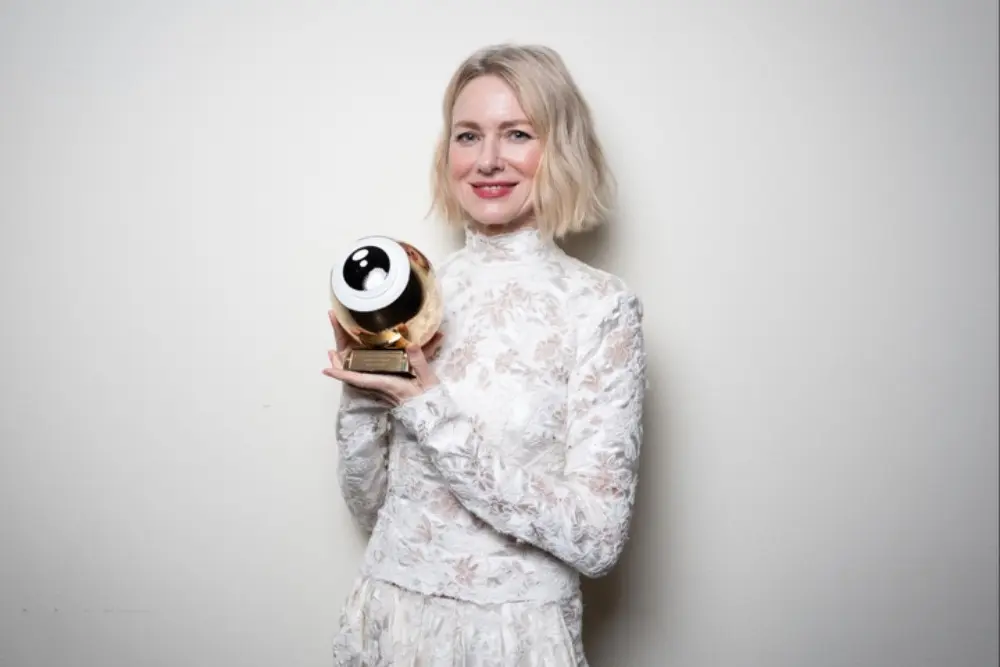
Naomi Watts is today recognized as one of the most accomplished and versatile actors of her generation, a performer whose filmography spans haunting psychological thrillers, gut-wrenching dramas, and blockbuster hits. Yet, during a recent masterclass at the Zurich Film Festival, where she was honored with the prestigious Golden Eye Award, Watts offered a candid and sobering look at the decade of struggle that preceded her rise to international prominence. Far from the glamorous trajectory one might assume, Watts’ early career was defined by financial instability, deep-seated self-doubt, and a desperate, often futile, attempt to mold herself into whatever the industry demanded.
The Long Road to Recognition
For Watts, the journey to becoming a household name was anything but linear. Reflecting on the ten-year period before she crossed paths with visionary director David Lynch, she described an existence characterized by a relentless “grind.” It was a time when the pressure to succeed began to erode her sense of self-worth.
“It was a grind. That 10 years before I met David, I became so locked up and I felt worthless,” Watts recalled during the festival event. The strain was so palpable that her agent at the time felt compelled to intervene, leading to a difficult, transformative conversation. “My agent pulled me aside and she said: ‘We need to have a heart-to-heart. Honey, you are too intense. You are freaking people out.’ I went: ‘Yeah, no shit.’ I was desperate! I was behind on my rent; I was getting evicted. I didn’t know what to bring to this room.”
This period of her life was marked by a constant, exhausting cycle of performance—not just in front of the camera, but in the audition room. Watts explained how she would constantly try to recalibrate her identity based on the shifting feedback she received from casting directors and industry insiders. If she was told she lacked humor, she would attempt to pivot toward comedy; if she was told she lacked a certain “sexiness,” she would try to embody that quality.
“You reshape yourself and try to read the tone of what is needed. That’s how it went and I couldn’t be myself anymore,” she said. “I was either an extreme version of myself or a diluted version of myself. It took a genius like David Lynch to see beyond all that weirdness I built up, undo it, and get to the real me.”
The Lynch Turning Point
The pivotal moment in her career arrived in her late 20s when she was cast in David Lynch’s Mulholland Drive. The film is widely regarded as her breakout, a project that didn’t just elevate her profile but fundamentally shifted her approach to her craft.
“That film gave me the most incredible role that affected people. To this day they still watch it. It’s still on these ‘bests’ lists. I’m just very, very proud to be a part of that film,” Watts noted. The impact of that collaboration was so profound that it echoed advice she had received years earlier from her friend and colleague, Nicole Kidman. Kidman had famously told her, “All it takes is one thing, one thing could change everything.” For a long time, Watts admitted, that sentiment felt like an abstraction—a hopeful platitude that held no weight in the face of her ongoing professional dry spells. It was only after working with Lynch that the advice became a tangible, lived reality.
Navigating Success and Finding Identity
Following the critical acclaim of Mulholland Drive, Watts found herself at a professional crossroads when offered a role in the horror classic The Ring. It was an unexpected pivot that caused tension between her and her representatives at the time. Watts, having just established herself as a serious, critically acclaimed actress, was hesitant to jump into a major studio blockbuster.
“I tried to say ‘no.’ There’s no certainty to anything you do, ever,” she explained. “My agents were excited about this. I said: ‘Wait. I just got this critical acclaim, so I want to instantly go into a Hollywood blockbuster-y movie?!’ I fought with my agent at the time. I didn’t know it was going to be a massive hit! I woke up the horror genre, in a way. It was a lucky, lucky break.”
Throughout her career, Watts has consistently gravitated toward themes of grief and identity, interests that she traces back to her transient childhood. Moving frequently as a young girl left her feeling like an outsider, a perspective that has profoundly shaped her work. “If there’s any theme in my work, it’s grief. It’s why I do what I do: I’m trying to figure out the meaning of my life. Another one is identity. I love the story that asks: ‘Who are you?’ That also comes from my moving around as a kid. I was always on the outskirts of the group, trying to find my way in.”
This exploration of complex, often flawed women continues in her recent work, such as Ben Shirinian’s The Housewife. Set in the 1960s, the film features Watts as a seemingly perfect domestic figure who harbors a dark, haunting past. Describing the character as an extreme challenge, Watts remarked, “I never played a character like this, even though I look for flawed women and I’m not afraid of unlikeable. But this was extreme. I knew what I was stepping into. I knew it was going to be a daunting, haunting understanding. A character like that comes to you at night, in your dreams.”
Vulnerability as a Superpower
As she reflects on her career from the vantage point of an established industry veteran, Watts emphasizes the importance of authenticity over the desperate need to please others—a lesson she wishes she had embraced much earlier.
“Vulnerability is a superpower. It has taken me a long time to know that, and own that,” she said. “I wish I’d learned earlier on to be more myself and care less about pleasing people. Some people are born with that level of confidence—I was never that person.” She remains open about the fact that self-doubt has not vanished, but she has learned to reframe it. Rather than fighting it or masking it, she views her insecurities as a useful tool for honesty. “I still have a lot of self-doubt, but I don’t pretend it’s not a real thing. I try to see it as a gift. It’s more effective than just bullshitting your way through it all.”
This commitment to honesty has extended into her personal life, particularly regarding her experience with menopause. Facing the physical and emotional challenges of early menopause with little guidance or societal support, Watts found that speaking openly about the experience was an act of liberation.
“Menopause became a huge topic of conversation, because I went through it early on in my life and had no clue what was happening with my body,” she said. After discussing the situation with her partner, actor Billy Crudup, she realized that shame was the primary barrier to finding support. She vividly recalled a moment of vulnerability in her home when she felt overwhelmed and feared the reaction of her partner, only to find the opposite of judgment.
“I was crying in the bathroom, trying to scratch off my estrogen patch. I told him what was going on, so nervous, and I thought: ‘He’s not gonna want to be with me anymore!’ He said: ‘Hold on. It’s great that you are taking care of yourself. Why are you ashamed?’ It was so sweet… And sexy. I felt safer than I ever felt.”
That experience, and the desire to provide others with the resources she lacked, led Watts to found Stripes Beauty, a brand dedicated to supporting women through perimenopause and menopause. For Watts, the mission is simple: to normalize the conversation and remove the stigma. “Men have to be curious and compassionate,” she concluded. “And our job, ladies, is to share the story.”