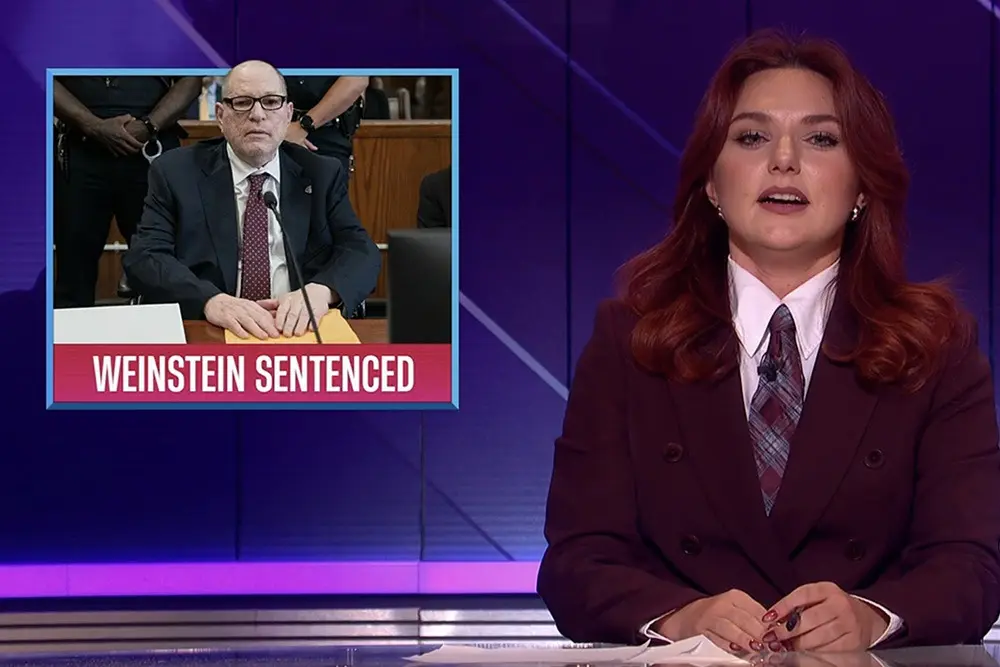
The latest installment of “Saturday Night Live U.K.” has once again thrust the program into the center of the cultural conversation, with its “Weekend Update” segment delivering a barrage of biting political and pop-culture commentary. Hosts Ania Magliano and her co-anchor, Young, spared few public figures this week, taking aim at a diverse range of high-profile individuals including U.S. President Donald Trump, OpenAI co-founder Sam Altman, and convicted former film producer Harvey Weinstein.
The sketch, which has become known for its irreverent take on current affairs, balanced international geopolitical tensions with domestic headlines, maintaining the show’s tradition of pushing the boundaries of televised satire. As the segment progressed, it became clear that no one—from world leaders to tech titans—was exempt from the program’s scrutiny.
Political Satire and Geopolitical Tensions
The segment opened with a focus on the recent diplomatic meeting between President Donald Trump and Chinese President Xi Jinping at the White House. Magliano wasted no time in dissecting the aesthetic and symbolic nature of the event, employing the show’s signature brand of acerbic wit.
“This week, President Trump welcomed President Xi to the White House,” Magliano began. “As a sign of respect, Trump wore a bright red tie as a sign of Communist China. And Xi wore a mottled purple tie, the color of Trump’s prostate.”
The joke, which drew immediate reactions from the studio audience, set the tone for a segment that frequently prioritized shock value and physiological humor to lampoon political figures. The satire continued as Magliano transitioned into a critique of the banquet held in honor of the visiting Chinese leader. Joking about the specific nature of the menu and the atmosphere of the event, she quipped, “Trump ordered a 20, an 18 and a 21. And afterwards sat down for a Chinese-inspired banquet.”
The segment then turned its focus toward the domestic political landscape in the United Kingdom. Young introduced the next topic by highlighting a meeting between Trump and U.K. Prime Minister Andy Burnham. “From Beijing to beige man, Trump met Andy Burnham,” Young remarked, before delivering a blunt, provocative critique regarding the President’s perceived mental acuity: “It wasn’t a memorable event for Trump, as he’s got dementia.”
This directness, while reflective of the show’s broader satirical mission, underscored the often-combative relationship between international late-night comedy and the figures it depicts. By characterizing the interaction as forgettable and making bold claims about the health of a world leader, the show signaled its intent to challenge the decorum typically associated with such high-level diplomatic meetings.
Technological Existentialism and the AI Debate
Moving away from traditional politics, the segment shifted its gaze toward the rapidly evolving landscape of artificial intelligence. Sam Altman, the co-founder of OpenAI, became the subject of the hosts’ scrutiny following his recent high-profile appearances at the United Nations.
Altman, who has been at the forefront of the generative AI revolution since the launch of ChatGPT, has frequently utilized his platform to warn of the potential existential risks posed by advanced artificial intelligence. The “SNL U.K.” team found this stance ripe for parody.
“Altman, whose company launched ChatGPT, warned his creation could destroy humanity,” Magliano said. “And then he slapped his own wrists and ran out of the room saying, ‘Someone stop me!’”
The sketch tapped into a common critique often leveled at Silicon Valley executives: the juxtaposition of building technologies that could fundamentally alter human existence while simultaneously positioning themselves as the primary voices calling for their own regulation. By framing Altman’s warnings as performative, the segment highlighted the skepticism that many observers feel regarding the tech industry’s self-policing efforts. It was a moment that resonated with the audience, reflecting the broader public anxiety surrounding the pace of AI development and the lack of concrete oversight.
Addressing the Weinstein Verdict
In a segment that proved to be the most contentious of the evening, “SNL U.K.” addressed the recent legal developments concerning Harvey Weinstein. The former Hollywood producer, who was sentenced to 15 years in prison in New York earlier this week, has been a frequent subject of media coverage, but the show’s approach was notably darker and more provocative than standard news reporting.
“Me Too is now what the inmates say in the queue for Weinstein’s arsehole,” Magliano joked. The remark triggered a collective, audible “oooh” from the live audience—a reaction that acknowledged the grim nature of the joke.
The segment continued to delve into the history of the Weinstein scandal, with Young providing a stark reminder of the methods used by the disgraced producer to maintain his power. “Back in 2016, Weinstein hired a private intelligence firm to dig up dirt on his victims,” Young noted. “So on one side, we have a prolific rapist with paid spies. On the other, we have abuse victims who have been silenced. A conflict described by Ed Sheeran as ‘nuanced.’”
The inclusion of the Ed Sheeran reference served as a sharp jab at the tendency of some public figures and media outlets to use softer language when describing severe criminal misconduct. By contrasting the brutality of the crimes with the concept of “nuance,” the hosts emphasized the moral gravity of the situation, even while utilizing a satirical format to convey the message.
International Conflict and Diplomatic Walkouts
The segment concluded by touching upon the recent speech delivered by Israeli President Benjamin Netanyahu at the United Nations, an event that became notable when representatives from various nations walked out of the chamber in protest.
The hosts approached this sensitive topic with a brevity that served as its own form of commentary. “Of course, it is easy to paint Netanyahu as the bad guy in this situation,” Young said, pausing just long enough for the weight of the statement to hang in the air before immediately transitioning to the next item on the program.
This rapid pivot reflected the show’s strategy of identifying the most contentious points of global discourse and addressing them with a mixture of irony and detachment. By refusing to linger on the complexity of the Israeli-Palestinian conflict, the segment avoided a deep dive into policy, instead focusing on the performative nature of diplomatic protests.
Ultimately, the latest “Weekend Update” from “SNL U.K.” served as a testament to the show’s commitment to its specific brand of acerbic, fast-paced political humor. By covering such a wide breadth of topics—ranging from the health of a U.S. President to the existential dread surrounding artificial intelligence and the dark legacy of a convicted predator—the program demonstrated its continued relevance in a media environment that is increasingly fragmented.
The segment’s ability to elicit gasps, laughter, and discomfort in equal measure remains its defining characteristic. Whether through lampooning the bizarre optics of diplomatic ties or stripping away the professional veneer of tech CEOs, “SNL U.K.” continues to position itself as a mirror to the societal tensions of the day, forcing viewers to confront the headlines through a lens that is often unflattering, frequently harsh, and undeniably direct. As the show looks toward its future episodes, it remains clear that no public figure or major global event is safe from the biting commentary of its hosts, ensuring that their “Weekend Update” will continue to be a focal point for those looking to engage with the news in an unconventional way.