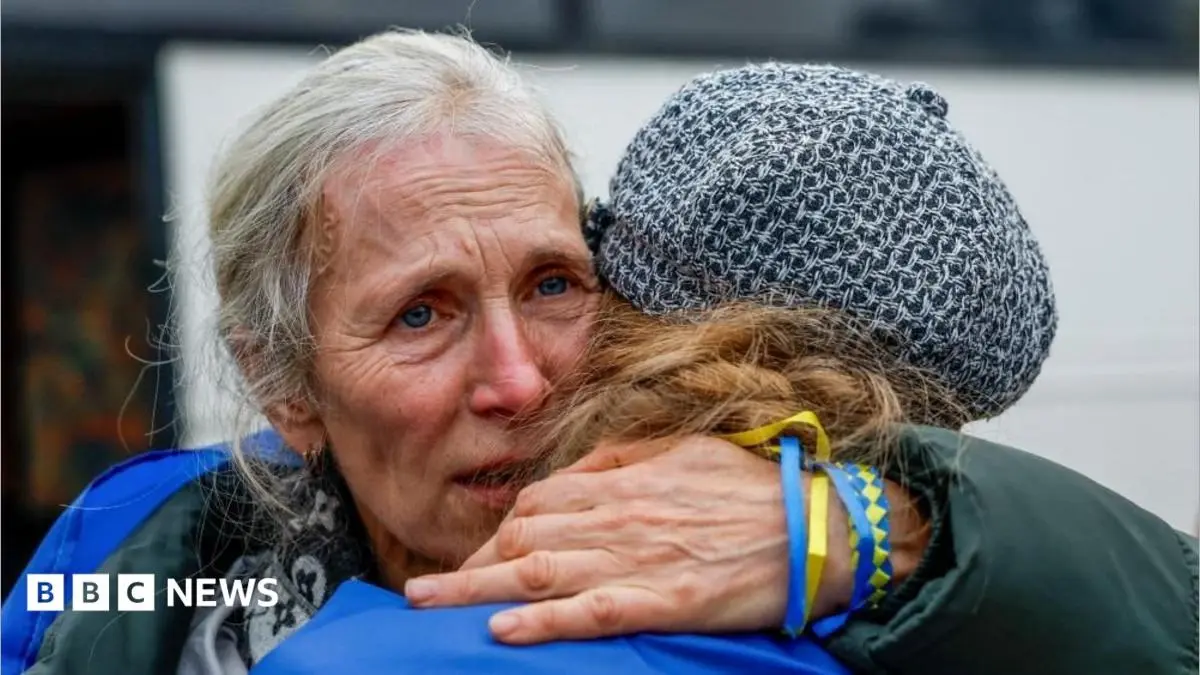
A group of Ukrainian citizens has successfully crossed the border into the Chernihiv region after escaping the Russian-occupied city of Oleshky, marking a significant, albeit harrowing, milestone in the ongoing humanitarian crisis triggered by Russia’s full-scale invasion. President Volodymyr Zelensky confirmed the arrival of the evacuees in a post on X, emphasizing the state’s commitment to their well-being.
"As of now, Ukrainian citizens from Oleshky have crossed the Ukrainian border in the Chernihiv region," President Zelensky stated. He underscored the logistical and moral imperative of the operation, adding, "All of them will receive the assistance they need. It is important that government agencies and all the regional and local authorities involved work effectively and help our people adapt."
The journey to safety was as complex as it was lengthy. Rather than moving directly toward nearby Ukrainian-held positions, the evacuees were transported through Russian and Belarusian territory before being driven across Ukraine’s northern border on Saturday. This circuitous route highlights the extreme difficulties faced by civilians trapped in the frontline regions of southern Ukraine, where the landscape has been rendered nearly impassable by the destruction of infrastructure and the pervasive threat of explosive ordnance.
According to Dmytro Lubinets, Ukraine’s human rights ombudsman, the demographics of the group underscored the vulnerability of those who had remained in Oleshky. The evacuees included a wide age range, with the oldest individual being 94 years old and the youngest a one-year-old child.
The Toll of Long-Term Occupation
For the residents of Oleshky, a city that was home to approximately 24,000 people before the Russian invasion began in February 2022, the past four years have been defined by deprivation and mounting fear. The city was seized by Russian forces during the very first days of the full-scale war, leaving its inhabitants isolated behind a frontline that effectively cut them off from the rest of Ukraine.
As the months turned into years, conditions within the city deteriorated to a point of desperation. Supplies became increasingly scarce, and the act of fleeing became a life-threatening gamble. Routes out of the area were heavily mined, and civilians faced the constant risk of drone attacks. The destruction of bridges spanning the nearby River Dnipro further compounded the isolation, as the riverbank itself became a dangerous, mined no-man’s-land. One resident who had managed to escape the city three weeks prior described a harrowing trek, claiming he had walked through 24 kilometers (15 miles) of minefields to reach safety.
The physical and psychological toll on those who remained was profound. Liubov, one of the evacuees who spoke with the Reuters news agency, described the paralyzing anxiety that governed their lives while awaiting the opportunity to leave. "Until we got on the buses, we were afraid of everything, we were so worried and nervous," she said. "Before that, we spent nights without sleeping, wondering how it would go, what would happen. But everything went well."
Others spoke of severe malnutrition. One evacuee reported losing 20 kilograms over the past year, noting, "My strength left me." Valera, another resident who shared his story with the AFP news agency, painted a grim picture of daily survival in the occupied city: "There was no bread. Nothing. Lots of people planted vegetable gardens. We ate whatever was available. Well, thank God, we’re here now."
A Rare Humanitarian Ceasefire
The evacuation was made possible by a temporary humanitarian ceasefire that took effect across the frontline region of Kherson on Tuesday. This agreement provided the first sustained period of relative peace in the area since the onset of the war. The ceasefire allowed for critical demining operations on the roads leading out of the city and facilitated the delivery of humanitarian aid to those who were still waiting to leave.
The window for departure was tightly managed. On Friday afternoon, a convoy of 25 buses—with a total capacity for 750 people—departed the town. Ambulances were integrated into the convoy to accommodate individuals with limited mobility. The ceasefire measures are scheduled to remain in place until the end of Sunday, November 1.
The logistical coordination required for this departure was immense. Although Ukrainian military positions lie just 5 kilometers (3.1 miles) from Oleshky, the evacuees were required to travel deep into Russian-occupied territory first. From there, they were taken to the southern Russian city of Anapa, where they were flown to Gomel in Belarus, before finally making the trek to the Ukrainian border.
Despite the severe conditions, not everyone chose to leave. Several hundred residents remain in the war-torn city, enduring a life without basic utilities such as gas, electricity, and running water. Ombudsman Dmytro Lubinets stated on Friday morning that those who elected to stay in their homes "will receive all the necessary humanitarian assistance," though the ability to provide such aid remains constrained by the realities of occupation and the ongoing conflict.
Diplomatic Precedent
The operation was marked by a rare instance of direct diplomatic coordination. Dmytro Lubinets traveled to Oleshky on Friday alongside his Russian counterpart, Yana Lantratova. The pair set off from Armiansk, located in the Russian-occupied Crimean peninsula. Lubinets’ presence in Oleshky is historic, as he is the first Ukrainian official to visit Russian-occupied parts of Ukraine since the beginning of the full-scale invasion.
President Zelensky lauded the efforts of the ombudsman and his team, crediting them for the safe passage of the evacuees. Furthermore, the president expressed his gratitude to those who have worked to bring international attention to the "true humanitarian catastrophe in Ukrainian territory temporarily occupied by Russia."
The arrival of these citizens marks a rare success in the context of the war’s humanitarian challenges. As the evacuees begin the process of adapting to life in government-controlled territory, the state is now tasked with providing the necessary support to help them recover from the trauma of the occupation. While the ceasefire provided a temporary respite, the broader situation for those still living under occupation remains critical, with the destruction of infrastructure and the absence of basic services continuing to define the daily lives of thousands of Ukrainians.
For now, the safe arrival of this group serves as a reminder of the human cost of the conflict and the ongoing, complex efforts required to protect civilian lives in the world’s most dangerous regions. As the deadline for the humanitarian ceasefire approaches, the focus remains on ensuring that the aid and support provided to these survivors can be sustained as they begin to rebuild their lives away from the frontlines.