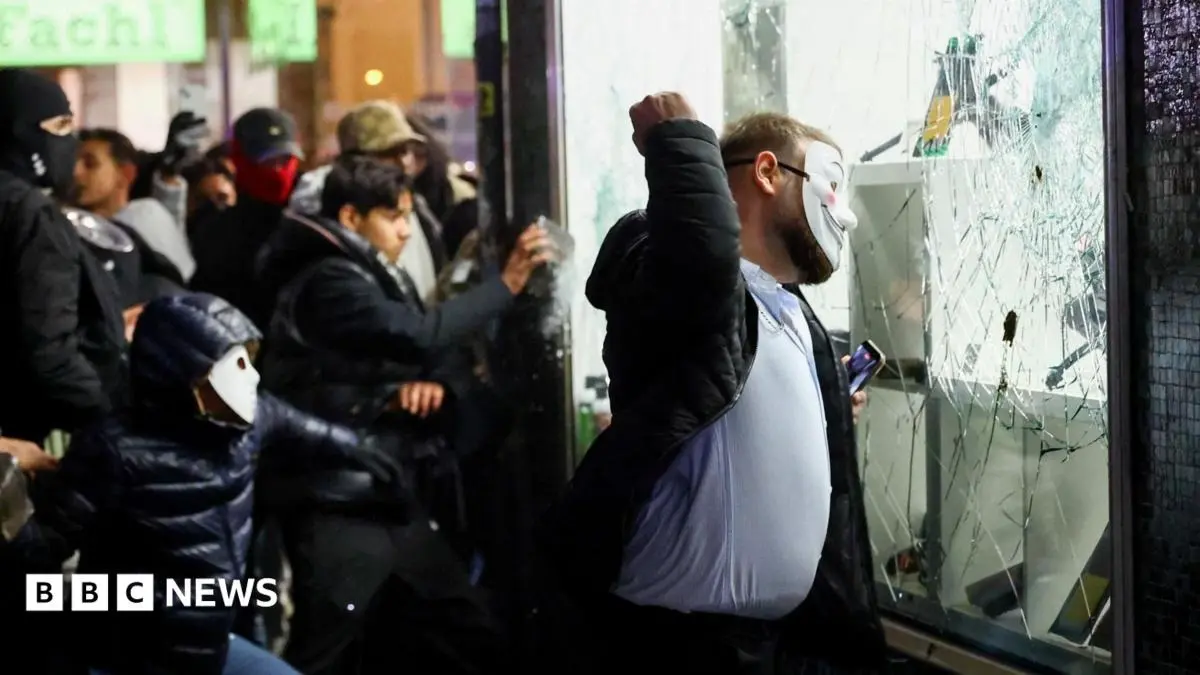
Widespread civil unrest gripped several major German cities late on Saturday as what began as a series of organized, youth-led demonstrations over the cost of living descended into chaotic scenes of looting and violent clashes. The disturbances, which saw rioters target shops in the heart of Frankfurt, represent a significant escalation in the ongoing wave of discontent currently sweeping across Europe.
In Frankfurt, Germany’s primary financial hub, police were forced to cordon off a major shopping thoroughfare as the atmosphere turned volatile under the cover of darkness. Authorities confirmed that numerous arrests were made throughout the night as officers struggled to regain control of the city center. Similar incidents of violence were reported in Berlin, Cologne, and Hamburg, where police resorted to the use of water cannons to disperse crowds that had begun targeting emergency services with fireworks, stones, and bottles.
These late-night confrontations stood in stark contrast to the earlier hours of the day, during which thousands of protesters participated in largely peaceful demonstrations. The rallies were orchestrated by the campaign group "Gen Z regelt"—or "Gen Z takes charge"—a movement that has gained significant traction by highlighting systemic grievances among the younger generation. Their platform centers on a demand for systemic reform, specifically addressing chronic underfunding in the education sector, the soaring cost of living, significant public spending cuts, and the potential reintroduction of compulsory military service.
Lina Friedrich, a spokesperson for Gen Z regelt, characterized the movement’s objectives as a pursuit of stability and social justice. "The demonstrations were organized to fight for peace and freedom, rather than for war and coercion," Friedrich stated. She emphasized that the primary motivation for the youth movement is to secure better support for the nation’s strained health and education systems. "What matters most to us is better support for the health and education systems," she added. "We are against compulsory military service, and we are in favor of a fairer distribution of the burden."
While organizers had initially estimated much larger turnouts on their website, authorities in Frankfurt, Munich, and Berlin reported a combined attendance of approximately 18,000 people. Despite the discrepancy between projected and actual numbers, German media outlets have characterized the day as a major mobilization, with tens of thousands of citizens taking to the streets across the country.
The unrest in Germany reflects a broader, transnational trend of youth-led mobilization that has intensified over recent weeks. The situation on the ground in German cities mirrors the intensity of protests currently unfolding in France, where more than 320,000 people took to the streets on Saturday in the third consecutive weekend of widespread demonstrations. In France, the focus of the protesters remains fixed on the erosion of purchasing power, the high cost of living, and the deterioration of essential public services, particularly within the education system.
The French government deployed thousands of police officers across the country to maintain order, a task that proved difficult as the demonstrations progressed. In cities such as Toulouse, Lyon, and Marseille, clashes between protesters and law enforcement resulted in more than 500 arrests. French Interior Minister Laurent Nuñez confirmed that the violence had taken a toll on security forces, reporting that at least one police officer sustained injuries after being targeted by a Molotov cocktail. In Paris, police reported that several hundred rioters had engaged in a sustained assault on security personnel, utilizing a variety of projectiles.
The wave of dissatisfaction is not confined to Germany and France. Italy also saw significant protest activity on Saturday, with police reporting skirmishes between law enforcement and demonstrators in the streets of Rome and Turin. Meanwhile, in Portugal, authorities took action to clear a makeshift tent camp that had been established by protesters. The demonstrators in Lisbon had marched to voice their opposition to a new rental bill, which they argue will exacerbate an already severe housing crisis. In Portugal, the cost of housing has risen dramatically, with market prices more than doubling over the course of the last decade, leaving many young people unable to secure affordable accommodation.
The recent surge in street protests has spanned a wide swath of the European continent, including Belgium, Ireland, Spain, Greece, Serbia, and Albania. While the specific socio-political landscapes of these nations differ, the underlying motivations for the demonstrations share a common thread. Across these diverse borders, the protesters are united by a focus on cost-of-living pressures, which have been compounded by high inflation and concerns over the long-term viability of public services.
For many of the young people involved, the grievances go beyond immediate financial hardship. There is a palpable sense of frustration regarding the perceived lack of investment in their future. Whether through the lens of housing accessibility, the quality of educational infrastructure, or the potential for increased military commitments, the protesters are demanding a fundamental reassessment of how public resources are distributed.
As European governments grapple with these recurring waves of civil disobedience, the events of this weekend underscore a growing divide between state policy and the expectations of the younger demographic. The transition from peaceful assembly to violent confrontation in cities like Frankfurt and across France poses a significant challenge to authorities, who must now balance the protection of public order with the democratic necessity of allowing for the expression of widespread public dissent.
In Germany, the government faces mounting pressure to address the specific concerns raised by groups like Gen Z regelt. The demand for a "fairer distribution of the burden" suggests that as the economic climate remains strained, the government’s ability to communicate its policy goals effectively will be tested. With the movement’s spokesperson emphasizing peace and freedom, the organizers of these demonstrations appear prepared to continue their push for structural change, even as the risk of further clashes remains high.
The ongoing demonstrations serve as a stark indicator of the social volatility currently present in Europe. As the cost-of-living crisis continues to impact households and the quality of public infrastructure remains a point of contention, the ability of European leaders to bridge the gap with their younger citizens remains a critical issue for the months ahead. The images of police water cannons in German streets and the smoke of tear gas in French city squares act as a visual manifestation of a deepening dissatisfaction that shows little sign of dissipating in the near term.
For now, the authorities in the affected cities are maintaining a heightened security presence, bracing for the possibility of further unrest. The organizers of the demonstrations have not yet signaled a cessation of their efforts, suggesting that the streets of Europe may remain a focal point for political debate for the foreseeable future. As the continent watches, the question remains whether the demands of these young protesters can be integrated into the political process or if the current cycle of protest and instability will continue to escalate across the region.