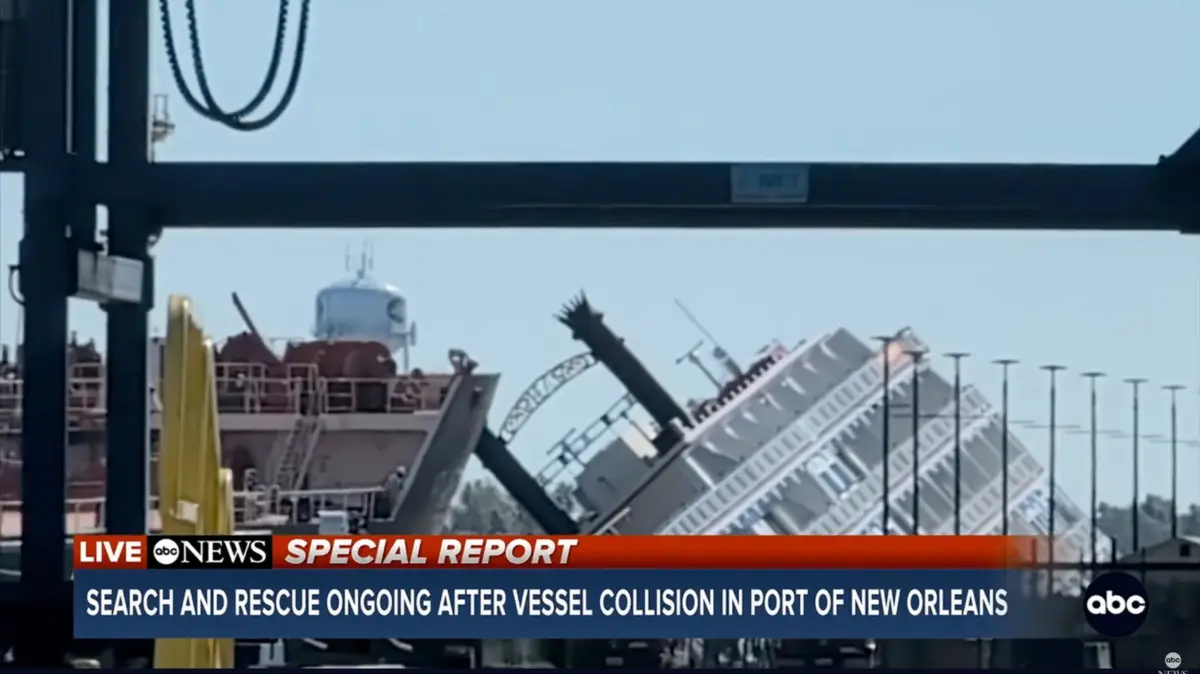
The Mississippi River has been partially closed to marine traffic following a dramatic and terrifying collision in the Port of New Orleans, where an asphalt tanker ship struck and sank a docked riverboat carrying approximately 129 passengers and crew members. The incident, which unfolded in the early afternoon, sent shockwaves through the local community and triggered a massive multi-agency emergency response. Miraculously, despite the severity of the crash and the rapid sinking of the vessel, city officials have confirmed that all passengers and crew have been accounted for and there are no reported fatalities.
The collision occurred at approximately 12:30 p.m. Eastern Time outside 1350 Port of New Orleans Place. According to local authorities, an estimated 32 individuals sustained injuries during the impact and its chaotic aftermath. These victims were swiftly transported by emergency medical services to nearby hospitals for treatment, though officials noted that their injuries are currently considered non-critical. Given the dynamic and ongoing nature of the incident, the exact total of minor injuries sustained across all passengers and crew remains under evaluation as medical personnel continue to assess those involved.
In the immediate aftermath of the disaster, the U.S. Coast Guard took decisive action to secure the waterway, establishing a complete closure of the Mississippi River to all vessel traffic between mile markers 93 and 96. This restriction is vital to ensure the safety of ongoing rescue and recovery operations and to prevent secondary maritime incidents in the congested port area.
The vessel involved in the collision is the American Heritage, a prominent riverboat operated by American Cruise Lines. At the time of the catastrophe, the ship had been securely docked for roughly two hours. The crew and passengers were in the process of beginning their scheduled disembarkation when the situation abruptly turned catastrophic. The Atlantic Asphalt, an asphalt-carrying tanker ship, bore down on the docked vessel and T-boned it with tremendous force.
Local news affiliates, including WDSU News, reported an immediate and overwhelming convergence of emergency responders at the site. Port NOLA Harbor Police, units from the New Orleans Fire Department, the New Orleans Police Department, the U.S. Coast Guard, and specialized emergency medical personnel rushed to the scene. These agencies immediately established a coordinated command structure to execute rescue and response operations. The rapid, synchronized deployment of these diverse emergency services has already been widely praised by observers and local officials, with many describing the successful
rescue phase as "a miracle on the Mississippi."
These river cruises attract elderly passengers
The demographic profile of those on board significantly heightened anxiety among state leaders during the unfolding crisis. Louisiana Lieutenant Governor Billy Nungesser spoke with ABC News shortly after the collision, expressing deep concern for the well-being of the passengers. He pointed out that this particular genre of leisurely river cruises traditionally attracts an overwhelmingly elderly clientele, a population that can be especially vulnerable to the physical trauma of sudden accidents, severe shocks, and environmental exposure.
To manage the influx of survivors, emergency personnel established a triage and assistance center inside the Port of New Orleans Administration Building. Rescued passengers, many of whom were shaken and disoriented, were escorted to this facility to receive immediate medical evaluations, blankets, and emotional support.
Adding to the urgency of the rescue and triage operations was the environmental condition of the river itself. According to data provided by the U.S. Army Corps of Engineers, the water temperature in the immediate vicinity of the shipwreck hovered around 66 degrees Fahrenheit. While this may not sound freezing, environmental experts note that prolonged immersion or exposure in water of this temperature poses a severe risk of hypothermia, making the rapid retrieval and sheltering of all individuals from the water a critical priority for rescue divers and marine patrols.
As emergency crews worked tirelessly on the surface and along the docks, investigators began the arduous process of determining what went wrong. While a formal and definitive cause of the crash has not yet been officially confirmed by federal or local maritime investigators, preliminary assessments strongly suspect a sudden and catastrophic loss of steering aboard the asphalt tanker. This potential mechanical or human failure left the massive vessel unable to correct its course before impacting the stationary cruise ship.
The physical consequences for the riverboat were swift and devastating. Following the initial, violent impact, the American Heritage immediately began taking on water at an alarming rate. The vessel capsized with extraordinary speed, leaving it resting heavily on its side directly against the dock where it had been safely moored only moments before.
The gravity of the incident drew immediate attention from the highest levels of government. Louisiana Governor Jeff Landry rushed to the scene of the disaster to personally oversee the coordination between state and local responders. During his briefing at the port, Governor Landry confirmed that he had spoken directly with President Donald Trump regarding the crash. According to the governor, the President assured him that the state of Louisiana has full access to any federal resources, logistical assistance, and disaster support it may need to manage the crisis and its aftermath.
With the immediate rescue phase successfully concluded and all passengers accounted for, the focus of the operation has shifted toward environmental mitigation, vessel recovery, and reopening the vital commercial waterway. The U.S. Coast Guard is currently collaborating closely with specialized salvage assistance teams. These maritime salvage experts are formulating a complex plan to safely right, stabilize, and remove the sunken riverboat from the port area without causing additional environmental hazards or prolonged disruptions to shipping lanes. Simultaneously, the Coast Guard is reviewing data and clearing navigational hazards to determine when it will be safe to reopen the Mississippi River to commercial and recreational vessel traffic.