The social and political climate in France has reached a critical boiling point as violent protests continue to sweep across the country, with an increasing number of educational institutions caught in the crossfire. According to Interior Minister Gérald Darmanin, the scale of the disruption is unprecedented; he confirmed that 735 of France’s 3,700 high schools are now affected “one way or another” by the ongoing unrest. The disturbances, which have seen students and agitators alike clashing with authorities, have prompted serious concerns from government officials regarding the safety of staff and the integrity of the academic environment.
As the situation on the ground evolves, the government’s response has become increasingly firm. Speaking late on Friday, Police Prefect Laurent Nuñez addressed the nation via the TF1 television network, offering a stark assessment of the volatility gripping the streets. "We are sliding into riot and urban violence," Nuñez stated, signaling a shift in how law enforcement is preparing to handle the demonstrators. He further emphasized that authorities are now utilizing “all intermediate means to put an end to it,” a clear indication that the state is prepared to deploy non-lethal crowd control tactics and tactical interventions to restore order in areas where the situation has spiraled beyond peaceful protest.
The nature of the movement has become a subject of intense debate within the halls of government. Education Minister Édouard Geffray has publicly voiced his belief that the protest movement has been fundamentally hijacked by individuals who have no connection to the student body. In an interview with French broadcaster BFMTV, Geffray relayed accounts from teachers who found themselves in the surreal position of attempting to manage protests where they did not recognize the participants. "The people in front of me were not my students," Geffray reported, echoing the sentiments of educators who believe that the genuine grievances of the student population are being exploited by external actors who are intent on inciting chaos rather than advocating for change.
The escalation of violence has led to several harrowing incidents, most notably in the north-eastern town of Belfort. Earlier on Friday, a 17-year-old was arrested on suspicion of attempted homicide following a confrontation that saw a police officer targeted during a demonstration. The incident has drawn national attention, further fueled by the circulation of graphic footage from the scene. BBC Verify has authenticated two separate videos documenting the assault, which reveal the gravity of the encounter. In the footage, a group of young men is seen chasing a lone officer. Once the officer falls to the ground, he is subjected to a brutal beating, involving multiple punches and kicks to the head. The violence of the act, confirmed by a government minister as a targeted attack on a law enforcement official, has served to harden the government’s resolve to crack down on the unrest.
The toll on school staff, who often find themselves on the front lines of these campus-based disruptions, is significant. The education ministry reported that at least 65 staff members have been injured in the unrest so far, a statistic that underscores the hazardous environment currently prevailing in many of the affected institutions. The combination of student demonstrations and the presence of external agitators has created a volatile atmosphere where educators and administrative personnel are increasingly at risk.
The geographical reach of the protests remains vast, with significant incidents reported in major cities across France. In the Paris suburb of Pantin, the situation took a turn for the worse when police were forced to charge at protesters after being pelted with various projectiles. The police intervention, which resulted in a number of arrests, highlights the tactical challenge authorities face in maintaining control while avoiding mass injuries. Similarly, in Strasbourg, the atmosphere became so hostile that police were forced to deploy tear gas to disperse crowds and prevent the situation from escalating into full-scale rioting. Reports from the Reuters news agency indicated that the police moved to deploy these measures out of a genuine fear that the conditions on the ground were rapidly becoming too dangerous to manage through dialogue alone.
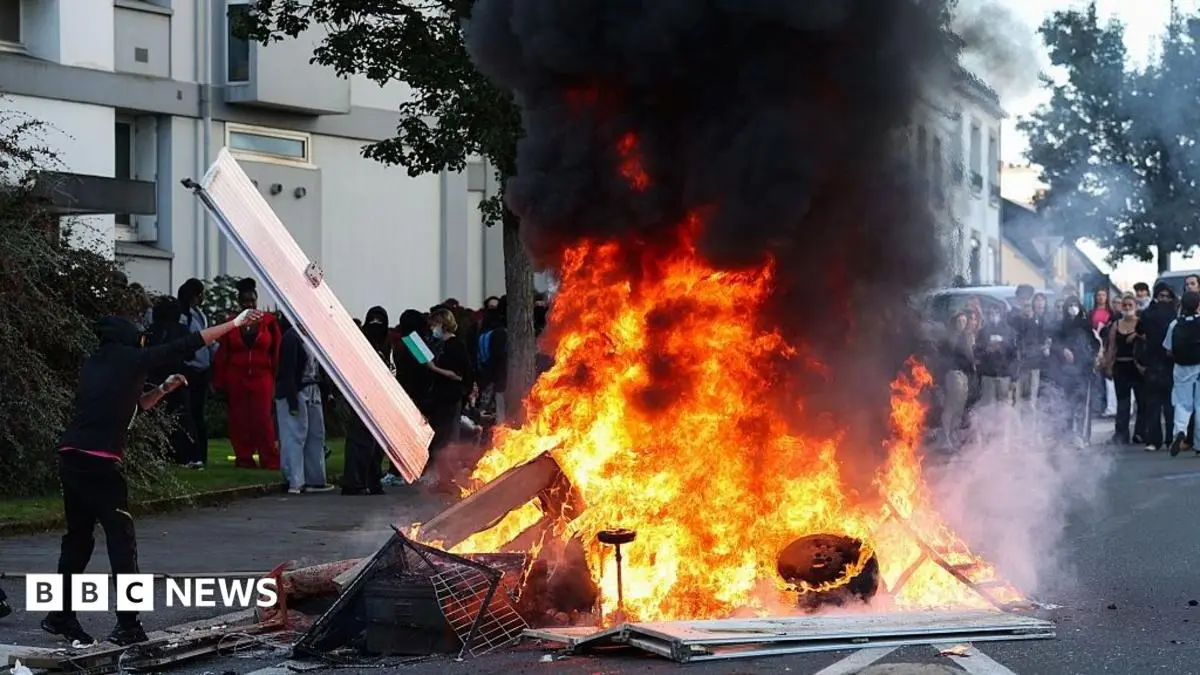
The visual evidence of the unrest is plain to see in cities like Rennes and Paris, where the remnants of the protests are frequently marked by burning rubbish bins and debris littering the streets. These acts, while seemingly localized, contribute to a broader sense of disorder that has unsettled residents and business owners alike. The destruction of public property and the obstruction of streets have become synonymous with the current wave of protests, further polarizing public opinion on the effectiveness and legitimacy of the movement.
Despite the mounting government pressure and the reports of violence, some protesters remain defiant, framing the struggle as a necessary reaction to perceived state overreach. For Lola, a 16-year-old student who participated in the protests on Friday, the government’s efforts to suppress the demonstrations have only served to heighten the frustrations of the youth. "As far as we’re concerned, we’ve won – our school is closed this morning," she told the AFP news agency. For her, the tactical response from law enforcement is counterproductive and serves to alienate the very population it is meant to manage. "It makes us even angrier," she added, specifically citing the use of tear gas and physical force by police as unacceptable violations of their right to demonstrate.
This sentiment highlights the profound disconnect between the student protesters and the authorities. While officials like Minister Geffray argue that the movement has been infiltrated by violent outsiders, students like Lola insist that their anger is a direct response to the methods employed by the police. The belief that the police have "no right" to hit or use chemical irritants on young people forms the backbone of the students’ resolve.
As the weekend approaches, the situation remains fluid. The government faces the difficult task of balancing the protection of public safety and educational infrastructure with the democratic necessity of allowing for freedom of expression. With 735 schools now impacted and the rhetoric from both the government and the protesters becoming increasingly polarized, there is little sign of a quick resolution. The involvement of non-students, the injury of dozens of staff members, and the brutal nature of attacks on law enforcement have elevated the crisis from a student-led protest into a significant national security challenge.
The focus of the coming days will likely be on whether the state can isolate the violent agitators from the student body, or if the cycle of confrontation will continue to deepen, further disrupting the academic year and the social fabric of the country. For now, the streets of France remain a site of tension, with the echoes of the protests still reverberating through the suburbs and city centers alike. The government’s promise to use all available means to restore order suggests that the upcoming period will be defined by a strictly enforced containment policy, even as the underlying grievances that sparked the unrest remain largely unaddressed. As the dust settles in places like Pantin and Strasbourg, the question remains: how will the French state reconcile the protection of its citizens with the volatile and often chaotic expressions of its youth? The answer to that question will likely determine the trajectory of the country’s stability in the weeks to come.