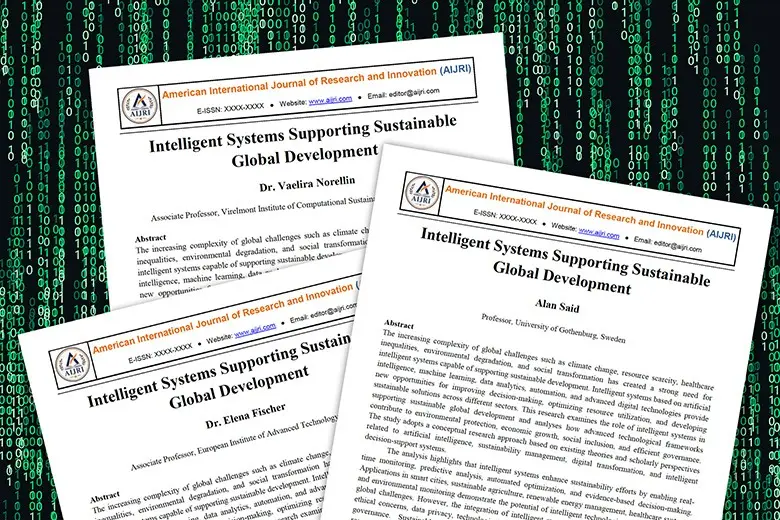
A concerning new front has emerged in the ongoing crisis of digital academic publishing, as an investigation has revealed that a network of little-known journals is actively publishing low-quality, artificial intelligence-generated papers under the names of prominent professors who never wrote them. The disturbing trend has sparked widespread alarm across the higher education community, highlighting how malicious actors are misusing researchers’ identities and polluting academic indices with what many are calling "AI slop."
The issue came to light when Alan Said, a professor of computer science at the University of Gothenburg, received an unexpected notification from Google Scholar. The alert informed him that a new research paper had been published under his name in a publication called the American International Journal of Research and Innovation (AIJRI).
The article, bearing the title "Intelligence Systems Supporting Sustainable Global Development," superficially mirrored themes related to Professor Said’s actual academic work in artificial intelligence and sustainability. However, upon reviewing the manuscript, he realized immediately that he had nothing to do with its creation.
Describing the experience, Said noted that while the subject matter fell within his broad field of expertise, the execution of the text revealed its true nature. "It wouldn’t be surprising if I wrote a paper on something around this topic, but just looking at this paper and looking at the citations in the paper, it looks AI-generated. It has no content, it’s like slop," he said, characterizing the papers falsely attributed to him as "very shallowly written or generated."

Determined to correct the false record, Said reported the unauthorized publication to the journal’s domain registrar. Although the registrar initially indicated that the article had been taken down, the situation quickly grew more bizarre. The paper remained accessible online, but Said’s name was quietly replaced with that of another individual. Screenshots reviewed during the investigation showed that within just two days, the listed author changed yet again, resulting in three distinct versions of the exact same paper being hosted online, each attributed to a completely different, unsuspecting person.
Further investigation into the publishing operation uncovered a broader network utilizing identical tactics. Said soon identified two related publications: the American Journal of Advanced Multidisciplinary Research and Innovation (AJAMRI) and the American Journal For Multidisciplinary Research (AJFMR). These journals share similar graphical design layouts, structural presentation, and list the exact same editor-in-chief and board members.
The scope of these operations appears extensive. AJAMRI, in particular, has featured dozens of papers falsely attributed to some of the most high-profile and respected academics in the fields of computer science and artificial intelligence. Among the victims of this identity misuse are prominent Stanford computer scientists Fei-Fei Li and Christopher Manning, as well as renowned University of California, Berkeley professors Michael I. Jordan and Stuart Russell.
Technical analysis of the journals reveals common red flags typical of predatory publishing networks. Records show that all three domain names were registered recently, yet their websites feature archived sections displaying papers supposedly published several years before the domains even existed. Furthermore, despite posing as legitimate academic outlets, the journals heavily market themselves through standard open-access buzzwords, describing their operations as "peer-reviewed, open access and multidisciplinary."
However, the websites also prominently advertise financial publication fees. According to their published schedules, AIJRI and AJAMRI charge a fee of $200 for papers written by five or more non-Indian authors. Meanwhile, the AJFMR applies a tiered pricing structure, charging $80 for papers authored by one to four individuals, or a reduced fee of $10 for submissions featuring five or more authors.

For established academics like Said, the primary concern extends far beyond mere intellectual property theft or reputational annoyance. The misuse of prominent names poses a serious structural risk to the broader academic ecosystem, particularly for early-career researchers who rely on established literature to guide their educational and professional paths.
"They all seem to be the same type of operation. Very shallowly written or generated," Said said. Expressing deep apprehension about the cascading effects of these fraudulent publications, he added, "I’m concerned, because if a new Ph.D. student were to see my name in this journal, they might think it’s OK to submit there, too, and I would really not want that to happen."
As the investigation widened, other prominent academics confirmed that their identities had been exploited in a similar fashion. Jure Leskovec, a professor of computer science at Stanford University who was also listed as an author by the network, expressed absolute shock upon learning of the deception.
"I can confirm that I did not write this paper, was not involved in its submission and did not authorize the use of my name. I was also unaware of its existence until this email. This is quite concerning," Leskovec stated. Like Said, he had no prior knowledge that his scholarly identity had been attached to the low-quality manuscript until journalists brought the matter to his attention.
Operational details across the network point toward a centralized, shadowy administration. All three journals identify their editor-in-chief as Denish Brown and list a WhatsApp contact number featuring a United States area code. Attempts to reach the editorial leadership for comment prior to publication yielded no response, as the journals failed to reply to inquiries sent by researchers and media outlets.

Compounding the deception, the journals also list dozens of editorial board members, many of whom are affiliated with higher education institutions located primarily in India. However, it appears that these academics have been included without their knowledge or consent, mirroring the treatment of the supposed authors.
One such individual, Kanakaraju Manupati, a postdoctoral fellow at Virginia Commonwealth University whose name appeared on the journals’ editorial boards, expressed utter astonishment when informed of his association with the enterprise.
"I was not aware of the existence of this journal and was not associated with it. I just checked the journal website, surprised to see my name on the editorial board," Manupati said, confirming that he had never agreed to serve in any capacity for the publication.
As investigations continue into these operations, the incident underscores a growing vulnerability within digital academic indexing and open-access publishing. With generative artificial intelligence making it easier to rapidly produce synthetic text at scale, bad actors are increasingly exploiting academic branding and trusted researcher identities to manufacture the illusion of scientific legitimacy, leaving institutions and scholars scrambling to protect the integrity of the scholarly record.