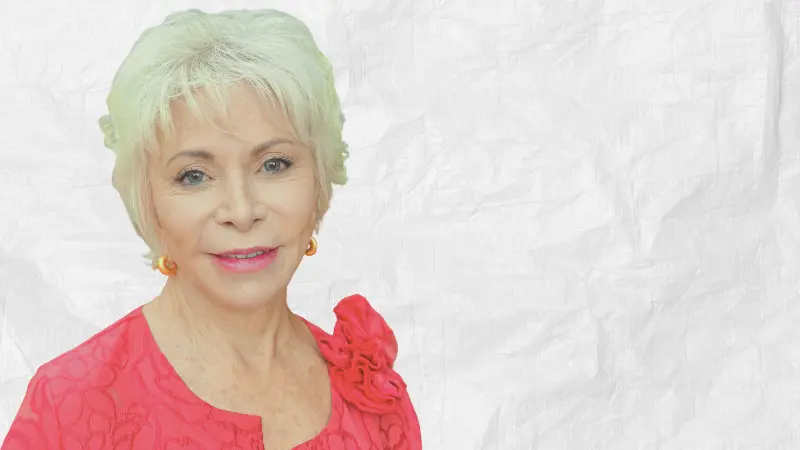
Renowned author Isabel Allende has shared the remarkable, deeply personal origin story of her internationally acclaimed debut novel, The House of the Spirits, revealing that the sweeping literary work began simply as a farewell letter to her dying grandfather in Chile.
In an essay originally featured in Lit Hub’s Craft of Writing newsletter and excerpted from her book Story Telling: A Writing Life, published by Ballantine Books, Allende reflects on the unique, unrepeatable moment of creative freedom that birthed her career as a novelist.
A Letter to a Dying Grandfather
On January 8, 1981, Allende sat down to write a letter to her grandfather, who was gravely ill and nearing the end of his life in Chile. Her initial motivation was modest and deeply affectionate: she wanted to assure him that she remembered all the colorful stories he had shared with her over the years, ensuring they would not be forgotten after his passing.
As she put pen to paper, however, the letter began to expand organically. It grew longer and more complex until Allende realized she was no longer writing a simple piece of correspondence. Instead, the text was transforming into something entirely different—the foundation of her first book, The House of the Spirits.
Looking back on the process, Allende noted that had she consciously set out to write a full-length novel from scratch, the psychological weight of the endeavor likely would have paralyzed her. Had she given herself the formal task of writing fiction, she believes she probably never would have made it past the first few sentences.
Because she framed the endeavor merely as a letter—much like the many casual missives she had previously written to her mother and other loved ones—she approached the page entirely devoid of expectations or literary ambitions. By the second page, the text had already taken on a distinct, melodramatic tone reminiscent of a soap opera.
Although her grandfather passed away before he could ever receive the letter, his death did not discourage Allende. On the contrary, she recalled that the realization gave her wings. Knowing he would never read it freed her from any fear of offending him, granting her the liberty to embellish, alter, and dramatically embroider the family anecdotes he had passed down. It was a singular creative milestone; Allende notes that she has never since experienced that same intoxicating, absolute freedom to write.
Writing by Night in the Kitchen
At the time she embarked on the project, Allende was navigating a demanding daily routine. She was working grueling twelve-hour shifts at a school in Caracas, leaving her with very little free time. Yet, despite her exhaustion, she possessed an unbounded reservoir of enthusiasm.
Every night, after returning home from her long workday, she would sit down in her kitchen and begin typing away. As she dipped into her reservoir of memories, the narrative began to take tangible shape. Characters emerged organically, one by one, almost all of them heavily inspired by her own extravagant relatives and various colorful figures she had known throughout her life.
Despite the daunting nature of the project, Allende was not intimidated by the sheer magnitude of the endeavor. Page after page, the story materialized naturally under her fingertips. She dedicated several hours every night and all her weekends to the manuscript.
The sprawling saga of the Trueba and del Valle families unfolded effortlessly, requiring no forced plotting. Within this intimate family narrative, a broader socio-political reality emerged. While Chile is never explicitly named within the text of the novel, the country functions as the story’s primary and most defining character.
The backdrop of the novel reflected the grim political climate of Latin America during the late 20th century. Across the region, numerous nations groaned under the weight of repressive governments, violent military coups, brutal dictatorships, and undeclared wars waged against impoverished and indigenous populations—often backed covertly by the CIA amid the geopolitical tensions of the Cold War. The atrocities unfolding in Chile during those dark years mirrored the systemic violence seen in Argentina, Uruguay, Brazil, and Central America, where leftist movements and guerrilla factions were suppressed with devastating brutality. In retrospect, Allende realized her novel could easily have been set anywhere across her tormented continent.
Guarding the Manuscript
During this intense period of creation, Allende carried out her daily professional duties at the school almost like a sleepwalker, her conscious mind entirely consumed by the fictional world she was building at night. As soon as she returned home in the evening, the words would pour out of her effortlessly, as though they were being dictated directly by a voice echoing from the deepest recesses of her memory.
By the end of that momentous year, Allende had accumulated a stack of more than five hundred typed pages resting on her kitchen counter.
The massive pile of paper defied easy categorization. It undeniably looked like a manuscript, yet only a single copy existed. In an era long before digital backups and ubiquitous photocopying, duplicating hundreds of pages was no small task. Throughout that year, Allende carried the fragile stack of pages in a canvas bag slung over her shoulder, guarding them as jealously as a mother protects her newborn children. She never parted from the manuscript.
Once, in a moment of sheer panic, she accidentally left the bag behind at a hair salon. By the time she realized her mistake and rushed back to retrieve it, staff members had already tossed the bag into a public trash container. Undeterred, Allende climbed directly into the large street container to fish out her life’s work. There it sat, intact and seemingly mocking her harrowing rescue mission.
The Life of a Novel
In the decades that have passed since those late-night writing sessions in her Caracas kitchen, much has changed in Allende’s life, and she has gone on to author numerous celebrated books. Yet, the foundational intimacy of the writing and reading experience remains unchanged for her.
Reflecting on the relationship between author and audience, Allende describes writing as a deeply quiet and private act. Through the medium of the printed page, she enters into a silent conversation with her readers—communicating, sharing, and offering a metaphorical handshake across vast expanses of time and space.
While an author proposes a narrative framework, every individual reader interprets it through their own lens, ensuring that a novel is symbolically reborn each time a new person opens its covers. For Allende, published books ultimately cease to belong to their creators; instead, they become living, independent creatures sent out into the wider world to fulfill their own unique destinies. With any luck, these stories find their way to readers, sparking their imaginations and deeply moving their hearts.