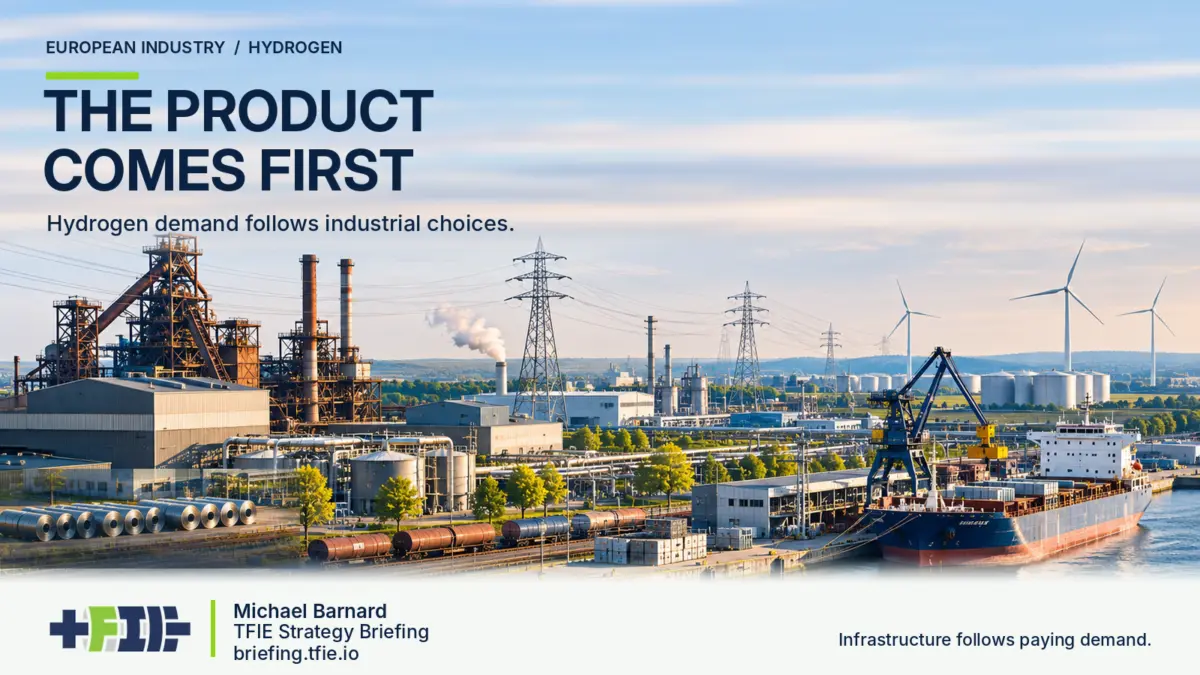
Europe’s industrial future is inextricably bound to production processes, electricity pricing, and international trade, making it imperative that the continent’s hydrogen requirements genuinely guide its massive infrastructure investments rather than rigid policy mandates. That is the core argument emerging from a recent strategic briefing that highlights a growing disconnect between ambitious European Union targets and the hard economic realities faced by heavy industry.
To understand the crux of the debate, one can look at a typical European fertiliser manufacturer purchasing ammonia. The company’s immediate, pragmatic concerns are straightforward: acquiring the right product, at the right quality and price, delivered reliably when needed. Depending on the operational setup, that manufacturer might produce ammonia using hydrogen generated on-site, purchase hydrogen delivered via pipeline, or simply import finished ammonia manufactured elsewhere in the world.
Choosing the third option—importing finished ammonia—preserves much of the downstream industrial work within Europe, but it creates zero demand for additional hydrogen production or new pipelines built inside the continent. That crucial distinction, experts argue, belongs right at the very beginning of Europe’s overarching hydrogen strategy.
The European Commission has reopened its hydrogen strategy for public consultation, with submissions recently closing on November 23. Within the consultation documents, the Commission acknowledges a sobering reality: renewable and low-carbon hydrogen production and consumption have grown significantly more slowly than initially expected. Consequently, Europe’s public investment decisions require a much closer, more critical look at the specific industries expected to utilize hydrogen, the exact products they manufacture, and the most competitive routes by which those goods can be supplied.
Ahead of the consultation deadline, industry experts submitted detailed demand-led assessments to the Commission, outlining the flaws in treating hydrogen as a standalone target. These analyses emphasize that Europe’s existing hydrogen market is primarily a market for industrial chemicals. According to estimates by the European Union Agency for the Cooperation of Energy Regulators (ACER), EU hydrogen consumption reached about 7.4 million tons in 2024. The vast majority of this total was concentrated in two sectors: about 4.2 million tons for petroleum refining and approximately 1.9 million tons for ammonia production.

By contrast, passenger cars, building heat, and power generation account for a negligible fraction of that established market. Furthermore, petroleum refining faces structural decline as global liquid fuel demand shifts, while fertilizer and chemical producers retain the flexibility to keep manufacturing even when upstream chemical inputs are sourced from international markets.
Steelmaking presents a similar complexity that cannot be captured by a single, blanket hydrogen-demand target. Producers possess multiple pathways to decarbonization. They can utilize recycled steel scrap, purchase reduced iron manufactured in regions where electricity is significantly cheaper, or deploy hydrogen-based direct reduction where local economic conditions allow. The choice of equipment, feedstock quality, and production location ultimately dictates the actual physical hydrogen requirement. At the same time, industrial heat offers direct electrical options for many thermal duties, while the broader electrification of transport steadily cuts the overall volume of liquid fuel that must be refined in the first place. These foundational industrial choices determine hydrogen demand long before any stakeholder chooses where to lay a pipeline.
Electricity costs expose the stark financial pressures underpinning these industrial comparisons. Electrolysis processes consuming 55 kilowatt-hours per kilogram require roughly €3.30 worth of electricity for every single kilogram of hydrogen produced if power costs €60 per megawatt-hour. That figure climbs steeply to €5.50 when electricity costs €100 per megawatt-hour. Crucially, those figures exclude the capital cost of the electrolyser itself, along with financing, maintenance, gas compression, and delivery. Industrial customers pay for a finished chemical product or service, not for the technical complexity of the upstream manufacturing process.
Recent economic assessments underscore this cost gap by comparing qualifying green ammonia imported into Europe—with modelled 2050 delivered costs ranging between €755 and €839 per ton—against European ammonia produced using local on-site hydrogen at roughly €1,222 per ton. That sizeable price gap of up to €467 per ton puts a heavy economic penalty on choosing the purely domestic manufacturing route within standard market models. While emissions certification, product quality, supply reliability, and geopolitical supply concentration are critical factors in procurement appraisals, they do not automatically transform a forecast of regional ammonia demand into a forecast of domestic hydrogen consumption.
Industrial policy certainly carries valid reasons to support European production beyond the pursuit of the lowest immediate price. Domestic industrial facilities provide stable local employment, preserve technical capabilities, and enhance strategic supply security. However, analysts argue that the correct policy approach is to explicitly identify those distinct benefits, calculate the associated extra costs, and state transparently who will pay for them. Enforcing rigid hydrogen production quotas effectively buries that fundamental economic choice inside a volume target, risking the long-term international competitiveness of European industrial products.
The resulting infrastructure consequences naturally flow from these industrial realities. A capital-intensive hydrogen pipeline requires real industrial customers who can actually afford to purchase delivered hydrogen. A non-binding capacity reservation or a corporate project announcement provides neither a firm purchase agreement nor a sound business case for long-term pipeline utilization. Diverging trends—such as Germany’s extensive hydrogen network reservations contrasted against the Netherlands’ noticeably lower demand projections—make this distinction worth examining closely. Europe should evaluate its planned infrastructure networks against the specific industrial customers likely to remain active after process and sourcing choices inevitably evolve.
European network planners already run sophisticated scenarios covering industrial activity, technology adoption, and hydrogen supply. Experts have proposed expanding these models to incorporate direct competition between alternative ways of supplying equivalent industrial products and transport services, including the geographical location of production. Under this framework, the resulting hydrogen requirements would emerge as natural inputs to infrastructure appraisal rather than serving as predetermined outputs dictated by top-down hydrogen policy.
Testing these assumptions requires a pragmatic approach to project evaluation. If a proposed pipeline design, estimated cost, total capacity, and scheduled opening date are held constant, that investment can be assessed under two distinct lenses. The first is a policy-aligned scenario incorporating existing hydrogen mandates, while the second is an economic-competition scenario where industrial buyers retain the freedom to select alternative emissions-qualified production routes. Publishing projected utilization rates, binding customer commitments, delivered costs, network tariffs, and public financial exposure would reveal the genuine risks involved. When the downside of the original proposal is visible, planners can properly weigh smaller pipeline diameters, staged construction timelines, localized hydrogen supply solutions, or imported industrial inputs. Redesigning pipeline specifications to fit a preferred narrative at the outset of every scenario merely hides the true risk of the underlying investment.
Independent research models utilizing reproducible code, evidence workbooks, and interactive dashboards allow observers to test how varying assumptions regarding industrial imports, technology, and production costs impact future hydrogen needs. For instance, in a strong transition pathway with central cost assumptions, selected European industrial markets and transport services might require nearly 1.9 million tons of physical hydrogen by 2050. However, halving the assumed import capacity for finished industrial products can push that requirement past 3.2 million tons. These figures describe targeted sectors and exclude hydrogen embodied in finished imported goods, illustrating that they are far from a forecast of total economy-wide EU demand.
A competitive European industrial economy will undoubtedly continue to require hydrogen for specialty chemicals and other select applications. Yet, to succeed, it requires production facilities and pipeline networks sized realistically for actual paying customers, with any excess capacity backed by an explicit security or industrial rationale. As the European Commission refines its renewed strategy, analysts suggest the process must begin by examining what European industries actually produce and sell, before attempting to calculate the size of the hydrogen system Europe is truly willing to pay for.