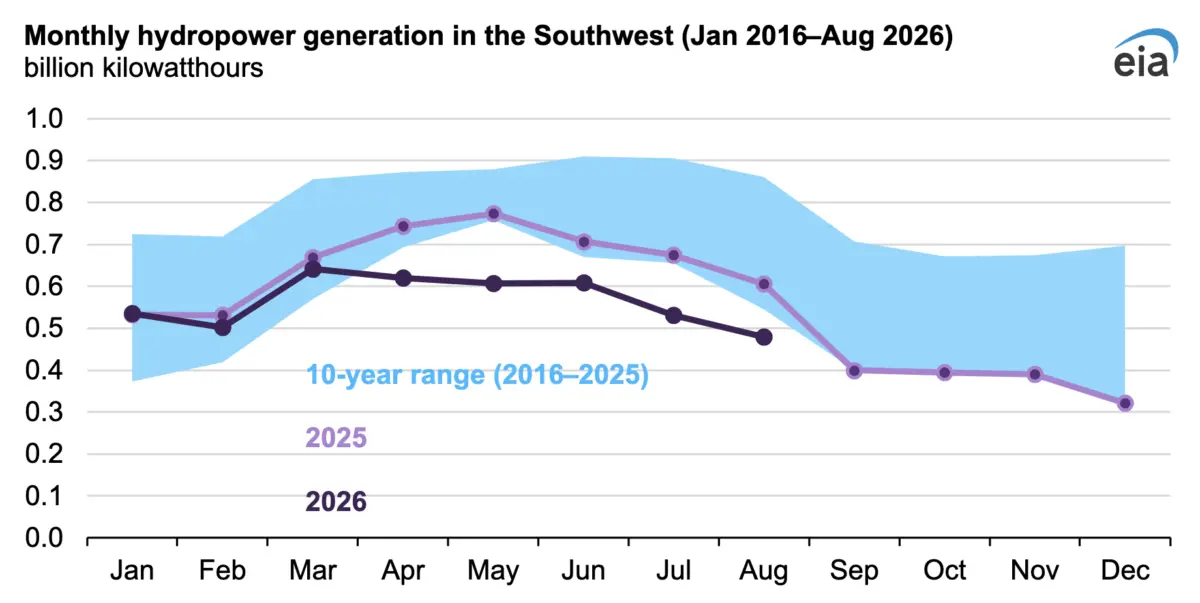
Prolonged and severe drought conditions gripping the Colorado River Basin have driven hydropower generation to record lows across the Southwestern United States. According to the latest energy data from the U.S. Energy Information Administration’s Form EIA-923 survey, electricity production from water-driven facilities in the region—which encompasses Arizona, New Mexico, and portions of Nevada and California—dropped sharply this summer, highlighting the growing vulnerability of vital infrastructure to long-term climate and water scarcity pressures.
Data compiled for the spring and summer months reveal the extent of the decline. Hydropower generation from April through August 2026 fell 19% lower than during the exact same period in the previous year. When compared against the 10-year historical average for those months, generation plummeted by 28%. These figures underscore a steady erosion of energy reliability in a region that has long depended on the mighty rivers of the American West to help balance its electrical grid.
The root cause of this generation slump lies in the drastically depleted water levels of the massive reservoirs that anchor the region’s hydroelectric capacity. Lake Powell and Lake Mead, formed respectively by the Glen Canyon Dam and the Hoover Dam, have both hit critical historic lows. These sprawling reservoirs are managed primarily by the U.S. Bureau of Reclamation, serving not just as power-generating hubs, but as lifelines for water supply across seven key states: Arizona, California, Colorado, Nevada, New Mexico, Utah, and Wyoming.
For the Glen Canyon Dam to generate hydropower effectively and safely, Lake Powell must maintain a water elevation of at least 3,490 feet above sea level, a threshold commonly referred to as the minimum power pool. By the end of September, the lake’s water elevation hovered at 3,518 feet. While technically above the absolute floor, this level sits less than 1% above the minimum power pool, leaving virtually no margin for error if dry conditions persist.
A similar stress is visible further downstream at Lake Mead, which feeds the Hoover Dam. That facility requires Lake Mead to maintain an elevation of at least 950 feet. By the close of September, Lake Mead’s elevation reached 1,038 feet. Although this places the reservoir roughly 9% higher than its minimum power pool, the buffer remains precarious given the relentless regional demand and long-term downward trends in basin inflows.
Federal and regional authorities have been forced to take aggressive operational steps to manage the crisis and prevent catastrophic failures at the dams. To mitigate the severe risk of Lake Powell’s water elevation dropping below the minimum power pool, emergency water was released upstream from Flaming Gorge, a major reservoir situated in the Upper Colorado River Basin. At the same time, water releases directly out of Lake Powell were deliberately curtailed to help preserve an elevation target of at least 3,510 feet, factoring in the most probable incoming water inflows.

However, managing water retention at Lake Powell creates a delicate balancing act for the entire river system. Lower water releases from Lake Powell directly impact water elevations further downstream at Lake Mead, which in turn threatens to restrict hydropower generation capacity at the iconic Hoover Dam. Recognizing the interconnected nature of these vulnerabilities, the U.S. Department of the Interior stepped in with decisive policy measures. The department finalized plans to significantly reduce the collective water consumption of the Lower Basin states—specifically California, Arizona, and Nevada—by 1.25 million acre-feet annually over the next two years.
Federal energy forecasters expect these compounding pressures to weigh heavily on regional power totals for the foreseeable future. According to projections published in the November Short-Term Energy Outlook by the EIA, total hydropower generation in the Southwest is expected to reach 6.13 billion kilowatthours for the entirety of 2026. This anticipated annual total represents a 9% decrease compared to the previous year and stands 24% lower than the 10-year historical average for the region.
Looking ahead to the following year, the outlook offers little immediate relief. The EIA forecasts that regional hydropower generation in 2027 will total roughly 6.1 billion kilowatthours, representing a further fractional decline of about 0.5% compared to the projected 2026 figures.

While meteorologists and water managers have pointed to the emergence of an El Niño pattern this year—which traditionally brings above-average precipitation to parts of the American Southwest and could provide temporary drought relief—experts caution that a single wet winter is unlikely to reverse years of accumulated moisture deficits. One good water year simply cannot erase the structural effects of multiple consecutive years of severe water scarcity across the basin.
The diminishing contribution of hydropower is also reshaping the broader energy mix of the Southwestern states. According to the Short-Term Energy Outlook, hydropower generation is expected to account for approximately 4% of the entire region’s electricity generation mix in 2026. This represents a substantial contraction from historical norms, having declined steadily from a peak generation share of 8% back in 2011. As climate patterns continue to challenge traditional generation models, regional planners face mounting pressure to adapt the grid to an era of constrained water resources.