In 2025, an estimated 36,640 traffic fatalities were reported across the United States. To understand where modern transportation is heading, it is worth looking back at the long trajectory of automotive safety innovations, how they transformed driving culture, and where systems like Tesla’s Full Self-Driving (FSD) fit into the ongoing effort to protect human lives on public roadways.
History of Seatbelts for Safety
The journey of automotive safety features offers a clear historical lens for evaluating new technologies. Seatbelts, for instance, were initially treated as novelties or optional accessories rather than essential life-saving devices. Over time, as empirical data demonstrated their undeniable ability to prevent ejection and fatal trauma during collisions, seatbelt use transitioned from a personal choice to a universally accepted practice, eventually becoming legally mandated in jurisdictions around the world.
The story of the three-point seatbelt, patented by Nils Bohlin in 1959 and subsequently made freely available by Volvo to all competing automakers, stands as one of the most generous and impactful safety milestones in industrial history. It set a precedent for how critical safety designs could be shared for the greater public good. Today, fastening a seatbelt is an instinctive, second-nature habit for the vast majority of motorists, illustrating how public perception and regulatory standards can successfully evolve around a life-saving mechanism.
Air Bags for Automobile Safety
Following the passage of the Intermodal Surface Transportation Efficiency Act of 1991, airbags became a federally mandated requirement in all new passenger cars sold in the United States starting September 1, 1998. Since then, front and side airbags have saved countless lives by cushioning vehicle occupants during high-impact crashes and preventing catastrophic strikes against hard interior surfaces.
However, the integration of powerful safety hardware also highlights a complex reality: powerful safety innovations can sometimes act as a double-edged sword. A vivid reminder of this occurred recently when a family member was involved in an automobile accident severe enough to trigger the vehicle’s airbags. While the system fulfilled its primary duty of preventing fatal trauma, the explosive force of the deploying airbag shattered her left wrist, resulting in a severe compound fracture where the bone penetrated the skin.
This duality raises important questions about the nature of vehicular protection. As the automotive industry transitions from passive safety devices designed to mitigate injury during a crash to active automation technologies designed to prevent crashes entirely, society must evaluate the risks, rewards, and moral implications of each new technological leap.
The Promise and Reality of Driving Automation
Where do we stand today on safety in the evolution of driving automation, such as Tesla’s Full Self-Driving? On April 8, 2026, Elon Musk publicly claimed that Tesla’s Full Self-Driving software is sufficiently advanced to be dramatically safer than human drivers, suggesting it has the potential to prevent up to 90 percent of the roughly one million lives lost annually in car crashes globally.
Proponents of autonomous and supervised driving systems point out that software does not suffer from the primary human failings that lead to tragedy on the roads. FSD does not consume alcohol or drugs, it does not become distracted by text messages or phone calls, and it does not fall asleep at the wheel. When considering the vast frequency with which human drivers lose focus, misjudge distances, experience road rage, or make poor split-second decisions, it becomes mathematically plausible that automated driving assistants could avoid a substantial percentage of everyday collisions. Similar safety potential has been highlighted by other autonomous vehicle developers, such as Waymo, which has reported significant figures regarding avoided injuries in urban test markets.
Yet, bridging the gap between theoretical safety and real-world execution is fraught with complications. Numerous reports and anecdotal accounts have documented instances where Tesla FSD software has behaved erratically or contributed to dangerous situations, and comprehensive, publicly available safety data remains limited.
A personal experience from earlier this summer underscores the nuances of human-machine interaction on the road. On June 9, while driving a 2018 Tesla Model 3 in Madison, Wisconsin, with FSD engaged, an intervention led to a near-miss collision. Approaching an intersection, the driver overrode the FSD system and proceeded through a stop sign, only to be struck in the rear by a motorist traveling in a perpendicular direction who was distracted and failed to yield. The driver is convinced that had the vehicle been left entirely to its own automated systems, the car would have brought itself to a complete stop at the sign, avoiding the impact altogether. Fortunately, neither the occupants nor the other driver were seriously injured, protected in part by traditional safety measures like seatbelts.
Economic Realities and Moral Responsibilities
Tesla’s commercial approach to FSD introduces further debate. The company currently charges a recurring monthly subscription fee of $99 for its FSD technology. At the same time, recent manufacturing updates saw the removal of automatic lane centering as a standard, included feature across all new vehicles, shifting it behind the FSD subscription paywall.
This business model raises pressing moral questions. Tesla has invested billions of dollars into research and development, utilizing massive supercomputers to train its neural networks on billions of miles of real-world traffic scenarios. The company has equipped all new vehicles manufactured since mid-2023 with upgraded cameras and computing hardware capable of supporting advanced software iterations like FSD V14. Generating continuous revenue streams makes financial sense for a corporation funding expensive, ongoing software refinement, but it forces a difficult question: Does monetizing advanced safety features come at the cost of immediate traffic fatalities that could be avoided if the technology were universally deployed?

The situation mirrors the early days of seatbelts. We remain in a transitional novelty phase with automated driving systems. While far more complex than a mechanical strap, Tesla’s proprietary FSD represents one of the most comprehensive and widely deployed automated driving systems operating across diverse infrastructure in the United States today.
Evaluating FSD V14 in Daily Driving
Tesla’s FSD system does not need to be infallible to save lives; it merely needs to demonstrate a safety record significantly superior to the average human driver to make a dent in the approximately 37,000 annual traffic fatalities recorded in the United States.
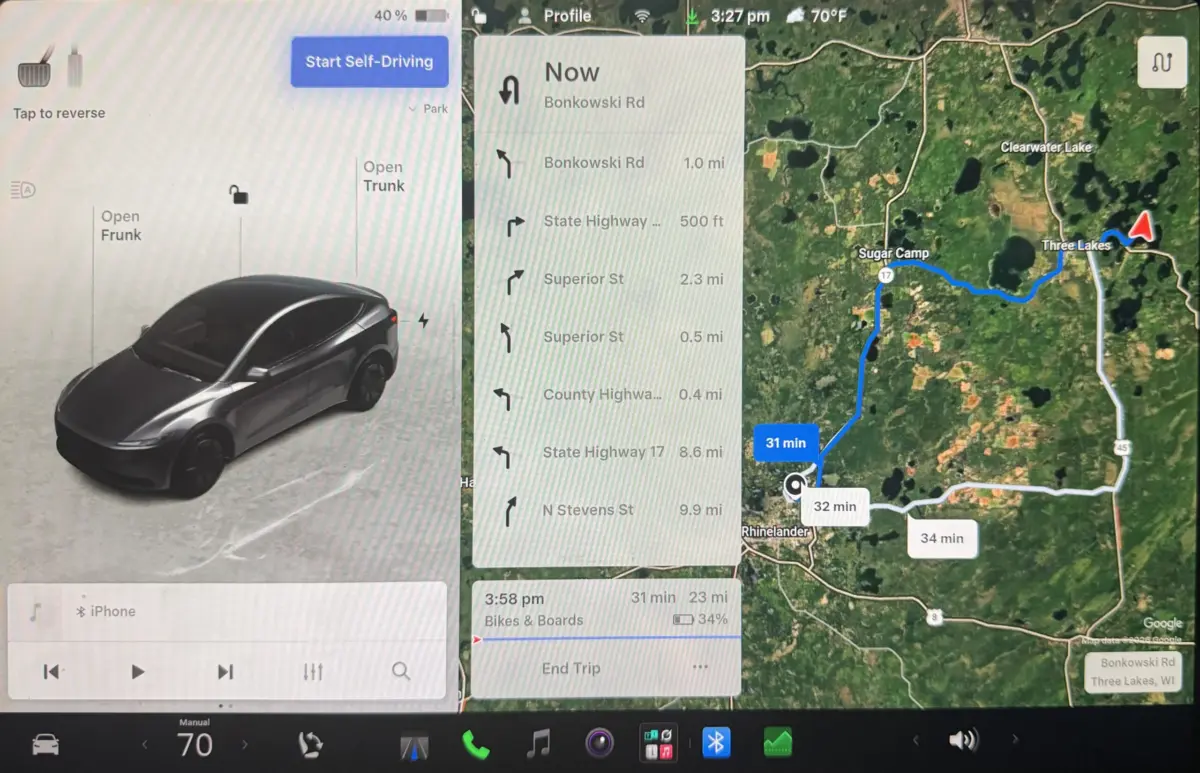
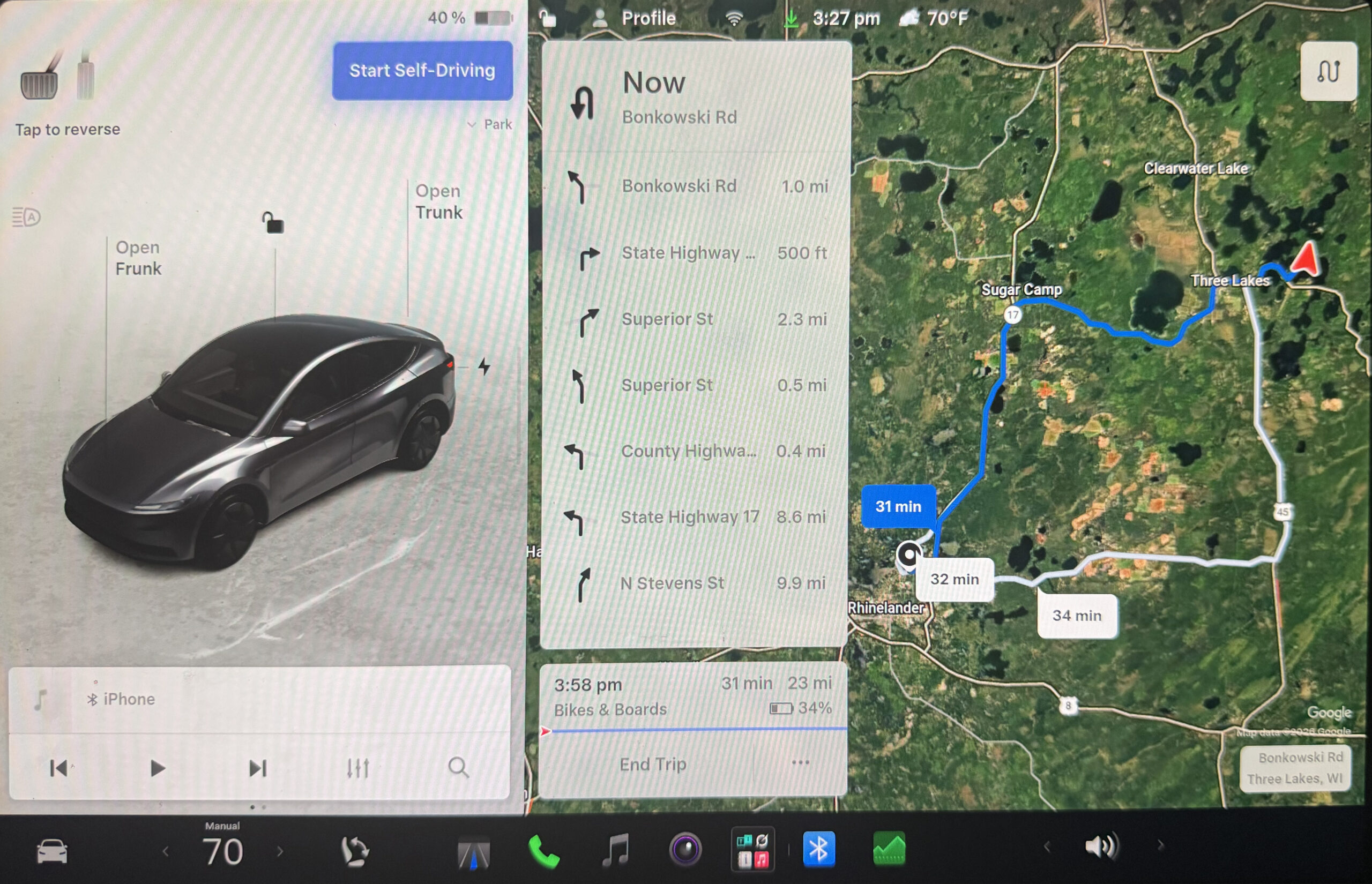
Having spent four months driving a 2026 Tesla Model Y equipped with FSD V14—captured on June 11, 2026, near Camp Hasler in Three Lakes, Wisconsin—the capabilities and limitations of the system become apparent. Because the technology cannot guarantee perfection, Tesla officially designates the feature as "FSD Supervised." The software still encounters occasional challenges, particularly regarding precise lane selection at complex traffic signals and low-speed maneuvers like parking at the beginning or end of trips.
Despite these limitations, real-world performance on highways is remarkably refined. Many drivers speculate that highway navigation may soon become robust enough to shed the "supervised" qualifier in upcoming software iterations. However, the broader timeline for true unsupervised autonomy—where occupants might safely read, sleep, or send empty vehicles to transport children from school—remains a subject of intense industry speculation and ongoing engineering refinement.
As these systems mature, the automotive industry faces a profound philosophical crossroads. Have we reached a point where manufacturers like Tesla are morally obligated to ensure that all new vehicles roll off the assembly line with comprehensive automated driving hardware and software as standard equipment? Furthermore, will companies eventually be compelled to license or offer these safety systems freely to any manufacturer willing to adopt the necessary hardware standards, much like Nils Bohlin did with the three-point seatbelt in 1959?
A precedent exists in Tesla’s own history regarding charging infrastructure. By opening its proprietary Supercharger network to competing automakers and establishing the North American Charging Standard (NACS), Tesla transformed a brand-exclusive asset into a universal public utility that accelerated nationwide electric vehicle adoption. Whether automated driving systems will follow a similar path toward universal standardization remains uncertain. Competing automakers continue to argue that an all-camera vision approach will struggle in extreme weather conditions compared to sensor suites utilizing lidar and radar. Yet, as proponents note, even human drivers routinely pull off the road during severe, blinding weather events, suggesting that practical automation may not need to conquer every theoretical edge case to fundamentally transform global transportation safety.