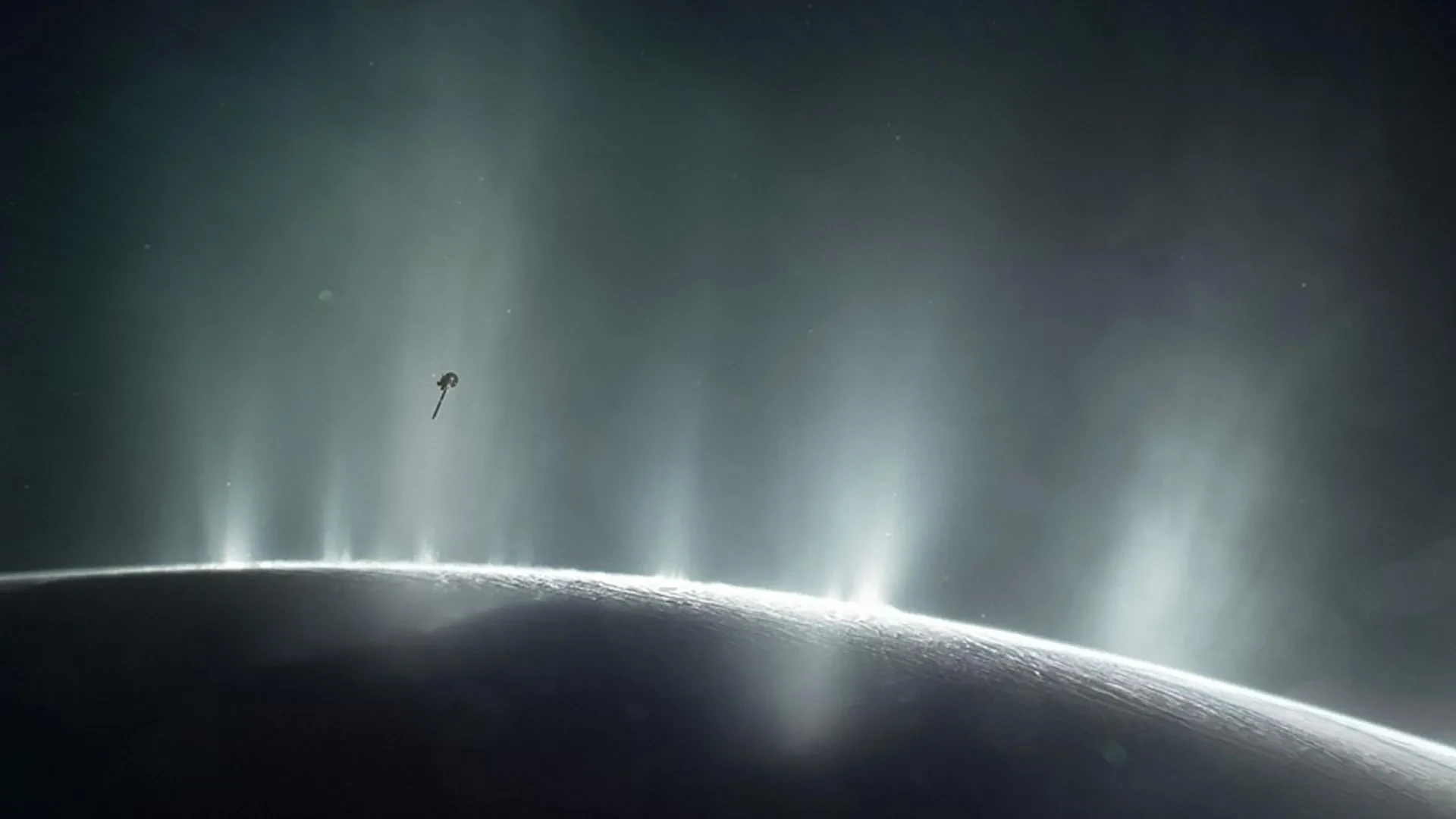
Saturn’s moon Enceladus has long captivated the scientific community as one of the most promising locations in our solar system for the search for extraterrestrial life. Cloaked in a thick, global shell of ice, the moon hides a vast, subsurface liquid ocean beneath its frozen exterior. Near the moon’s south pole, dramatic geysers erupt through fractures in the crust, venting water vapor and ice particles directly into space. This natural phenomenon provides planetary scientists with an unprecedented opportunity: the chance to study the chemical composition of an alien ocean without the immense engineering challenge of landing a probe and drilling through kilometers of solid ice.
An international research team, including scientists from the Earth-Life Science Institute (ELSI) at the Institute of Science Tokyo, has now unlocked a long-standing mystery regarding these plumes. By investigating how ocean water transforms from liquid into the tiny ice grains detected in space, the researchers have discovered that the moon itself acts as a sophisticated laboratory, naturally sorting and concentrating chemicals in a way that could significantly aid the search for biological precursors.
Cassini’s Discovery of Diverse Ice Grains
Between 2004 and 2017, NASA’s Cassini spacecraft performed a series of daring flybys through the plume of Enceladus. Among its most critical instruments was the Cosmic Dust Analyzer (CDA), which measured the composition of individual ice particles circulating within Saturn’s E-ring. Because the E-ring is continuously replenished by the material erupting from Enceladus, the CDA’s data provided a high-resolution look at the moon’s internal chemistry.
A team led by Professor Frank Postberg at Freie Universität Berlin conducted a detailed re-examination of 961 mass spectra collected by the CDA, focusing specifically on salt-rich grains classified as Type 3 particles. Under traditional assumptions, one might expect that if these grains originated from the same homogeneous subsurface ocean, they would exhibit a relatively uniform chemical signature. However, the data revealed a striking degree of variance.
The grains displayed a high level of chemical heterogeneity. Some particles were heavily enriched with sodium chloride, while others contained significantly higher concentrations of carbonates, phosphates, or potassium chloride. A particularly puzzling pattern emerged from the data: chloride and carbonate rarely appeared together in the same sodium-rich particle. This created an immediate scientific problem: if these grains were all derived from the same reservoir of liquid water, why did their chemical profiles differ so drastically?
Recreating Enceladus’ Ocean Droplets in the Lab
To address this anomaly, Professor Yasuhito Sekine and his colleagues at ELSI designed a series of laboratory experiments intended to replicate the environment of Enceladus’ subterranean vents. The researchers created artificial droplets containing the major salts believed to exist within the moon’s ocean. By freezing these droplets under various cooling conditions and measuring the distribution of chemical elements once the liquid solidified, the team sought to understand the physical mechanisms at play.
The results of the experiments were definitive: the speed of the freezing process is a primary driver of chemical distribution. In droplets approximately 200 micrometers in diameter, salts underwent a process of separation when frozen at a relatively slow rate—specifically 10 Kelvin per minute or slower. During this gradual solidification, the salts migrated to different regions within the droplet. In contrast, when the droplets were frozen rapidly, the chemical ingredients remained evenly mixed, reflecting the initial composition of the liquid.
"What surprised us was that the diversity seen by Cassini could emerge from droplets originating from essentially the same ocean water," Professor Sekine explained. "Our experiments show that when relatively large ocean droplets freeze slowly, different salts can separate within them. If those frozen droplets are later broken apart, they can produce much smaller ice grains, each with very different chemical compositions."
A Slower Journey Through Enceladus’ Ice
These findings challenge previous models of how material travels from the ocean to the vacuum of space. Early scientific consensus often assumed that seawater spray from Enceladus froze almost instantaneously upon exposure to the cold, then moved rapidly toward the surface. The new experimental data suggest a much more complex and protracted journey.
Instead of a swift exit, the droplets likely traverse the moon’s icy crust through an intricate network of fractures and vent systems. The researchers propose that ocean spray initially forms droplets ranging from tens to hundreds of micrometers in size. As these droplets migrate slowly through the deeper, colder sections of the vents, they undergo a gradual freezing process. This slow cooling provides the necessary time for the salts to segregate into distinct, concentrated regions within each droplet.
As these frozen droplets reach the narrower channels closer to the surface, the physical dynamics shift. The gas pressure increases, causing the frozen droplets to collide with the walls of the icy conduits at high speeds. These high-velocity impacts effectively shatter the frozen droplets into smaller fragments. Because each fragment originates from a different salt-rich region of the original droplet, the resulting ice grains exhibit the chemical diversity detected by Cassini.
"The Cassini data showed us that these salt-rich grains are far more chemically diverse than an average ocean composition would suggest," noted Professor Postberg. "Combining those observations with the freezing experiments gives us a physical explanation: Cassini may have sampled fragments of larger frozen ocean droplets, each preserving different components that became separated during their journey towards the surface."
Enceladus as a Natural Laboratory
This discovery holds profound implications for future missions aimed at exploring Enceladus. The natural "sample preparation" occurring within the moon’s crust could prove invaluable for scientists seeking to detect trace organic compounds. In laboratory settings on Earth, researchers often expend significant energy and resources separating and concentrating chemicals from a dilute mixture to analyze them effectively. Enceladus appears to perform these essential tasks naturally.
As the droplets freeze and fracture, individual compounds—including complex organic substances—can become trapped and concentrated within specific grains. This process effectively amplifies the signal of certain chemicals, making them much easier to detect than they would be if they remained uniformly dispersed throughout the entire volume of the ocean. By concentrating these diluted substances into individual ice particles, the moon effectively flags potentially interesting chemistry for future instruments to find.
Implications for Prebiotic Chemistry
The significance of this slow-freezing process may extend beyond mere analytical convenience. As ice crystals form within the cooling droplets, small pockets of liquid brine remain trapped between the crystalline structures. Within these micro-environments, salts and organic molecules can reach extremely high concentrations.
This mechanism is of particular interest to the field of prebiotic chemistry, which studies the processes that lead to the emergence of life. A fundamental hurdle in prebiotic science is the challenge of bringing molecules that are typically dilute into sufficiently close contact to facilitate complex reactions. The freezing, concentration, and recycling process described by the ELSI team offers a plausible pathway for these reactions to occur on an icy moon. Because a significant portion of the material ejected from the plume eventually falls back onto the surface, this cycle of freezing and concentration could be a repeating, dynamic process.
Understanding the physics behind Enceladus’ ice grains does more than explain the unique data set provided by the Cassini mission. It provides a deeper look into the hidden, volatile environment beneath the moon’s surface. As space agencies continue to plan future missions to the Saturnian system, these insights will be critical in guiding how we search for evidence of habitability and potential biological markers, ensuring that future probes are equipped to interpret the chemical history written into the ice grains of Enceladus.