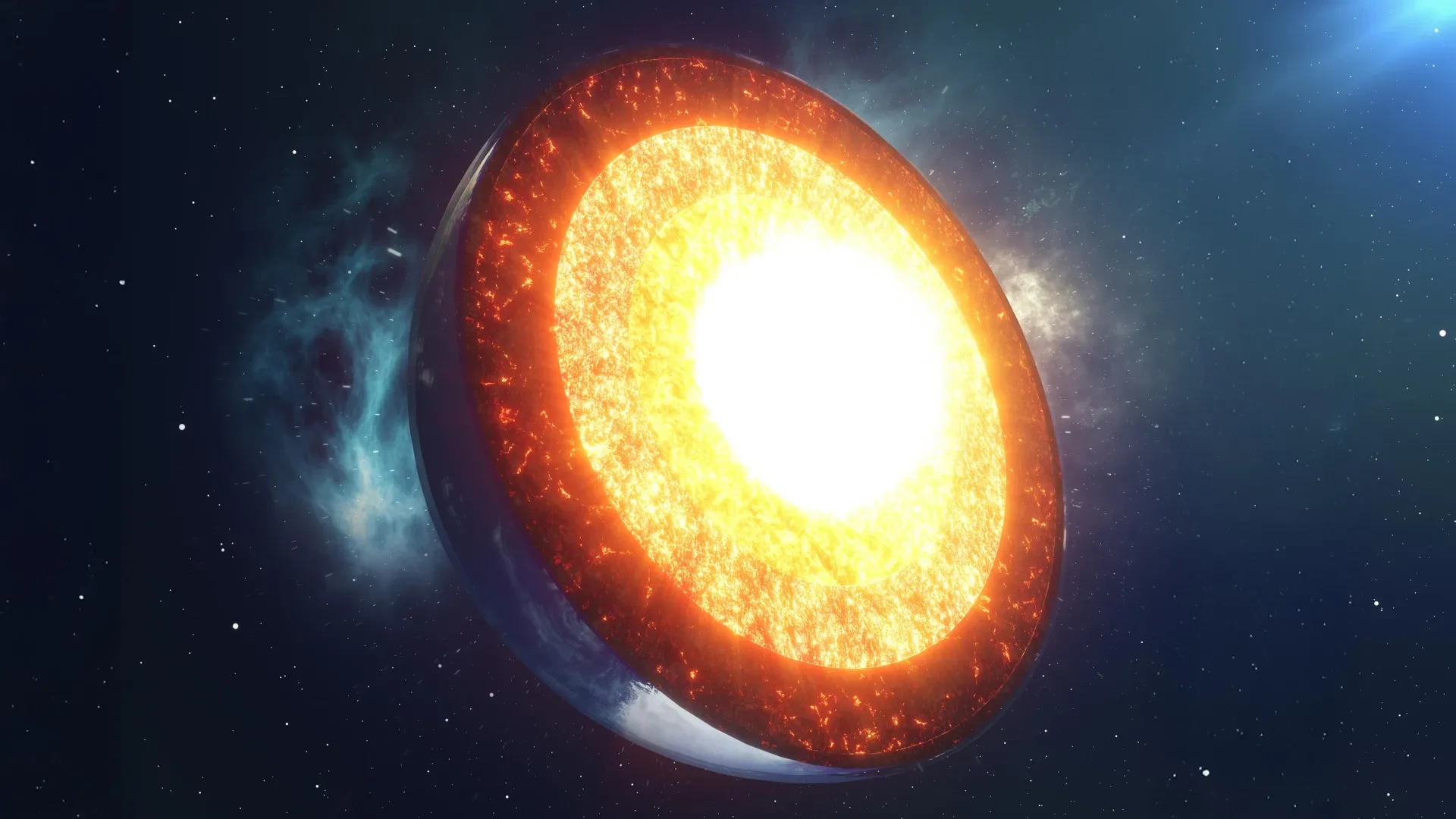
For most of humanity, the concept of a "day" is an absolute constant—a reliable, unyielding measure of 24 hours that anchors our schedules, our societies, and our perception of time. We mark the passage of the sun and the arrival of night as if they are dictated by the clockwork precision of a Swiss timepiece. However, the reality of our planet’s rotation is far more fluid and complex than our daily lives suggest. Earth does not rotate at a perfectly constant rate, and the length of a day is subject to subtle, invisible fluctuations that occur deep beneath our feet.
While these differences are measured in mere milliseconds, they are not beyond the reach of modern science. Physicists have long been able to detect these infinitesimal deviations, observing that days occasionally become slightly shorter or longer over time. These variations are not random; they are the result of complex, dynamic processes unfolding thousands of kilometers beneath the crust, driven by the turbulent, shifting movements of the planet’s molten interior.
Earth’s Core and Mantle Trade Momentum
For roughly three decades, the scientific community has been aware of a peculiar phenomenon: Earth’s liquid outer core does not always rotate at the same velocity as the rest of the planet. Changes in the intensity and structure of Earth’s magnetic field—which is generated by the swirling movement of liquid iron in the core—have provided researchers with a window into this hidden activity. These observations have revealed that the liquid core can gradually accelerate over several decades, only to lose momentum and slow down during the subsequent decades.
This internal dance is a matter of physical necessity. The mantle, a massive, 3,000-kilometer-thick rocky layer that encompasses the bulk of the planet’s volume and supports the crust, must respond to these changes in the core. Because the Earth is a closed system, its total angular momentum must remain constant. Consequently, the mantle and the core exist in a delicate, inverse relationship: when the liquid core speeds up, the mantle must experience a slight deceleration to compensate. Conversely, when the core slows down, the mantle’s rotation quickens.
Even though the mantle is immense and incredibly dense, these shifts in rotational momentum are sufficient to alter the length of a day by a few milliseconds. While these fluctuations are imperceptible to the average person, they are significant enough to be tracked by geophysicists and climate scientists who rely on high-precision timekeeping. For years, however, the exact mechanism governing how the core and the mantle exchange this momentum remained an enigma, leaving a critical gap in our understanding of planetary physics.
A Hidden Gravitational Tug Inside Earth
The mystery of how these two massive layers communicate their rotational changes has long occupied the minds of geophysicists. A significant breakthrough arrived on September 23, with the publication of a new study in the journal Nature. In this research, University of Alberta physics PhD student Huifeng Zhang and professor Mathieu Dumberry propose a compelling solution that links the behavior of the planet’s center to the rotation of its surface.
The study centers on the Earth’s inner core, the solid, dense sphere of iron and nickel located at the very heart of the planet. Zhang and Dumberry demonstrate that even small variations in the rotational speed of this inner core can generate what scientists call a "gravitational torque."
The crux of this discovery lies in the geometry of the inner core. Because the inner core is not a perfect sphere, its rotation is not uniform in its impact on surrounding layers. As it spins, its uneven mass distribution creates gravitational interactions with the mass distributions within the mantle. This gravitational "tug" acts as a coupling mechanism. When the inner core changes its rotational speed, it exerts a gravitational force on the mantle, forcing it to adjust its own rotation. This interaction provides the missing link in explaining how rotational momentum is traded between the planet’s layers, ultimately manifesting as those small, observable changes in the length of a day that have puzzled scientists for years.
Competing Forces Control Earth’s Rotation
The relationship between the core and the mantle is not governed by a single force; rather, it is a tug-of-war between competing physical influences. While the gravitational torque identified by Zhang and Dumberry plays a vital role in transferring momentum, another force operates simultaneously at the boundary between the core and the mantle.
Known as "core-mantle boundary torque," this force is essentially a product of friction and electromagnetic drag. As the liquid core churns against the base of the mantle, the resulting friction and the electromagnetic interactions between the two layers create a significant amount of resistance. This resistance acts as a counterweight to the gravitational pull.
According to the researchers, the variations we observe in the length of a day are the result of the shifting balance between these two forces. It is not merely a one-way street of momentum transfer, but a complex, fluctuating equilibrium where gravitational torque and boundary friction constantly vie for dominance. When one force gains the upper hand, the mantle’s rotation—and by extension, the length of our day—shifts accordingly. Understanding this interplay is essential for building more accurate models of how our planet functions on a global, geological scale.
Earth’s Inner Core May Be More Dynamic Than Expected
The implications of this research extend far beyond the technical challenge of explaining why our days fluctuate by a few milliseconds. By identifying the mechanism behind this rotational exchange, Zhang and Dumberry have offered new, startling insights into the nature of Earth’s deepest, most inaccessible interior.
Their findings suggest that the inner core is far more dynamic than previously assumed. Specifically, the study indicates that the inner core appears to "deform viscously" on a time scale of approximately 10 years. This implies that the deepest part of our planet is not merely a static, rigid block of metal, but a material that can change shape and respond to external forces with a level of plasticity that is surprising given its solid composition and the immense pressures under which it exists.
This "viscous deformation" suggests that the inner core is capable of responding to the stresses placed upon it by the surrounding liquid outer core and the mantle, effectively "giving way" or shifting its form in response to gravitational pressure. This adds a new layer of complexity to our understanding of Earth’s internal structure, suggesting that the interior is a highly active, responsive system that undergoes constant, subtle transformations.
By bridging the gap between the behavior of the solid inner core and the observable length of a day, this study underscores the interconnectedness of our planet. The processes that dictate the length of our days are the same processes that govern the generation of our magnetic field and the tectonic stability of our surface. As researchers continue to refine these models, they move closer to a complete picture of the Earth not as a static rock, but as a living, breathing, and constantly evolving system. What begins as a quest to explain a few milliseconds of time turns out to be a journey into the very heart of the planet, revealing a world of fluid movement and hidden gravitational forces that define the rhythms of our existence.