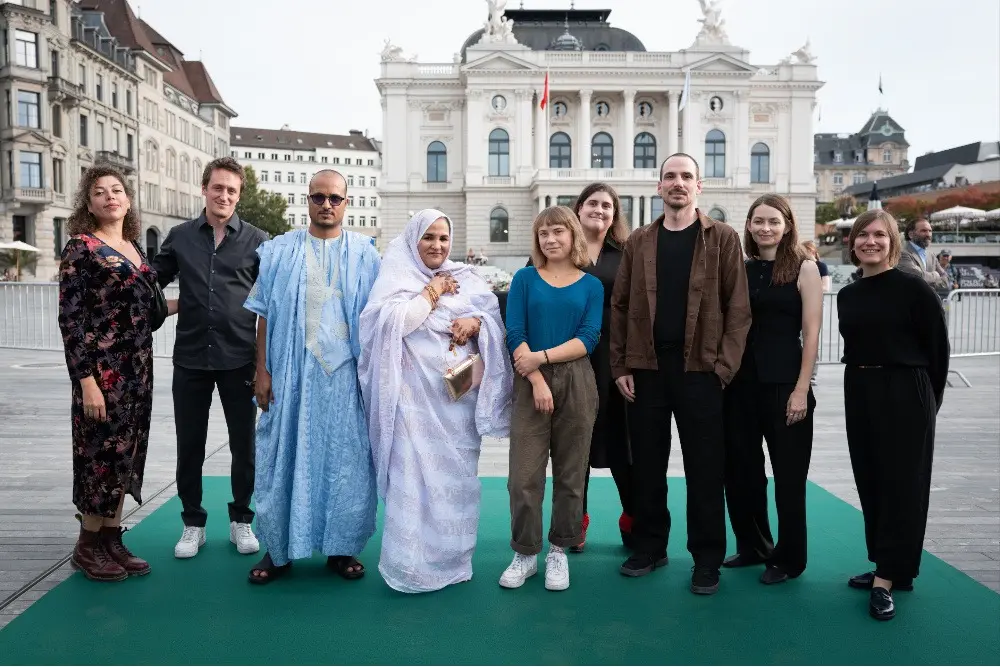
Climate activist Greta Thunberg made an unannounced and impactful appearance at the Zurich Film Festival on Tuesday, lending her platform to the urgent cause of Western Sahara. Thunberg joined the audience for a special screening of the new documentary "My Home of Wind and Sand," a film that meticulously chronicles the ongoing occupation of Western Sahara by Morocco—a conflict often described as the last colonial struggle on the African continent.
The film, directed by Patrick Wally and handled by sales agent Lightbox, serves as a poignant window into a region that has remained under Moroccan control since 1975. Following the screening, Thunberg engaged in a passionate discussion regarding the geopolitical landscape of the region, emphasizing the "extreme hypocrisy" that she believes characterizes the international community’s approach to the Sahrawi people.
"There’s this extreme hypocrisy that makes me so, so angry and upset," Thunberg stated during her appearance. She described the documentary as a "powerful" piece of filmmaking capable of fostering real-world change, yet she lamented the systemic neglect the conflict faces in global discourse. For Thunberg, the film was a stark meditation on the nature of betrayal.
"For me, this movie was so much about betrayal. There are so many levels of betrayal," she explained to the audience. "First, there’s the occupation and the violence itself that somehow becomes ‘normal’ or is viewed as normal. It’s not easy to get any media attention and clicks, which is another betrayal." She further highlighted what she termed the "betrayal of the international solidarity movement," arguing that the world’s silence—or selective engagement—has allowed a dire human rights situation to persist in the shadows.
The status of Western Sahara remains one of the most contentious geopolitical issues in North Africa. The territory has been a point of conflict for nearly half a century, with the Sahrawi people seeking independence from Moroccan rule. The international stance on the region is complex and shifting; notably, as recently as 2025, the United States reaffirmed its recognition of Moroccan sovereignty over the territory, a move that has drawn significant criticism from human rights groups and Sahrawi activists.
The issue has recently bled into the cultural sphere as well. Director Christopher Nolan found himself at the center of a heated controversy regarding his production, "The Odyssey." The project faced intense backlash for filming scenes within the disputed Western Sahara, with critics accusing the production of inadvertently contributing to the Moroccan government’s repression of the Sahrawi people. The Western Sahara International Film Festival, known as FiSahara, issued a formal statement during the controversy, explicitly urging the director to halt production in the region, arguing that the presence of such high-profile filming projects risks legitimizing an illegal occupation.
Thunberg’s presence at the festival was not merely performative; it was anchored by her direct involvement with the cause. Having visited a Sahrawi refugee camp in 2025, she brought a sense of personal urgency to the panel discussion titled "Resistance and Activism for Western Sahara."
During the discussion, Thunberg turned her attention to the film’s protagonist, Sahrawi human rights activist Najla Mohamed-Lamin. Addressing her directly, Thunberg challenged the audience to move beyond passive observation. "I’m convinced that people like you do not want thanks or applause, but action," Thunberg said. "It falls on every single one of us in this room, especially us privileged people who have a platform and access to resources, to take that moral obligation to amplify the Western Sahara struggles. Otherwise, we are nothing more than hypocrites."
The screening and subsequent panel provided a platform for Mohamed-Lamin to reflect on her decade-long struggle, which is captured in the documentary. Visibly moved, Mohamed-Lamin spoke of the weight of history and the thousands of lives that remain unacknowledged by the international community.
"As I was watching these 10 years of my life, I couldn’t stop thinking about all the stories and lives in the last 50 years that nobody has heard of, which are probably far more inspiring than mine," Mohamed-Lamin reflected. "My grandmother, my sister who passed away, my mother, all our neighbors. All the thousands of people we buried in these camps who would have never wished to be buried there."
For Mohamed-Lamin, the documentary is more than just a personal project; it is a vital vessel for a truth that has been suppressed for generations. She described the persistent difficulty of being a voice for a displaced population, noting that as a "refugee forgotten in the desert," the opportunity to share one’s story is rare and precious.
"I didn’t know it would develop into a documentary," she said, reflecting on her journey. "The only thing I know is that I carry the message of my people, and I will share it everywhere I go: In a documentary, in an article, in a train station, or on a plane, because I’m the voice. The world has to know the truth."
The collaboration between a globally recognized activist like Thunberg and a grassroots voice like Mohamed-Lamin highlights a growing movement to bring the Western Sahara conflict back into the spotlight. By using the high-profile venue of the Zurich Film Festival, the participants aimed to force a conversation that has often been sidelined by major media outlets and political bodies.
The "betrayal" that Thunberg spoke of—the normalization of occupation and the lack of media interest—is precisely what "My Home of Wind and Sand" seeks to disrupt. Through the lens of Patrick Wally’s direction, the film forces viewers to confront the reality of the Sahrawi people’s daily existence, from the harsh conditions of refugee camps to the persistent desire for self-determination.
As the festival continues, the impact of the screening remains a talking point among attendees. The intersection of cinema, human rights, and high-profile activism has provided a rare moment of visibility for the Sahrawi cause, emphasizing that the struggle for Western Sahara is not a relic of the past, but an active, ongoing humanitarian crisis.
For Thunberg, the message is clear: the privilege of a platform is a responsibility that must be exercised to challenge the status quo. Her call to action—to move from the safety of an auditorium into the messy, uncomfortable work of advocacy—serves as the core takeaway from her visit. As Mohamed-Lamin continues to travel and share her message, the hope is that the visibility provided by the documentary and the support of activists will finally force the international community to move past its current state of indifference.
The conflict in Western Sahara, while often ignored in Western media, remains a defining issue for the Sahrawi people, whose resilience is documented in the film. Whether through the advocacy of figures like Thunberg or the persistent, firsthand accounts of activists like Mohamed-Lamin, the effort to break the cycle of silence continues. The documentary "My Home of Wind and Sand" stands as a testament to this effort, ensuring that even if the world chooses to look away, the truth of the last colonial conflict in Africa continues to be told.