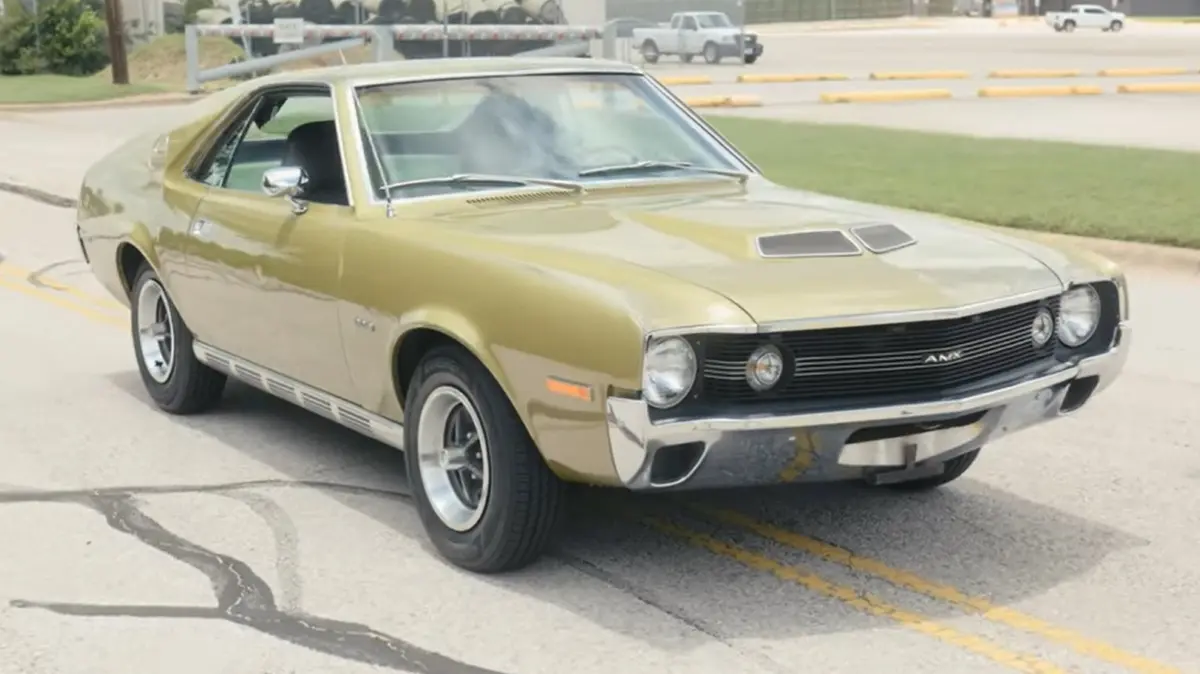
It is not often that automotive enthusiasts run across a vintage vehicle from 1970 showing a mere 14,900 miles on the odometer. It is even rarer to find a survivor of that vintage wearing the badges of the American Motors Corporation, particularly one of the most distinctive muscle cars of its era. Yet, that is precisely the discovery currently waiting for its next custodian just a short drive from the Circuit of the Americas outside Austin, Texas.
Motors Corner USA, an Austin-based classic car dealer, has listed a remarkably preserved 1970 AMC AMX for sale. Equipped with a 360-cubic-inch V8 engine and a grab-a-gear manual transmission, this low-mileage survivor occupies a fascinating space in the collector car market. It is not an over-restored, trailer-queen showpiece destined to be hidden away from the elements. Instead, it presents itself as a perfectly imperfect time capsule—one that possesses just enough patina to encourage a new owner to get behind the wheel, add some serious mileage, and use the car for what it was built to do.
This 56-Year-Old AMC AMX Is a Manual, V8-Powered Survivor
To fully appreciate the significance of this find, one must understand the unique history of the AMX. Produced by the American Motors Corporation from 1968 through 1970, the AMX was a daring two-seater entry designed to compete directly in the fiercely contested American muscle car market against heavyweights like the Ford Mustang and the Chevrolet Corvette. AMC positioned its short-wheelbase offering as a true sports car available at the price of a sporty car, aiming to capture the imagination of performance-minded buyers seeking something distinct from the Detroit establishment.
Despite its performance credentials and aggressive styling, the 1970 AMX did not capture the massive sales volumes enjoyed by its competitors. AMC manufactured just 4,116 examples of the AMX for the 1970 model year. That production run represented roughly half of what the company achieved the previous year and accounted for only about a tenth of the total volume Ford achieved with the Mach 1 Mustang during the exact same period.
That low production volume changes the modern landscape for collectors and enthusiasts. Securing a clean, well-preserved AMX is considerably more difficult than tracking down a more common rival from the era. While it may not command the attention of elite crowds at high-end concours d’elegance events where attendees sip expensive champagne under pristine canopies, its potential as a solid, dependable driver is exceptionally high. For an enthusiast willing to look past minor cosmetic flaws and perform a bit of light cosmetic upkeep, this vintage muscle car could represent a surprisingly smart acquisition in the current collector market.
The 1968 to 1970 production run marks the golden era of the standalone AMX model. After 1971, AMC pivoted the nameplate, turning the AMX into a performance-oriented option package that buyers could select when purchasing an AMC Javelin. Consequently, a solid 1970 AMC AMX holds a special place in automotive history as the definitive final chapter of the vehicle’s independent identity.
Adding to its appeal, this particular example leaves behind the automatic gearboxes that many buyers selected in period, pairing its V8 powerplant with a traditional manual transmission. When it left the factory floor, the 360-cubic-inch V8 engine was officially rated at 290 horsepower and 395 pound-feet of torque. That output represented a notable 65-horsepower increase over the specifications of the 1969 model, though decades of history mean a few of those original horses may have wandered away over the years.
While the 1970 AMX could be ordered with a Shift Command automatic transmission, this car features an all-synchromesh four-speed manual transmission equipped with a Hurst shifter. Inside the cabin, the environment remains remarkably authentic to the original factory specifications, bearing genuine signs of age and normal wear. The dashboard retains its original instrumentation, while the leather upholstery and wood trim have managed to survive the decades largely intact. Furthermore, the vehicle comes complete with original documentation, including its historic operating record booklet and the factory owner’s manual.
For buyers interested in acquiring the vehicle, the Texas-based muscle car has been listed on AutoTrader with an asking price of $34,900. While that figure represents a substantial financial commitment, it sits well below the typical valuations commanded by 1970 AMC AMXs in the broader collector market. Market data compiled by Classic.com indicates that the average sale price for a comparable vehicle hovers around $68,091, though final transactions fluctuate significantly based on overall condition, documented mileage, and geographic location. While an ambitious builder can certainly track down an AMC AMX project car for around $20,000, this running, driving survivor offers a much shorter path for enthusiasts who simply want to turn a key and hit the open road.
Somebody Please Drive This Thing Unapologetically
Considering that this machine has traversed more than half a century of automotive history, its current mechanical and structural condition is remarkably sound. According to Motors Corner USA, the 360-cubic-inch V8 engine fires up promptly and settles into a steady idle without excessive hesitation, particularly following a recently completed round of mechanical maintenance. That servicing process included a comprehensive rebuild of the original equipment manufacturer four-barrel carburetor, a complete brake fluid bleed, and the installation of a fresh set of spark plugs.
To be sure, this is not a pristine, concours-level restoration vehicle. It wears its history openly as a genuine automotive time capsule. Having endured more than fifty years without undergoing a painstaking, nut-and-bolt teardown and restoration, it exhibits only minor imperfections that tell the story of its long life.
Close inspection reveals small blemishes in the original paint, minor dents on the trunk lid, some deterioration of interior trim components, and slight dimpling on the passenger-side door. More observant enthusiasts may also spot early signs of rust forming behind the right rear wheel well. Yet, these minor flaws only add to its character. The car requires a modest amount of attention—potentially some bodywork, fresh paint, and basic detailing—but most importantly, it needs a driver.
Finding an AMC AMX with fewer than 15,000 miles recorded on the odometer is an exceedingly rare occurrence in the modern classic car community. As automotive history continues to move forward, preservation stories like this serve as a welcome reminder of the era’s engineering. This particular AMX has successfully avoided joining the ranks of forgotten classics left to waste away in fields or barns, and its next chapter depends entirely on an owner willing to put it back on the highway.