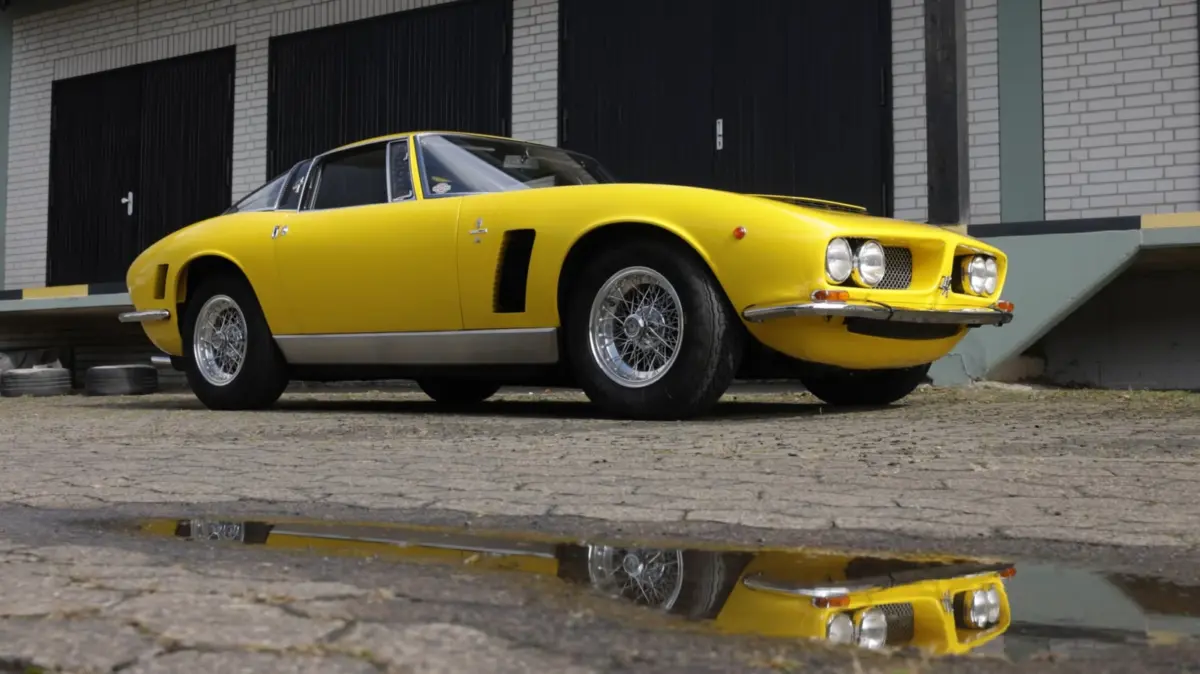
The marriage of sleek Italian coachwork and thunderous American V8 power is a concept that has been executed countless times throughout automotive history. Legendary grand tourers like the Facel Vega HK500, the Jensen Interceptor, and De Tomaso’s fierce Mangusta and Pantera all capitalized on the winning formula of European styling paired with reliable, easily serviceable American grunt. Yet, among this elite group of transatlantic hybrids, a strong argument can be made that the Iso Grifo executed the concept better than anyone else.
With its low-slung, drop-dead gorgeous lines penned by some of the industry’s greatest talents and enough raw performance to leave the fastest dedicated sports cars of its era struggling to keep pace, the Grifo remains a masterclass in automotive design. Only around 400 examples were ever manufactured across a near decade-long production run, and the automaker itself folded shortly after production ceased. However, more than half a century after the covers were first lifted to reveal Giorgetto Giugiaro’s breathtaking curves at the 1963 Turin Motor Show, the Grifo is just as worthy of celebration today. Examining the history of this rare exotic reveals a fascinating tale of engineering excellence, soaring valuations, and a cross-cultural collaboration that forever changed the landscape of high-performance grand touring.
The Iso Grifo Was Powered by Numerous American V8s
When automotive enthusiasts reflect on the titans of European motoring from the late 1960s and early 1970s, powertrain consistency is often the norm. Buyers of the Ferrari 365 GTB/4 received a 4.4-liter Colombo V12 regardless of the model year, Lamborghini Miura buyers all received a 3.9-liter V12, and every Aston Martin DB5 was equipped with a 4.0-liter Tadek Marek-designed inline-six. In stark contrast, American performance cars of the era—such as the Chevrolet Corvette and Ford Mustang—offered a dizzying array of small-block and big-block V8 options.
Fascinatingly, while Iso was boldly taking on the entrenched European elite, the Italian manufacturer adopted not only an American heart for its flagship grand tourer, but also an American philosophy regarding powertrain choices. Throughout the Grifo’s production run, buyers were given a wide selection of powerplants to suit their driving preferences. The base Series 1 Grifo sported a Chevrolet-sourced small-block 327-cubic-inch engine, with factory output comfortably sitting between 300 and 350 horsepower. The option of an updated 350-cubic-inch Chevy small block was also integrated into the Series I lineup as production progressed.
For later Series II cars built from 1972 onward, designated as IR-8 models, Ford’s robust 351 Cleveland engine was supplied, producing around 330 horsepower. These Ford-powered variants are exceptionally uncommon, with only 37 examples ever finding homes. For drivers craving massive displacement and tyre-shredding torque, big-block options arrived in the form of Chevrolet’s legendary 427-cubic-inch engine, unleashing up to 435 horsepower and 460 pound-feet of torque through a Tri-Power setup utilizing a trio of two-barrel carburetors. Certain models pushed the envelope even further by adopting a 454-cubic-inch Chevrolet engine, which delivered 395 horsepower alongside a staggering near-500 pound-feet of torque.
Only 402 Examples Were Ever Made
While Iso embraced American powertrain philosophy and mechanical components, other aspects of the company’s operations remained decidedly European, most notably its minuscule production scale. Given its sky-high asking prices, the Iso Grifo was never destined to be a high-volume commercial success. A total of just 402 examples were manufactured, even though production spanned nearly a decade from 1965 through 1974. This timeline highlights just how limited Iso’s manufacturing capacity truly was.
The production history of the Grifo can be clearly divided into distinct eras. Following the debut of the initial prototype at the 1963 Turin Motor Show, the first production Series I cars hit the road in 1965. A striking Targa body style followed in 1966, paving the way for the massive big-block models in 1968. Series II cars featuring subtle stylistic updates debuted for the 1970 model year, followed by the arrival of the Ford 351C-powered variants in 1972. Production officially ceased in 1974 when Iso closed its doors for good. While the devastating global Oil Crisis of 1973 undoubtedly accelerated the Grifo’s commercial demise, a decade in production meant the car’s natural lifecycle was drawing to a close regardless.
Pinpointing exact production numbers remains a challenge for automotive historians. Factory chassis numbers officially ran up to 412, but numerous cars were sent back to the factory over the years to be reworked and upgraded, receiving new chassis numbers in the process and muddying historical records. The most accurate historical breakdown accounts for 321 Series 1 cars, 79 Series II cars, and a pair of unique prototypes, culminating in the recognized total of 402 production units.
Iso Also Offered a Targa Version of the Grifo
While the Iso Grifo is universally celebrated as a sleek, muscular coupe, the company also crafted a select few open-top variants that command immense attention from collectors today. The story began with the Iso Grifo A3/L Spider Prototype—a stunning one-off vehicle displayed at the 1964 Geneva Motor Show. After changing hands multiple times over the decades, the car eventually found its way into the legendary and secretive collection of Rudi Klein. Following Klein’s passing, the unique prototype was famously auctioned off by RM Sotheby’s in 2024, fetching a staggering $1.875 million. At the same high-profile auction, a similarly weathered and unrestored Series I Grifo coupe achieved $162,400, underscoring the immense financial premium placed on the Spider’s one-of-one prototype status.
Beyond that initial show car, Iso went on to produce a total of 13 Series I Targa models, which relied exclusively on Chevrolet small-block V8 powerplants. During the subsequent Series II run, just four additional Targa models were built, likewise utilizing Chevy small-block engines under their respective hoods.
The Grifo Offered Extraordinary Performance for the Era
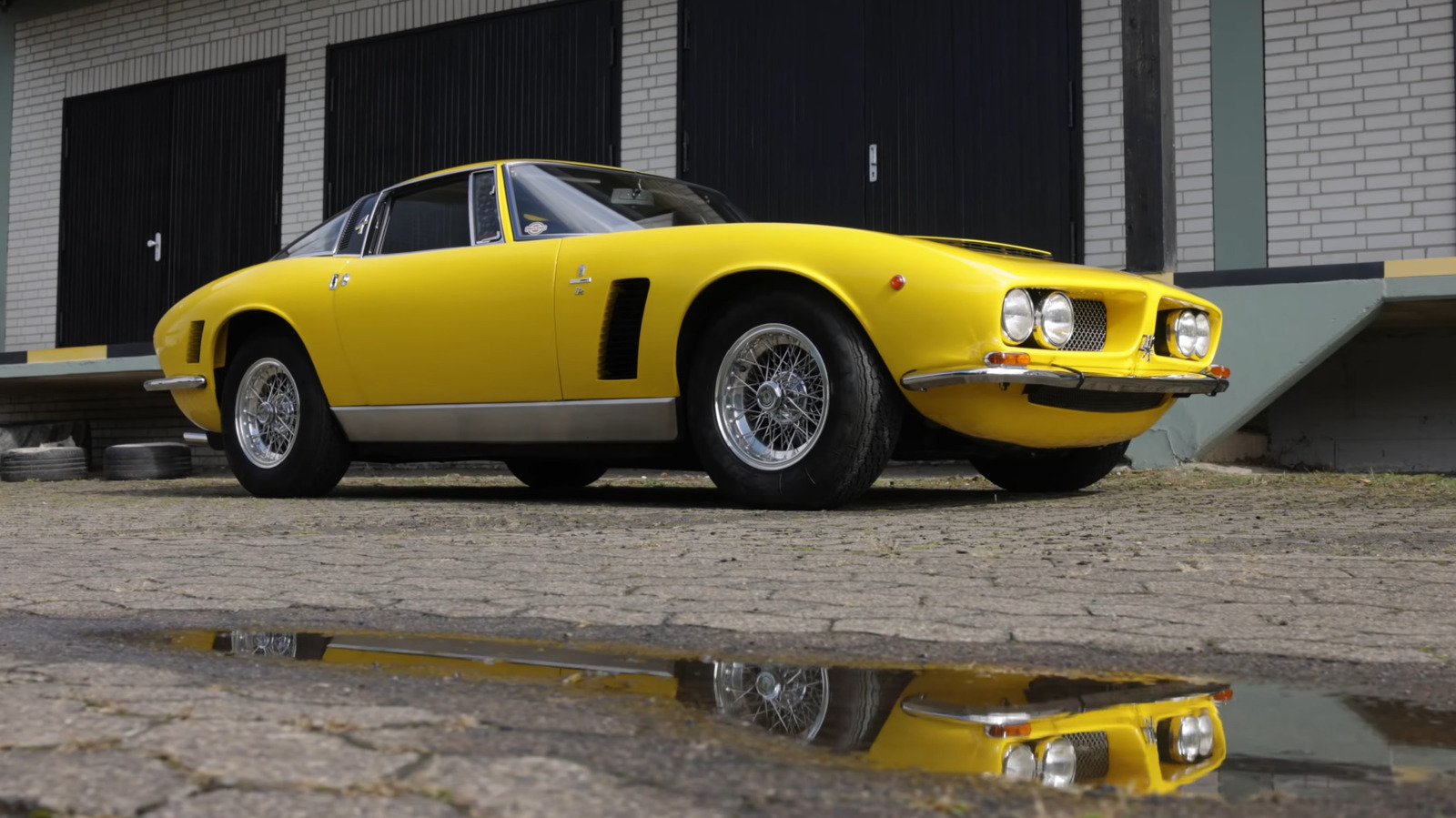
Iso engineered far more than just a visually striking grand tourer; true to its muscle-car-infused mechanical layout, the Grifo was a formidable performer on both the road and the track. Period automotive road tests confirmed that even the earlier small-block-powered cars were an absolute force to be reckoned with, sprinting from zero to 60 miles per hour in 7.2 seconds, reaching 100 miles per hour in 19.4 seconds, and effortlessly covering the standing quarter-mile in the low 15-second range. All of this performance was achieved while geared for a top speed well north of 150 miles per hour. Notably, British magazine Autocar managed to record an astonishing top speed of 161 miles per hour in a 327-powered Series I car, a figure that stood virtually unchallenged until Lamborghini’s legendary Miura arrived on the scene.
While those performance figures were undeniably impressive, they were not quite fast enough to humble Ferrari’s 330 GTC or big-block Corvettes on a straightaway. To bridge that gap, Iso introduced the big-block Grifo variants. Period reports indicate that later Series II cars equipped with the 395-horsepower, 454-cubic-inch big block were capable of rocketing from zero to 60 miles per hour in just 5.5 seconds, while pushing top speeds to approximately 165 miles per hour.
For the ultimate iteration—the rare 427-powered models—Iso made the ambitious factory claim that these cars were capable of touching an unbelievable 186 miles per hour. While verified records of that exact velocity being achieved are scarce, automotive historians generally agree that the big-block Grifo possessed more than enough horsepower to comfortably crack 170 miles per hour, representing the absolute pinnacle of high-speed motoring in the late 1960s and early 1970s.
The Grifo Was Developed by Italian Legends of the Auto Industry
The trio of automotive luminaries responsible for bringing the Iso Grifo to life represents some of the most celebrated engineering and design minds of the 20th century. With visionary founder Renzo Rivolta, legendary designer Giorgetto Giugiaro, and master engineer Giotto Bizzarrini collaborating on the project, it is hardly surprising that the resulting automobile achieved such sublime status.
Renzo Rivolta, the industrialist founder of Iso, provided the financial backing and overarching direction for a project designed to merge Italian elegance with American muscle. Giugiaro and Bizzarrini were the creative and technical forces tasked with turning Rivolta’s ambitious vision into a tangible reality. Giugiaro, widely recognized as one of the preeminent car designers in history, was responsible not only for the Grifo’s mesmerizing lines, but also for iconic machines like the BMW M1 and the original Volkswagen Golf. Bizzarrini, meanwhile, handled the engineering and chassis development. Having previously worked for Ferrari—where he played an integral role in developing monumental models like the legendary Ferrari 250 GTO—Bizzarrini was uniquely qualified to engineer a world-class chassis capable of harnessing American V8 power and allowing Iso to compete directly against Europe’s finest automotive marques.
Big-Block Examples Required Modifications to Accommodate Larger Engines
While a variety of powerplants were offered throughout the Grifo’s production run, the 427-equipped examples remain the most coveted by collectors with a heavy right foot. The decision to slide Chevrolet’s venerable L71 big-block engine beneath the hood came for the 1969 model year, serving as a direct response to aggressive new releases from rival Italian manufacturers.
Lamborghini had recently updated its Miura with the high-performance P400 S specification boasting 370 horsepower, while Ferrari’s contemporary 365 GTB/4 Daytona was churning out 352 horses. Because small-block Grifos maxed out at 350 horsepower, a 435-horsepower L71 update was deemed necessary to keep the car competitive at the top of the grand tourer hierarchy.
The integration presented a singular mechanical hurdle: the massive engine simply would not fit under the standard hoodline. Engineers were forced to design a very distinct hood scoop to clear the towering L71 engine. This prominent protrusion, which quickly attracted affectionate nicknames such as "pagoda" or "penthouse," made the 7-liter Grifo instantly identifiable among its smaller-engine siblings. In addition to the cosmetic modification, Iso engineers were forced to structurally reinforce the chassis on all 7-liter cars to handle the immense torque and additional weight. While the big-block cars possessed vastly superior straight-line performance, the extra heft over the front axle reportedly resulted in slightly altered handling dynamics. Ultimately, just 66 examples of the 7-liter Grifo were ever built, with a mere six units delivered new to the United States, cementing their status as exceptionally scarce collector items.
They Were Laughably Expensive When New and Remain Pricey Today
Given its recipe of sleek 1960s Italian coachwork combined with thunderous American horsepower, it is hardly surprising that the Iso Grifo commanded an astronomical price tag when new, nor that it continues to demand staggering sums on the modern classic market.
When it debuted, an Iso Grifo would set a buyer back approximately $14,000 in 1967. To put that figure into perspective, a base 1967 Chevrolet Corvette coupe cost just $4,388, and opting for the high-performance 430-horsepower L88 engine added a mere $947.90 to the total. Clearly, Iso was marketing its flagship machine directly to an ultra-wealthy clientele. For further context, Ferrari’s 365 GTB/4 Daytona started at $19,500 in 1968, while the 330 GTS commanded figures very similar to what Iso was asking for the Grifo. Adjusted for inflation, a $14,000 price tag in 1967 equates to roughly $141,000 today.
However, modern buyers hoping to secure an authentic Iso Grifo for the inflation-adjusted equivalent will find themselves out of luck. Current classic car market valuations suggest that enthusiasts can expect to pay anywhere from approximately $293,000 to nearly $358,000 for a well-maintained 1967 Coupe GL, while later 7.0-liter models from 1969 regularly command between $411,000 and $492,000. Rare Targa models trade within a similar bracket, valued between roughly $370,000 and $436,000 for early examples. Meanwhile, ultra-rare competition-spec A3/C models and one-off prototypes soar far higher into the seven-figure territory, easily clearing $1.5 million at major international auctions.