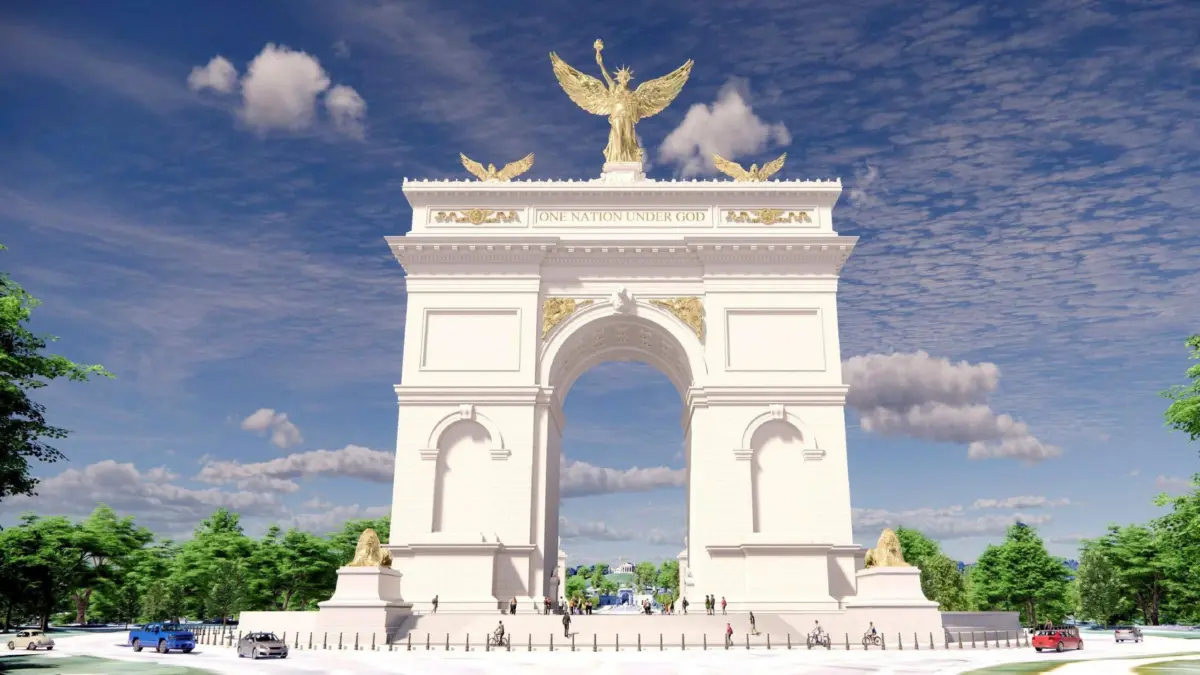
The political dynasty of the late President John F. Kennedy has launched a significant legal challenge against the Trump administration, seeking to permanently halt the construction of a massive, 250-foot-tall (76-meter) triumphal arch slated for the nation’s capital. The proposed monument, which has become the center of a growing firestorm of controversy, is intended to serve as a landmark commemoration of the United States’ upcoming 250th anniversary. However, members of the Kennedy family argue that the sheer scale and placement of the structure will irreversibly alter the landscape of one of the country’s most solemn sites.
Nine prominent members of the Kennedy family have filed a formal motion to intervene in ongoing litigation, joining forces with conservation groups and veterans’ organizations that have already been seeking to block the project. Their primary grievance concerns the potential for the structure to obstruct, shadow, and fundamentally degrade the visual and emotional integrity of the gravesites at Arlington National Cemetery, the final resting place for hundreds of thousands of American service members, including John F. Kennedy himself.
Legal Battle Intensifies as Construction Faces Scrutiny
The legal maneuver comes on the heels of a temporary reprieve granted by U.S. District Judge Tanya Chutkan. Last week, following a decision by the National Capital Planning Commission to approve the project, Judge Chutkan intervened to issue a 14-day pause on all construction activities. This brief window has provided the necessary space for the Kennedy family to formally enter the fray alongside a joint lawsuit already brought by the state of Virginia and the District of Columbia.
The plaintiffs argue that the massive monument, which some critics have colloquially dubbed the "Arc de Trump," constitutes an encroachment on historically protected sightlines. In their court filings, the family members contend that the structure would not only cast permanent shadows over the sacred grounds but would also "fundamentally alter the experience of visiting the gravesites." The motion suggests that for the descendants of the former president, the monument would create a "permanent denigration" of the area, preventing future generations from experiencing the cemetery in the way the Kennedy family—and the American public—has historically intended.
The list of plaintiffs is extensive and includes seven of the children of Robert and Ethel Kennedy, as well as their grandson, former Democratic Congressman Joe Kennedy, and Edward Kennedy Jr., the son of the late Senator Ted Kennedy. Notably, the lawsuit does not include Robert F. Kennedy Jr., who currently serves in President Trump’s cabinet as the head of the Department of Health and Human Services, highlighting a clear internal division within the broader Kennedy political orbit regarding the project.

The White House Defends the Monument
In response to the mounting legal pressure, the White House has expressed frustration, characterizing the lawsuit as an unfortunate attempt to politicize what it describes as a patriotic tribute. Officials maintain that the monument is intended to honor the sacrifices of American veterans and serve as a unifying symbol for the nation during its semiquincentennial celebrations.
"The judiciary should not be abused to politicize a structure designed to unite our nation," White House spokesman Davis R. Ingle said in a statement provided to the BBC. Ingle went on to state that the administration views the arch as a "beautiful and fitting monument" to the heroes resting at Arlington. He expressed confidence that the government’s position would be vindicated as the litigation proceeds through the court system, emphasizing that the project was designed with the intention of honoring the fallen rather than causing harm to the dignity of the cemetery.
However, the legal complaint filed by the plaintiffs raises deeper questions regarding the administrative process behind the project. The lawsuit alleges that the National Park Service and the Department of the Interior authorized the commencement of construction on November 5, 2026, without first securing the mandatory congressional approval required for such a significant public work. If the court determines that the authorization process was flawed or bypassed necessary legislative oversight, the project could face significant, if not permanent, setbacks.
A Legacy of Controversy Over Public Monuments
The proposed arch is part of a broader, stated ambition by President Trump to reshape the visual landscape of Washington, D.C. The scale of the project—at 250 feet, it would loom significantly over the surrounding area—has drawn sharp criticism from urban planners and historical preservationists who fear the impact on the capital’s carefully managed architectural and historical vistas.
This is not the first time the Trump administration’s efforts to place his name or stamp on iconic D.C. landmarks have encountered legal and administrative hurdles. Just last year, the president added his name to the Kennedy Center for the Performing Arts, a premier cultural institution named in honor of the 35th president. That move was met with immediate backlash and eventually faced a legal challenge of its own. The name remained on the center’s facade for six months before a court ruling declared the addition illegal, forcing its removal.

The current controversy over the triumphal arch mirrors these earlier tensions, pitting the president’s vision for monumental architecture against the concerns of families and organizations dedicated to preserving the existing character of the capital’s most sensitive sites. For the Kennedy family, the issue is not merely one of aesthetics, but of ensuring that the solemnity of Arlington National Cemetery remains undisturbed. They contend that the arch, if built, would overshadow the memories of those buried there, effectively altering the landscape of national mourning.
As the 14-day judicial pause continues, the nation watches to see how the court will weigh the administration’s executive prerogatives against the arguments presented by the plaintiffs regarding historical integrity and procedural oversight. The outcome of this case will likely serve as a definitive moment for the future of monument-building in the nation’s capital, setting a precedent for how the government balances modern commemorative projects with the protection of long-standing national memorials.
With the legal teams preparing their arguments, the debate remains polarized. Supporters of the arch continue to point to its grand design as a necessary tribute to the nation’s history, while opponents—led by the Kennedy family and various advocacy groups—insist that the structure’s size and location are fundamentally incompatible with the sacred, reflective atmosphere that has defined Arlington for generations. The impending court proceedings are expected to be rigorous, as the judiciary examines whether the executive branch exceeded its authority in fast-tracking a project that has sparked such profound public and familial dissent.