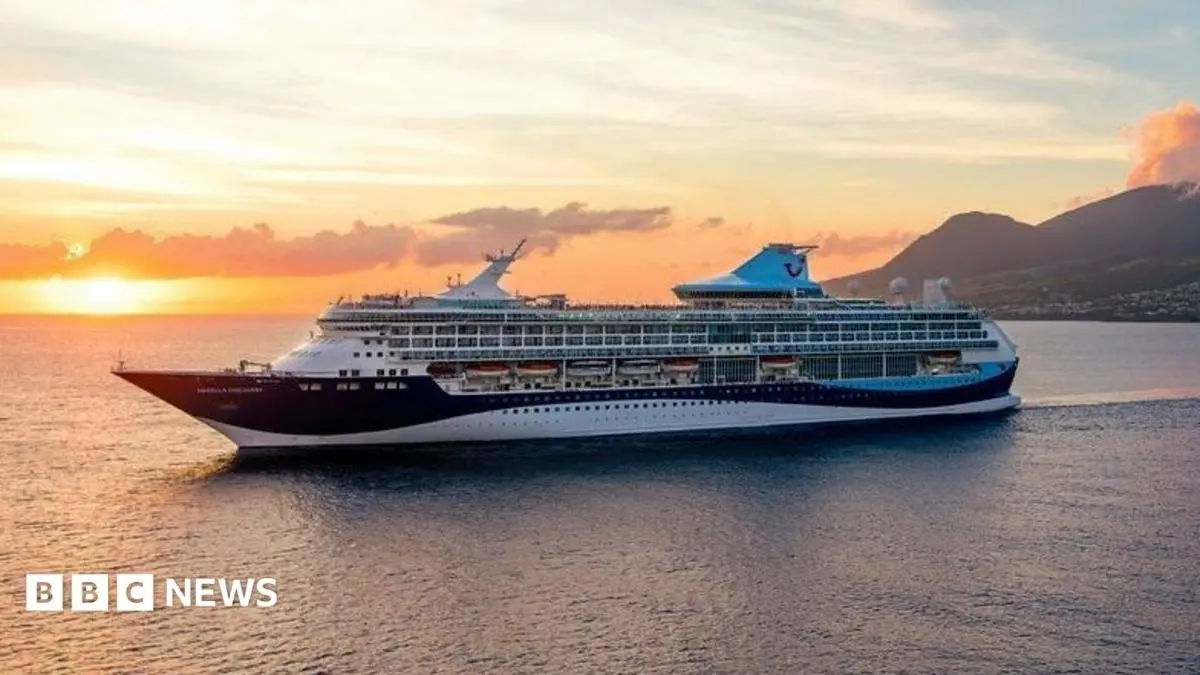
The search for a 72-year-old British woman, who is believed to have gone overboard from the Marella Voyager while it was crossing the Atlantic Ocean, has been officially suspended by the United States Coast Guard (USCG). The tragic incident, which occurred in a remote stretch of the North Atlantic, has prompted a somber response from both the cruise operator and international maritime authorities.
The woman was last seen aboard the Tui-operated vessel on Monday, November 6, as the ship made its way from Malaga toward the Caribbean. The disappearance was only realized on Tuesday, when cabin staff entered her room and discovered that her bed had remained untouched. The realization triggered an immediate and frantic search effort on board, as well as an urgent call for assistance to international maritime agencies.
A Remote Search Operation
According to the USCG, the Marella Voyager was roughly 1,400 nautical miles from Bermuda when the alarm was raised. By the time the ship’s crew had fully processed the situation and alerted the coast guard, the vessel was already approximately 500 nautical miles away from the area where it was estimated the passenger may have entered the water.
The logistical challenges of the location were immense. Given the vast, empty expanses of the North Atlantic, the search effort required a high level of international coordination. The USCG reported that it had been working in conjunction with search and rescue partners, including the Maritime Rescue Coordination Center Delgada and the United Kingdom’s Joint Rescue Coordination Centre. These agencies issued urgent maritime broadcasts to any commercial vessels operating within the vicinity, requesting that they keep a vigilant lookout for any signs of the passenger.
However, the nature of the region—often referred to as a "blue desert" by mariners due to the lack of heavy commercial traffic—proved to be a significant obstacle. The USCG confirmed that while multiple commercial vessels were contacted to consider potential search opportunities, none were in the immediate vicinity to assist.
The Decision to Call Off the Search
On Wednesday, after evaluating the conditions and the timeline of the disappearance, the USCG took the difficult decision to suspend the search. The official announcement cited a variety of factors that rendered the continuation of the operation futile, most notably the "low likelihood of survival."
The coast guard emphasized that the decision was based on a comprehensive assessment, which included the extensive size of the potential search area, the significant elapsed time between the presumed incident and the initial notification, the lack of available search assets in such a remote location, and the unfavorable sea states.
Furthermore, the operational capabilities of the Marella Voyager itself were a factor in the response. It was reported that the cruise ship did not possess the necessary fuel reserves to safely double back and return to the specific coordinates where the woman was believed to have gone overboard. Consequently, the USCG instructed the vessel to continue its planned transatlantic crossing to ensure the safety of the remaining passengers and crew, rather than attempting a maneuver that could have left the ship stranded in open water.
Chaos and Concern Aboard the Marella Voyager
For the passengers aboard the Marella Voyager, which was carrying approximately 2,000 guests and 800 crew members, the discovery of the missing passenger caused significant alarm. Reports from the Daily Mail indicated that the cruise line’s usual evening atmosphere of entertainment and leisure was abruptly shattered on Tuesday.
Passengers were instructed to abandon their dinners, drinks, and social activities as the crew initiated an emergency headcount. In a process designed to ensure the absolute accuracy of the manifest, passengers were reportedly directed to stand in lines of four while staff methodically scanned boarding cards. This verified the presence of every person currently on board, confirming that the 72-year-old woman was, indeed, missing.
The Marella Voyager had departed from Malaga on November 4, marking the start of a journey intended to culminate in the Caribbean. The ship is currently scheduled to arrive in Antigua this Friday, with subsequent stops in Dominica, before concluding its voyage in Barbados on Sunday.
Official Responses and Ongoing Support
In the wake of the news, Tui, the parent company of Marella Cruises, issued a statement expressing its deep sadness regarding the disappearance. A spokesperson for the company stated that the cruise line is fully supporting the relevant authorities with their ongoing enquiries. "Our thoughts are with the guest’s loved ones at this very difficult time," the spokesperson added.
The UK Foreign Office has also confirmed its involvement, noting that it is providing support to the family of the British national. "We are supporting the family of a British national reported missing on a cruise ship in the Atlantic Ocean and we are in touch with the relevant authorities," a Foreign Office spokesperson said in an official statement.
The incident has reignited public conversation about safety aboard large cruise liners, particularly the challenges of monitoring passengers during long-haul crossings. While cruise ships utilize sophisticated technology and security protocols, the sheer scale of the vessels and the vast, unforgiving nature of the open ocean mean that accidents involving people going overboard remain among the most difficult and distressing incidents for maritime authorities to manage.
Contextualizing the Incident
The disappearance of the passenger on the Marella Voyager comes in the same week that another maritime incident highlighted the extreme difficulty of surviving an overboard situation. In a separate event off the coast of California, a cruise ship pianist working for Royal Caribbean was miraculously found alive after falling into the Pacific Ocean.
The man was discovered by two fishermen near Catalina Island on Sunday. Officials believe he may have been treading water for as long as nine hours before being rescued. The contrast between that survival story and the tragic outcome of the Marella Voyager search serves as a grim reminder of how narrow the window for rescue can be. In the case of the woman in the North Atlantic, the time elapsed between her last being seen at a cabin door around midday on Monday and the realization of her absence on Tuesday—coupled with the remote, cold, and turbulent nature of that section of the ocean—left search teams with few options.
As the Marella Voyager continues its journey toward the Caribbean, the investigation into the circumstances of the disappearance will continue under the jurisdiction of the relevant maritime and government agencies. For the family of the missing woman, the suspension of the search marks the transition from a period of desperate hope to a period of mourning, as the international community acknowledges the stark reality of the dangers present on the high seas.