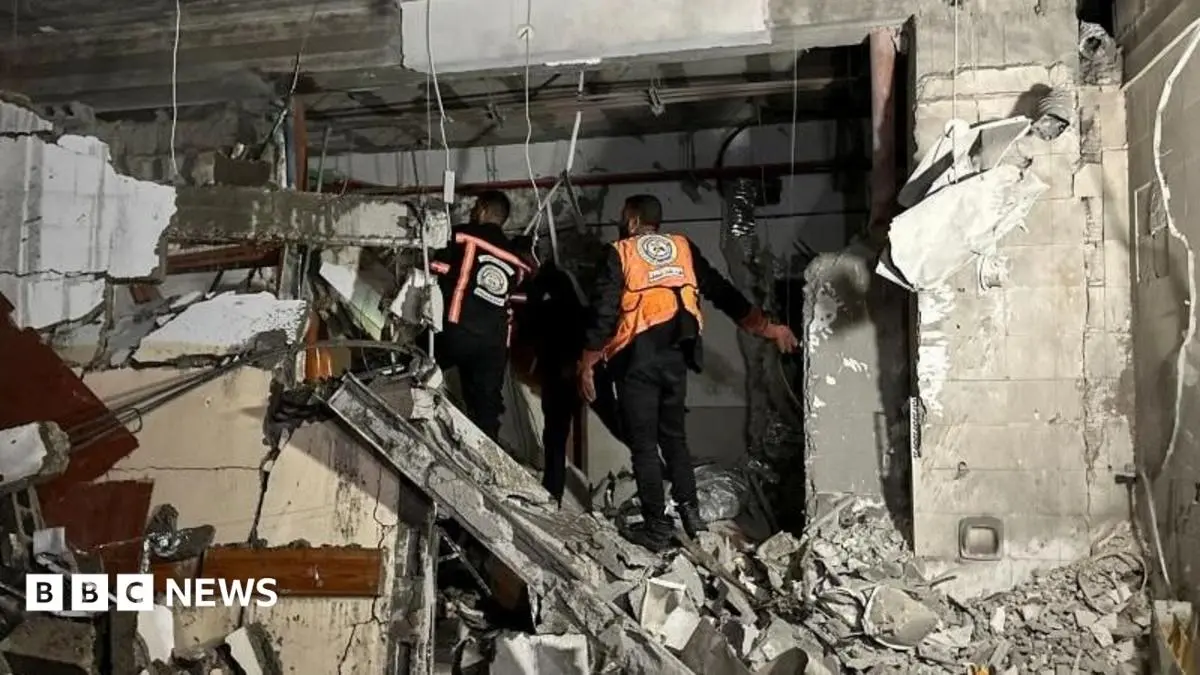
At least five people have been killed following an Israeli airstrike that struck a building within the complex of Nasser Hospital in southern Gaza, according to an official from the Hamas-run Civil Defence agency. The incident, which occurred early on Thursday, has once again brought the precarious status of medical facilities in the war-torn strip to the forefront of international concern.
Eyewitnesses on the ground reported that a single missile, launched from a warplane that had been observed briefly circling the airspace above the area, struck a building specifically housing the hospital’s surgical wards and intensive care units. In addition to the five fatalities confirmed by the Civil Defence, at least twenty others sustained injuries during the blast. Among the victims, officials reported that a surgeon was killed while on duty, marking another instance of healthcare workers being caught in the crossfire of the ongoing conflict.
The Israeli military has acknowledged the operation, stating that it specifically targeted a senior Hamas operative and other militants. According to the Israel Defense Forces (IDF) and the Israel Security Agency (ISA), these individuals were utilizing the hospital as a command center for military and terrorist activities. In a joint statement issued shortly after the strike, Israeli officials expressed a strong condemnation of Hamas, accusing the group of systematically exploiting civilian and medical infrastructure to conduct its operations.
The military further asserted that it had taken specific steps to mitigate potential harm to civilians, emphasizing that the strike was carried out using precision munitions and was informed by aerial surveillance. Despite these assertions, the strike has caused extensive damage to critical medical infrastructure. The director of the Nasser Medical Complex described the impact as a "vertical strike," noting that the intensive care and surgical departments—which serve both male and female patients—suffered severe structural damage that has hindered their ability to provide life-saving care.
Under the framework of international law, hospitals are afforded a protected status, intended to ensure that medical facilities remain sanctuaries for the wounded and sick, even in the midst of armed conflict. However, throughout the duration of the Gaza war, these facilities have been repeatedly caught in the line of fire. Israel maintains that this is a direct result of Hamas’s strategy, accusing the group of storing weapons, maintaining security control, and operating command and control rooms from within the hospital grounds. Hamas has consistently denied these allegations, maintaining that its activities are separate from the civilian healthcare system.
The logistical challenges of verifying these conflicting accounts remain immense. The BBC, like many international media outlets, is currently prevented by the Israeli government from reporting independently from inside the Gaza Strip. Consequently, the ability to independently verify the exact details of the incident—including the precise nature of the target and the identities of all those killed—remains restricted.
The recovery operations at the site were led by the Civil Defence in Gaza, an organization that operates under the Hamas-run interior ministry. Their efforts, which have been consistently hampered by the lack of resources and the ongoing security risks, have been supported by the International Committee of the Red Cross (ICRC). Earlier in the day, Civil Defence spokesperson Mahmoud Basal had provided a slightly higher casualty count to the news agency AFP, suggesting that six people had been killed, though subsequent reports consolidated the figure to at least five.
Visual evidence from the scene, circulated by local activists and shared widely on social media, depicted the aftermath of the explosion. Videos show thick smoke billowing from within the building and extensive destruction on the second floor. Images captured in the wake of the strike show medical equipment overturned and hospital beds scattered, providing a stark look at the physical toll the strike has taken on the facility’s surgical capacity.
Adding to the complexity of the narrative, local reports and social media claims have circulated suggesting that the strike may have been specifically aimed at a senior Hamas security figure who was allegedly hiding within the hospital building. While the Israeli military’s statement regarding the targeting of a senior operative aligns with these claims, the surrounding destruction of medical departments has drawn intense scrutiny regarding the proportionality of the attack and the adherence to protections afforded to hospitals under the laws of war.
Nasser Hospital, which serves as the largest medical facility in southern Gaza, has been a recurring site of military impact. The facility was hit by a double Israeli strike in August 2025, an incident that resulted in the deaths of at least 20 people, including a significant number of journalists and health workers who were present at the site. The recurrence of such events underscores the extreme vulnerability of the few remaining functional hospitals in the region.
The ongoing airstrikes continue to take place despite a ceasefire agreement that was reached in October of last year. Since that time, the violence has not abated, and according to data from Gaza’s Hamas-run health ministry—figures that the United Nations and other international observers consider generally reliable—more than 1,600 people have been killed in the period following the agreement. Both Israel and Hamas have leveled accusations against one another, claiming that the other side has repeatedly violated the terms of the ceasefire, leading to a state of perpetual instability.
The situation for the civilian population is further compounded by a deepening humanitarian crisis. Recent heavy rains have caused widespread flooding, affecting tens of thousands of tents that currently house families displaced by the conflict. The lack of adequate shelter, combined with the destruction of medical infrastructure, has left much of the population without access to basic necessities or urgent medical attention.
The broader conflict, which has left a devastating mark on the region, was triggered by the Hamas-led attack on southern Israel on October 7, 2023. During that initial assault, approximately 1,200 people were killed, and 251 individuals were taken hostage. In the subsequent months, the scale of the war has resulted in a massive loss of life. According to the most recent figures provided by the health ministry in Gaza, the total death toll since the start of the war has risen to more than 74,645 people.
As the recovery efforts continue at Nasser Hospital, the incident serves as a grim reminder of the challenges inherent in a conflict where the lines between civilian infrastructure and military operations are deeply contested. For the medical staff attempting to operate in the ruins of the surgical ward, the priority remains the stabilization of those injured in the blast, even as the hospital itself remains under threat from the ongoing hostilities. The international community continues to monitor the situation, though the lack of independent access to the Gaza Strip remains a significant hurdle in reaching a comprehensive understanding of the tactical and humanitarian realities on the ground.