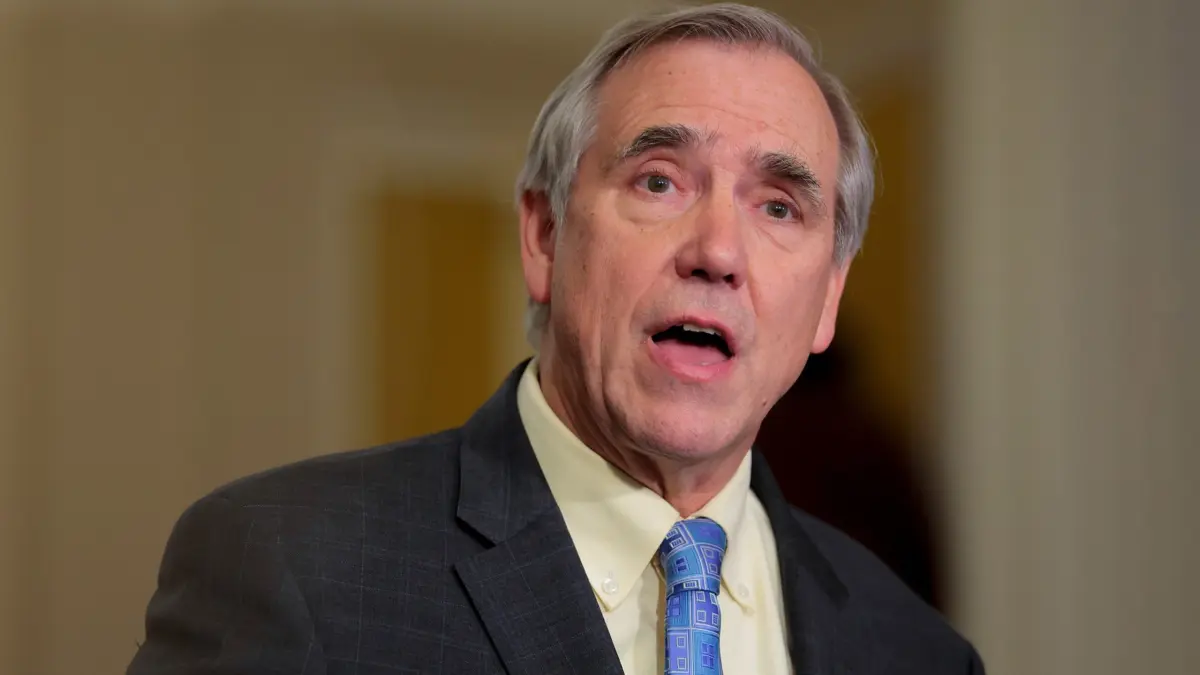
A new piece of federal legislation introduced by Sen. Jeff Merkley aims to tackle the mounting barriers to homeownership by providing prospective buyers with up to $50,000 in government matching funds.
The proposal, known as the Homeownership Promise Act, was introduced by the Oregon Democrat and is cosponsored by fellow Oregon Democratic Sen. Ron Wyden. Under the framework of the bill, Americans would be permitted to open specialized savings vehicles called Homeownership Promise Accounts. For every dollar an individual deposits into these accounts, the federal government would match the contribution at a 5-to-1 ratio, capping the federal assistance at $50,000.
The policy is designed to address a stark reality in the modern American housing market: homeownership has slipped out of reach for a growing number of young people and working families.
"Working families should be able to afford a decent home in a decent community," Merkley said in a statement regarding the legislation. "For millions of young Americans, homeownership remains further out of reach than ever before, keeping them from establishing the foundation that has enabled middle-class families to build equity for generations."
Merkley formulated the bill after reviewing data highlighting how the profile of the typical first-time homebuyer has shifted dramatically over the past decade. According to a 2025 report published by the National Association of Realtors, the median age of a first-time homebuyer has climbed to 40 years old. That figure represents a substantial increase from just a decade prior, when the median age for entering the housing market for the first time sat at 31 in 2015.
While the Homeownership Promise Act does not impose an income requirement to qualify for an account, it does establish several specific stipulations to ensure the funds are used as intended. To be eligible, participants must be genuine first-time homebuyers purchasing a principal residence. They are also required to complete HUD-approved housing counseling before utilizing the funds.
Furthermore, the legislation places restrictions on the types of properties that can be purchased using the matched savings. The accounts can only be deployed for homes that do not exceed the median single-family purchase price in the given local area. To support local financial infrastructure, the proposal also mandates that these savings accounts must be opened through community development institutions, such as designated community development banks or local credit unions.
The introduction of Merkley’s bill marks the latest in a series of legislative efforts by progressive lawmakers aimed at injecting direct financial support into the housing market to help sidelined buyers.
In 2023, California Democratic Rep. Maxine Waters introduced the Downpayment Toward Equity Act in Congress, though that measure ultimately stalled. The ambitious proposal pledged $100 billion in direct financial assistance to help first-time, first-generation homebuyers secure their initial properties. Waters reintroduced the legislation in 2025 alongside fellow Democratic Reps. Al Green and Sylvia Garcia of Texas, as well as Ayanna Pressley of Massachusetts, but the bill has similarly failed to move forward in the legislative process.
The debate over federal down payment assistance also played a prominent role on the national stage during the 2024 presidential election cycle. Democratic presidential nominee Kamala Harris proposed a comparable policy that would have provided up to 4 million first-time homebuyers with $25,000 in direct down payment assistance distributed over a four-year period.
At the time, Harris’ proposal drew sharp scrutiny from various economists and housing experts who warned that injecting billions of dollars in demand-side subsidies could backfire. Critics argued that such measures would stoke intense competition in an already constrained housing market, ultimately driving home prices even higher and canceling out the benefits of the financial aid.
Ken Johnson, a professor of finance and the Walker Chair of Real Estate at the University of Mississippi, cautioned at the time that offering widespread, broad-based down payment assistance would act like "throwing gasoline on an already on-fire housing market."
"The real symptom of what’s going on is that we’re short in supply. We’re dangerously short in supply. We just cannot build homes fast enough," Johnson said, emphasizing the structural imbalances plaguing the market. "You can’t make it easier for people to buy homes, and offer easier credit to buy homes, when you have the housing market so overpriced."
Given the current composition of Washington lawmakers, political analysts view the immediate prospects of Merkley’s bill with skepticism. It is widely considered doubtful that the Homeownership Promise Act will advance in a Republican-controlled Congress. However, political strategists note that the proposal could potentially gain legislative traction following the midterm elections if the balance of power in Congress shifts.
Housing policy has increasingly become a central battleground for both political parties seeking to address voter anxieties ahead of the midterms. A national poll conducted in May by the Bipartisan Policy Center underscored the urgency of the issue, finding that 79% of registered voters viewed housing costs as either an extremely or very important issue facing the country.
In June, Congress managed to pass the 21st Century Road to Housing Act, despite receiving expression of concerns from President Donald Trump. The bipartisan-backed act is intended to stimulate the domestic housing supply while placing stricter regulations and limitations on corporate ownership of single-family residential properties.
Meanwhile, the executive branch’s approach to the affordability crisis has centered largely on broader macroeconomic conditions, specifically interest rates. During the first half of his second term, Trump has focused his housing message on pointing to a decline in mortgage rates from the roughly 7% levels recorded when he took office, watching them edge back down toward the 6% range at various points.
However, external geopolitical and economic pressures have complicated those trends. Following the outbreak of conflict with Iran in late February, rising inflationary pressures have pushed mortgage rates back upward toward the 7% threshold in recent weeks, marking the highest borrowing costs recorded since October 2022 and keeping homeownership pressures acute for millions of Americans.