"Whoever wins AI, WINS!"
US President Donald Trump has been characteristically blunt about his administration’s AI ambitions, framing the rapid development of artificial intelligence not merely as a technological breakthrough, but as the defining geopolitical contest of the century. Central to this vision is his identification of China as the United States’ primary adversary in the race for digital and cognitive supremacy.
While Chinese leader Xi Jinping has maintained a more measured public posture, avoiding the combative rhetoric often employed by the White House, analysts suggest that Beijing views the stakes as equally existential. "China very much sees it as a race; they very much think China should be the leading force in AI—they see AI as a power maximiser," explains Rebecca Arcesati, an analyst at the Mercator Institute for China Studies.
For observers of global affairs, this rivalry is not new. AI has been a cornerstone of China’s long-term industrial and technological strategy for over a decade. Whether or not President Xi emphasizes the technology in every speech, the state-directed investment and structural integration of AI into China’s economy signal a clear intent to rival, if not surpass, American capabilities.
For President Trump, the imperative to beat China to AI supremacy is a singular focus that outweighs the concerns regarding the societal risks of the technology—risks that he has famously dismissed as a "hoax." Conversely, Beijing has consistently pushed back against what it characterizes as "narratives of threat" from Washington, arguing that framing the development of AI as a zero-sum conflict only serves to hinder global governance and stalls potential breakthroughs that could benefit humanity at large.

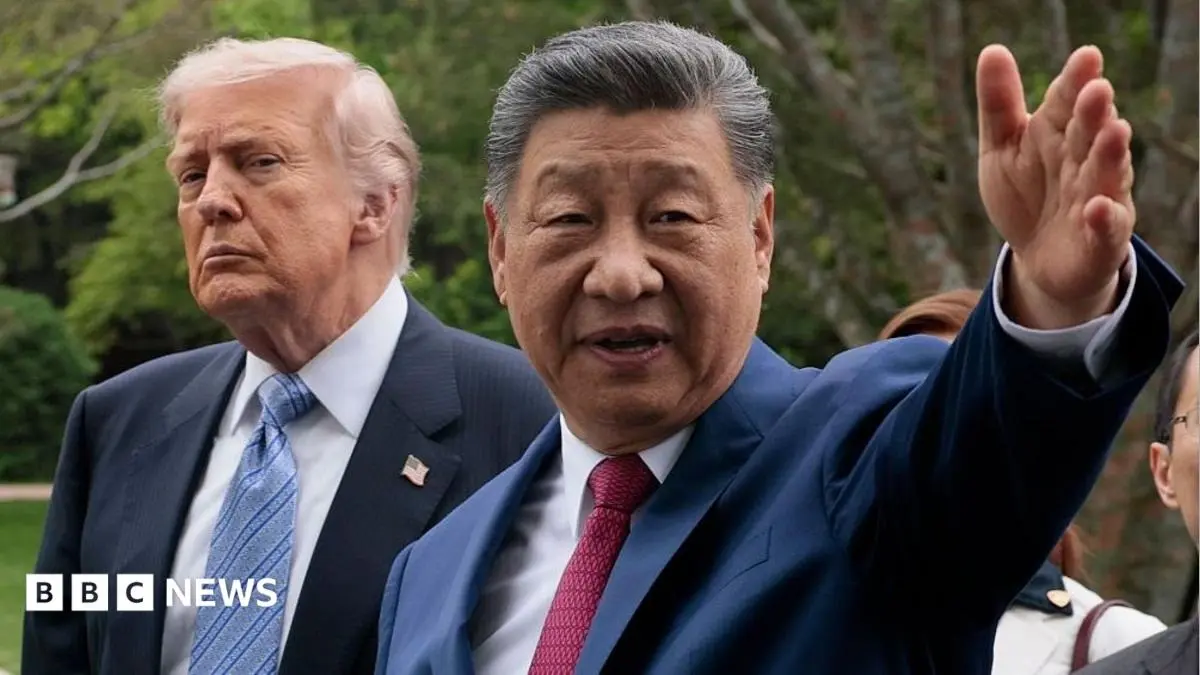
As the two presidents prepare to sit down for high-stakes discussions this Thursday, artificial intelligence stands at the top of the agenda. The decisions reached in this meeting will likely echo across the global economy, influencing everything from international security protocols to the pace of innovation in the private sector.
Is the US in the Lead?
Determining which nation holds the "lead" in the AI race is a complex task that depends heavily on the metrics applied. By most conventional measures, the United States currently maintains an edge in the development of "frontier models"—the most sophisticated, high-performance systems capable of complex reasoning and multi-modal tasks. Firms such as OpenAI, Google, and Anthropic continue to produce the benchmarks against which the rest of the world is measured.
However, the gap is narrowing. In February 2025, a model released by the Chinese firm DeepSeek briefly matched the performance of the leading US systems, signaling that China’s research capabilities are rapidly evolving. According to the 2026 AI Index Report from Stanford University, as of March 2026, the top American models led their Chinese counterparts by a margin of only 2.7%.
This American advantage is fueled by staggering levels of private capital investment. The US ecosystem allows "frontier labs" to burn through billions of dollars in pursuit of the computational infrastructure required to train next-generation models. Furthermore, the US stock market is currently undergoing a massive expansion, with market valuations buoyed by the projected profitability and transformative potential of AI firms.
Yet, the US government has actively sought to impede China’s progress through aggressive policy, most notably through sweeping export controls that prevent US companies from selling advanced microchips to Chinese firms. These high-end chips are the essential building blocks for training cutting-edge models, and their absence has created a significant hurdle for Chinese developers.

China’s Strategic Advantage
Despite the restrictive chip environment, the pace of innovation in China remains relentless. New models are emerging on a monthly basis in both nations, leading many experts to question whether the concept of "winning" the AI race is even coherent. There is no clear finish line, and the industry’s ultimate goal—Artificial General Intelligence (AGI), which would theoretically possess the ability to learn and reason at or above human levels—remains a moving target.
Where China’s strategy diverges significantly from that of the US is in its approach to deployment and accessibility. While US firms primarily focus on proprietary models—often walled-off behind paid subscriptions or exclusive platforms—the Chinese industry has made significant strides in "open weight" models. These systems are downloadable and adaptable, functioning similarly to open-source software.
Models such as Moonshot AI’s Kimi K3 have gained significant traction both within China and in international markets. These models offer performance levels that rival the US frontier systems while remaining freely available for developers to tweak and integrate. Lizzi Lee, an analyst at the Asia Society Policy Institute, suggests that this strategy reflects a different end goal. "AI isn’t the moon landing," she notes. "The US may lead at the frontier, while China could still gain enormous economic and geopolitical leverage by making capable AI cheap, open, and ubiquitous."
Beyond software, China holds a distinct advantage in infrastructure. AI development is incredibly energy-intensive, and China is uniquely positioned to manage the massive electricity demands of large-scale data centers at a lower cost than its Western counterparts.
Furthermore, China’s integration of AI into physical industry is unparalleled. The International Federation of Robotics estimates that more than two million robots are currently operating in Chinese factories. Perhaps more significantly, China has emerged as the world’s leading manufacturer of humanoid robots, accounting for over 90% of global shipments in the first half of 2026. This physical presence, combined with the "remarkable resilience" of its developers in overcoming chip shortages, suggests that China is building a deep, foundational strength that could prove as vital as the performance of a single AI model.

US officials have occasionally alleged that Chinese developers closed the technological gap by utilizing "distillation," a technique that allows smaller, less advanced models to learn from the outputs of more powerful ones. Beijing, in response, maintains that its progress is a result of its "vision of extensive consultation and joint contribution for shared benefit."
Differing Approaches to Safety
The competition between the US and China is compounded by a fundamental disagreement regarding the risks associated with AI. In the United States, there is a vocal segment of the industry warning of "existential risks"—the potential for AI to grow beyond human control. President Trump, however, has largely dismissed these warnings, arguing that the US has sufficient regulatory frameworks in place and that the only "guardrails" required are the leadership of a "high IQ" president. His administration has prioritized innovation, aiming to reduce regulation to ensure American labs remain ahead.
China’s approach is markedly different. While Beijing is less concerned with the "existential" or sci-fi risks debated in Silicon Valley, it is hyper-focused on the potential for AI to disrupt domestic stability, facilitate cyber warfare, or be used for unauthorized purposes. Consequently, the Chinese government has taken a more centralized, interventionist approach. Xi Jinping has repeatedly urged leadership to ensure that AI remains "under human control."
According to Jayant Dave, an information security officer at Check Point Software Technologies, China has adopted a "relatively cautious and centrally-coordinated approach." This includes the early introduction of guidelines for data usage and algorithms. While these guidelines are not always legally binding, they set clear expectations for developers while still providing enough room for industrial innovation, according to Jonathan Sim, an AI ethics lecturer at the National University of Singapore.
Will They Cooperate?
Despite the obvious dangers associated with advanced AI, the path toward international cooperation remains obscured by the intense rivalry between the two nations. Historically, the US and China have managed to coordinate on existential threats, such as nuclear non-proliferation, but that cooperation was predicated on a shared understanding of the risk. With AI, that consensus is currently missing.

"Washington worries about capability escaping control. Beijing worries about capability threatening domestic stability," Dave explains.
President Trump has consistently rejected calls for a coordinated global slowdown in AI development, fearing that such a pause would simply allow China to catch up. Nevertheless, there are glimmers of potential dialogue. In the lead-up to the summit, US Treasury Secretary Scott Bessent and Chinese Vice Premier He Lifeng have held discussions regarding a potential "notification mechanism" for serious AI incidents—a move aimed at preventing accidental escalation.
While the tone of the Trump administration’s rhetoric toward Beijing has been notably antagonistic in recent weeks, the inclusion of AI on the summit agenda is seen by many as a positive development. Policy analyst Leia Wang from the Carnegie Endowment for International Peace suggests that the primary danger is the perpetuation of an "unhealthy version of the race narrative." As the two leaders meet, the world waits to see if they can move beyond the language of conflict and establish the foundational trust necessary to manage the most powerful technology of the modern age.