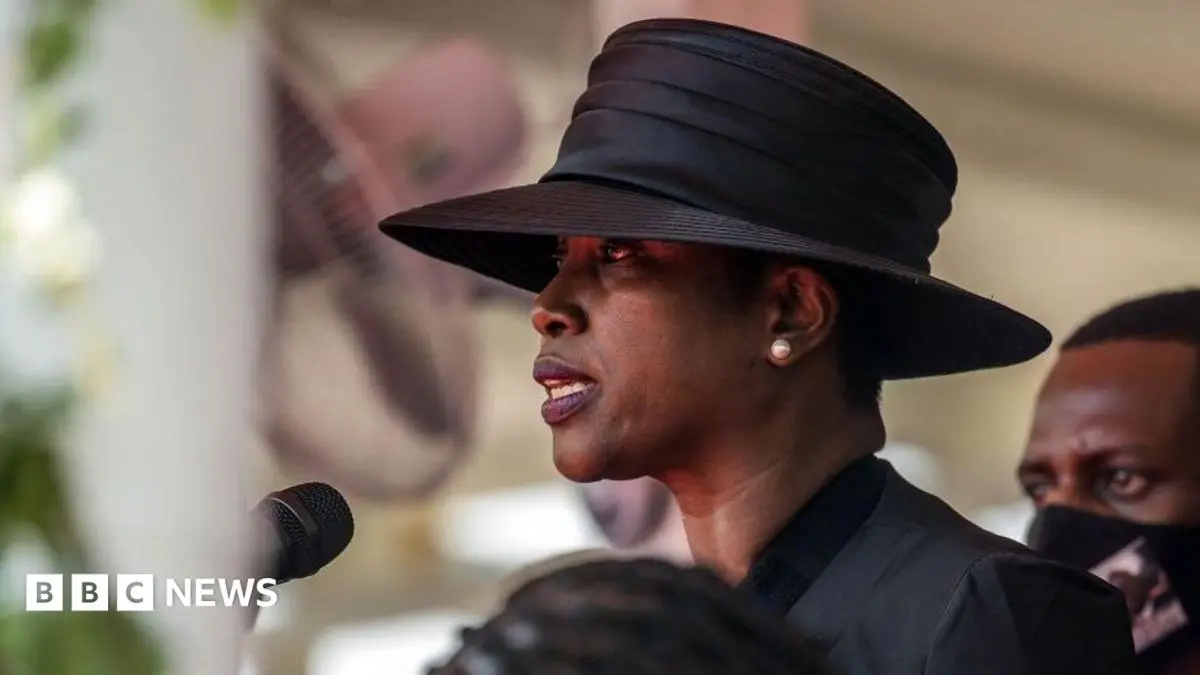
Martine Moïse, the widow of the late Haitian President Jovenel Moïse, has officially registered as a candidate for the Caribbean nation’s upcoming presidential elections. The move, which has sent ripples through Haiti’s fragile political landscape, was confirmed on Sunday via the official website of the national electoral council. Her entry into the race marks a significant and controversial chapter in a country still reeling from the violent assassination of her husband more than three years ago.
The political environment into which Mrs. Moïse is stepping is defined by profound instability. Haiti has not held a presidential election since 2016, a fact that has contributed to a deep-seated crisis of legitimacy for the nation’s governance. Originally scheduled for December of this year, the elections were postponed until July due to the overwhelming insecurity that has crippled the country, driven by rampant gang violence and a total collapse of public order in many regions, particularly in the capital, Port-au-Prince.
While Martine Moïse has yet to offer a formal public comment regarding her specific platform or motivations for seeking the presidency, her recent digital footprint provides a window into her messaging. Last week, she took to the social media platform X, formerly known as Twitter, to express a desire for national renewal. "Haiti will rise again on its own two feet, because politics needs to be done differently," she wrote, signaling an intent to distance her campaign from the traditional political machinery that has dominated the country for decades.
A Crowded and Contentious Field
Mrs. Moïse is far from the only figure vying for the top office. The electoral council’s registration lists reveal a crowded field of 33 candidates, reflecting the high stakes and the fragmented nature of Haitian politics. Among those who have registered are several heavyweights of the political establishment, including former presidents Michel Martelly and Jocelerme Privert. Also seeking the presidency are former Prime Minister Claude Joseph and former Foreign Minister Dominique Dupuy. This diverse list of contenders suggests that despite the pervasive violence, the political class is positioning itself for a transition that many hope will restore some semblance of constitutional order.
The context of this election cannot be separated from the trauma of July 2021. President Jovenel Moïse, who had led Haiti since 2017, was assassinated in the middle of the night at his private residence in the Pèlerin 5 neighborhood of Port-au-Prince. The audacity of the attack—carried out by a group of heavily armed individuals, predominantly identified as Colombian mercenaries—left the nation in shock. The ease with which the assailants breached the security of the presidential residence raised immediate, harrowing questions about the depth of corruption and the fragility of the state’s security apparatus.
Martine Moïse herself was a victim of that night’s brutality. She suffered multiple, life-threatening gunshot wounds during the raid and was subsequently airlifted to a hospital in Florida for emergency treatment. Her recovery was followed by a complicated legal journey; in 2024, she was formally charged in connection with the assassination investigation, an indictment that stunned many observers. However, in a major legal development, those charges were overturned last year, clearing the way for her current political aspirations.
The Long Shadow of the Assassination
The investigation into the assassination remains one of the most significant and complex legal processes in Haitian history. To date, thirty suspects have been indicted in connection with the killing. The international dimension of the case became particularly clear in September, when 18 individuals were transferred from Haitian custody to Florida to face trial in the United States. This move underscored the belief that the conspiracy to murder the president involved a transnational network, and it highlighted the limitations of the Haitian judicial system, which has struggled to process the case impartially amidst the country’s broader security collapse.
For the average Haitian, the events of July 2021 serve as a grim benchmark for the decline of their country. Since the president’s death, the security situation has deteriorated rapidly, with criminal gangs seizing control of large swaths of the capital and terrorizing the population. The state has struggled to maintain control, leading to a humanitarian crisis that has seen thousands displaced, businesses shuttered, and public services ground to a halt.
The data provided by the UN Integrated Office in Haiti paints a harrowing picture of the current state of the nation. Between April and June of this year alone, at least 1,408 people were killed and 656 were injured as a direct result of gang-related violence. These statistics, while staggering, only begin to capture the day-to-day reality of life in Port-au-Prince, where kidnappings, extortion, and indiscriminate violence have become a common occurrence.
Challenges to the Electoral Process
The path to the July elections is fraught with uncertainty. The postponement from December was a reflection of the reality on the ground; holding a secure, transparent, and inclusive election in a country where gangs control the streets is a monumental challenge. International observers and domestic civil society groups have expressed deep concerns about whether the current electoral council can ensure that voters can cast their ballots without fear of intimidation or coercion.
Moreover, the candidacy of Martine Moïse brings its own set of complexities. As the widow of the assassinated leader, she occupies a unique, albeit polarizing, position in the public consciousness. To some, she is a symbol of resilience and a continuation of the late president’s vision; to others, her involvement in the political process is a reminder of the unfinished business and the unresolved mysteries surrounding her husband’s tenure and death. Her supporters point to her survival as a testament to her strength, while her critics argue that her candidacy could exacerbate existing tensions in an already volatile environment.
The registration of former presidents and high-level officials like Claude Joseph and Dominique Dupuy indicates that the political elite remains deeply invested in the outcome of the race. This underscores a broader struggle for the soul of the country. With 33 candidates currently on the ballot, the electoral field is highly diluted, suggesting that any path to victory will require complex coalition-building and an ability to navigate a deeply divided electorate.
As the months progress toward the rescheduled July date, the eyes of the international community will remain fixed on Port-au-Prince. The upcoming election is widely viewed as a pivotal moment for Haiti—a potential opportunity to pivot away from the cycle of violence and instability that has defined the post-2021 era. Yet, the history of the last three years suggests that the road to stability will be anything but straightforward.
The registration of candidates is only the first step in a long and arduous process. Ensuring that the democratic institutions can function under the current pressure will require not only political will from the candidates themselves but also sustained support and monitoring from the global community. For now, the people of Haiti are left to observe a familiar cast of political figures attempting to claim the mantle of leadership, while the daily struggle for security and survival continues unabated across the nation.
Whether the entry of Martine Moïse into the race acts as a catalyst for a new political direction or adds to the existing friction remains to be seen. What is clear is that the upcoming election will be a defining moment for a nation that has endured years of profound trauma and political upheaval. The promise that "Haiti will rise again" resonates deeply with a populace exhausted by violence, but whether the current political framework can deliver on that promise remains the central, unanswered question of this campaign. As the campaign period unfolds, the debates, the rhetoric, and the reactions from the Haitian public will likely set the tone for a summer that could either mark the beginning of a recovery or a continuation of the status quo.