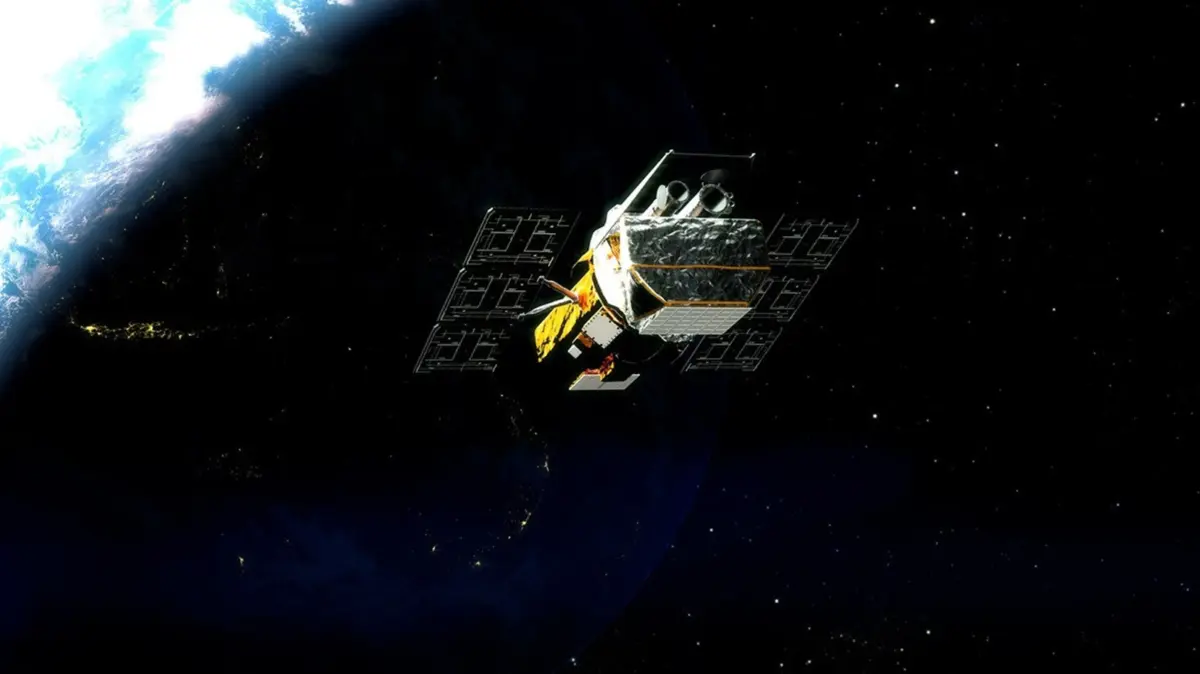
On Wednesday, NASA’s Neil Gehrels Swift Observatory—a veteran space telescope that has operated in orbit since 2004—finally re-entered Earth’s atmosphere above Indonesia. However, the long-serving spacecraft’s descent concluded with a human casualty risk factor calculated at five times greater than the strict limits mandated by NASA technical standards.
The precise chain of events and technical factors leading to this elevated risk profile remain under scrutiny. Alise Fisher, a NASA Public Affairs Specialist, addressed the discrepancy in a statement to journalists, noting that in the lead-up to the observatory’s November 20, 2004, launch, the agency determined the anticipated risk was fully consistent with mission requirements and aligned with established internal agency policy.
Somewhere between the initial launch two decades ago and the final uncontrolled plunge back toward Earth, that risk assessment shifted significantly. Experts suggest it is unlikely that any single individual made a specific tactical or administrative mistake; rather, the situation underscores the harsh realities of orbital mechanics and the inherent unpredictability of aerospace operations. Nevertheless, the event highlights a sobering truth for observers on the ground: humanity’s primary defense against the descending detritus of our astronomical ambitions often relies on pure statistical luck.
The Swift observatory’s journey back to Earth was precipitated by the exhaustion of its onboard fuel reserves, rendering it incapable of maintaining a stable orbit or executing trajectory adjustments to ensure a controlled descent. In a notable effort to avert this outcome, NASA previously allocated $30 million to a private aerospace company in an unprecedented attempt to rescue the observatory. The ambitious plan involved dispatching a secondary satellite to rendezvous with Swift, latch onto the aging telescope, and elevate it back into a safe, sustainable orbit. Unfortunately, the rescue satellite itself suffered critical operational failures, ultimately sealing Swift’s fate and leaving it on an unchangeable collision course with the atmosphere.
Shifting Odds of Risk from Above
In formal aerospace terminology, the observatory suffered an uncontrolled reentry. This designation indicates that the spacecraft possessed no remaining propulsion capabilities, leaving it entirely at the mercy of gravitational pull and atmospheric drag as it plummeted downward from space.
NASA maintains rigorous internal safety requirements governing such events. These guidelines, most recently updated in 2021 but tracing their lineage back to 2001, stipulate that for uncontrolled reentries, the statistical risk of human casualty resulting from surviving debris must remain strictly less than 0.0001, commonly expressed as a one-in-10,000 probability.
Within the broader aerospace regulatory landscape, there is currently no universal international law or binding domestic legislation mandating that defunct satellites must execute controlled de-orbits designed to avoid populated areas or landmasses entirely. Consequently, humanity’s primary shield against falling space debris is built on statistical probability.
The one-in-10,000 threshold represents the exact point at which NASA has historically deemed the probability of injury to be acceptable for agency missions. To put that figure into historical perspective, approximately 10,000 individual satellites have de-orbited throughout the entire history of space exploration. Statistically speaking, cumulative probability suggests that humanity is increasingly due for an unfavorable outcome. Furthermore, that baseline calculation was established long before the dawn of the modern megaconstellation era, which has seen commercial operators launch tens of thousands of new satellites into low-Earth orbit every few years.
In the case of the Swift observatory, however, NASA handled the public communication of the reentry parameters with notable caution. Initially, the agency did not release a dedicated risk assessment regarding the impending reentry—an omission that deviated from standard transparency practices for high-profile spacecraft. Later, tucked inside the middle of a routine, longer-form operational announcement, the agency disclosed that the actual calculated risk of human casualties associated with Swift’s descent was approximately one in 2,100. This figure represented a hazard level of human injury or death running roughly five times higher than the agency’s own maximum allowable threshold.
The Odds Will Give Out Eventually
Fortunately, when the debris field finally descended over Indonesia on Wednesday, the statistical dice roll resolved in humanity’s favor. As of the immediate aftermath, there have been no confirmed reports of any individuals being struck by surviving space debris from the observatory.
During a typical atmospheric reentry, the intense heat and frictional forces cause the vast majority of a spacecraft’s mass to burn up completely. The primary engineering concern during these events centers on dense, heat-resistant components that are capable of surviving the fiery descent to reach the Earth’s surface. For Swift, those resilient elements were expected to include components such as the primary telescope lens and the spacecraft’s reaction wheels. If any of those substantial fragments survived the plunge and made it to the surface, they appear to have landed harmlessly in uninhabited terrain or open water without encountering anyone on the ground.
While this outcome is a relief, relying indefinitely on favorable probabilities is not a sustainable long-term strategy for space administration. As commercial space activity intensifies and thousands of retired satellites begin de-orbiting on an annual basis amidst the new megaconstellation era, aerospace experts argue that formal legal frameworks and stricter regulations must be enacted to manage orbital debris.
Adopting such formal management would likely necessitate sweeping policy changes, such as requiring mandatory controlled reentries for all qualifying spacecraft. Under this approach, operators would be legally bound to preserve a sufficient reserve of onboard propellant, enabling engineers to command the satellite to maneuver toward a designated, safe disposal corridor located deep within the remote ocean.
The alternative approach, which has been pursued by commercial entities such as SpaceX, involves engineering satellites from specialized materials designed to vaporize and burn up entirely during atmospheric reentry. However, this strategy introduces an entirely new set of environmental variables, raising questions about the potential chemical and physical effects that millions of pounds of vaporized metal might have on the upper layers of Earth’s atmosphere. Atmospheric scientists currently lack definitive answers to these questions, largely because there was previously no operational precedent or scientific necessity to evaluate the atmospheric impact of burning megaconstellations. Today, the long-term health and stability of our planet’s atmosphere may ultimately depend on finding those answers.
As low-Earth orbit becomes increasingly congested, a growing volume of hardware will inevitably transition from active service to uncontrolled descent. Up to this point, the comforting buffer of statistical probability has successfully insulated humanity from tragedy. Yet, probability theory dictates that an improbable event will eventually occur given enough trials, especially if a portion of those events carries a risk profile significantly higher than originally intended.