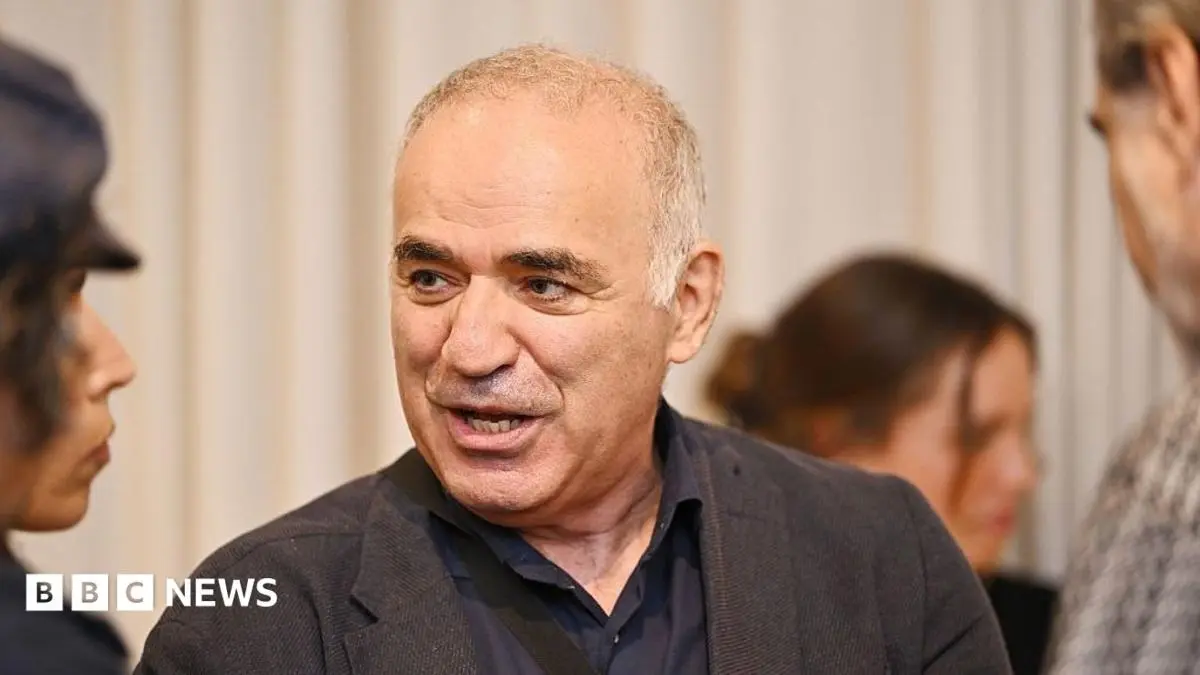
Garry Kasparov, the legendary former world chess champion and one of the most prominent voices of the Russian political opposition, has revealed that he was formally warned by security services in both the United States and Lithuania that his life was in imminent danger. The chilling disclosure, which highlights the intensifying reach of Russian state-backed operations against dissidents abroad, marks a significant escalation in the ongoing shadow conflict between the Kremlin and those who have fled its borders.
Kasparov, who has spent years as a fierce critic of Russian President Vladimir Putin, stated that he was one of two prominent dissidents contacted by intelligence officials and advised to take immediate and specific security precautions. He confirmed that he has adhered to those instructions. The revelation follows a high-profile move by the United States Justice Department earlier this month, which unsealed an indictment charging five individuals allegedly operating within a Kremlin-linked network. These suspects are accused of plotting a series of targeted attacks and murders across several countries, including the United States, with a specific focus on Russian dissidents and defectors living in exile.
In a recent piece published in his own publication, The Next Move, Kasparov clarified that while he was not explicitly informed that he and his fellow Free Russia Forum co-founder, Ivan Tyutrin, were the primary targets of a specific, imminent hit, both men were given stern warnings regarding their personal safety. The atmosphere of heightened threat has been confirmed by other international reports. The Spanish newspaper El Mundo reported that it had obtained information confirming that Kasparov, alongside another outspoken Russian opposition figure, Ilya Ponomarev, had been formally alerted by U.S. authorities over the summer regarding the existence of a sophisticated plot against them. According to sources close to the chess grandmaster, the threats were deemed serious enough that Kasparov was placed under enhanced security protection for the first time since he established his residence in the United States.
For Kasparov, the psychological weight of such a warning is significant, yet he remains resolute in his opposition to the Kremlin. "I will not stop and I will not hide, even if I thought it was possible to do so," he wrote in a defiant statement accompanying the news of the threat. "My family and I will not truly be safe as long as Putin is in power in Russia—a circumstance shared by millions."
The trajectory of Kasparov’s life—from the world’s greatest chess player to a political exile—serves as a backdrop to the current crisis. In 2005, at the height of his influence in the sports world, Kasparov made the decision to retire from competitive chess to devote his energy to political activism. He became a founding member of several movements designed to openly oppose the centralization of power in the Kremlin. By 2013, faced with mounting pressure and the narrowing of democratic space, he fled Russia. He has not returned to his homeland since.
The Russian state’s reaction to his advocacy has been systematic and severe. Following the full-scale invasion of Ukraine in 2022, the Russian government formally classified Kasparov as a "foreign agent," a legal designation often used to stigmatize and isolate critics. In 2024, the escalation continued as the Russian state added him to an official list of "terrorists and extremists." Kasparov has consistently and publicly rejected both categorizations, viewing them as badge-of-honor efforts by the regime to silence dissent.
The second figure identified as a target, Ilya Ponomarev, occupies a unique position in the history of the Russian opposition. Ponomarev holds the distinction of being the only member of the Russian Duma to vote against the illegal annexation of Crimea in 2014. Following that vote, he was forced into exile, eventually settling in Ukraine. When asked by the Moscow Times to comment on the reports of a plot against his life, Ponomarev declined to confirm or deny the specific details of the warning he received. However, he did note that the current allegations represent "a new level of escalation" in the methods employed by the Russian state to neutralize its enemies abroad.
The U.S. Justice Department’s indictment provides a rare, granular look into the mechanisms of these operations. Federal prosecutors state that a network of individuals acting on behalf of Russian intelligence services has been active since at least 2024. This organization, referred to in legal documents as the "RIS Network," is alleged to have been conspiring to conduct attacks and assassinations against Russian defectors and dissidents worldwide.
Assistant Attorney General for National Security John A. Eisenberg, in announcing the charges, described the scope of the operation as a "global assassination network" that had successfully reached into the United States. According to the Justice Department, the network’s reach was not limited to professional operatives; the group was actively attempting to recruit both U.S. citizens and foreign nationals to carry out killings on behalf of the Kremlin.
The five individuals named in the indictment as the primary organizers of the plots are Yuri Khrameev, Kirill Khrameev, Oemis Romagoza Durruthy, Yaidel Delgado Suarez, and Angel Eduardo Castro. As of the latest update from federal authorities, all five suspects remain at large, adding a layer of uncertainty and danger for those identified as potential targets.
The Kremlin’s official reaction to the indictment was one of standard dismissal. Shortly after the U.S. government unsealed the charges, Kremlin spokesman Dmitry Peskov addressed the media. He stated that he would not offer any comment on the serious allegations until he had seen "any credible evidence" or "tangible facts" to support the claims. The Russian government has historically denied involvement in the extraterritorial targeting of its citizens, despite numerous reports from international intelligence agencies suggesting otherwise.
The situation remains fluid, as authorities continue to monitor the activities of the alleged network. For figures like Kasparov, the threat is a stark reminder of the risks inherent in challenging a state apparatus that has shown a willingness to extend its reach far beyond its own borders. As the legal proceedings in the United States move forward, the focus remains on the safety of those on the front lines of the Russian opposition, many of whom are now navigating a world where the borders of their home country no longer guarantee the safety of their political exile.
The case underscores a growing trend in international security, where dissidents who have sought refuge in Western democracies find themselves under the constant surveillance and threat of state-sponsored violence. For the international community, the indictment is a test of how effectively law enforcement agencies can track, identify, and dismantle the sophisticated, decentralized networks that modern autocracies use to silence their critics. For those like Kasparov, however, the reality is much more personal; it is a daily assessment of risk in a life dedicated to a cause he believes is far larger than his own survival. Despite the warnings and the enhanced protection, the former chess champion remains a vocal presence, signaling that for him, the game against the Kremlin is far from over.