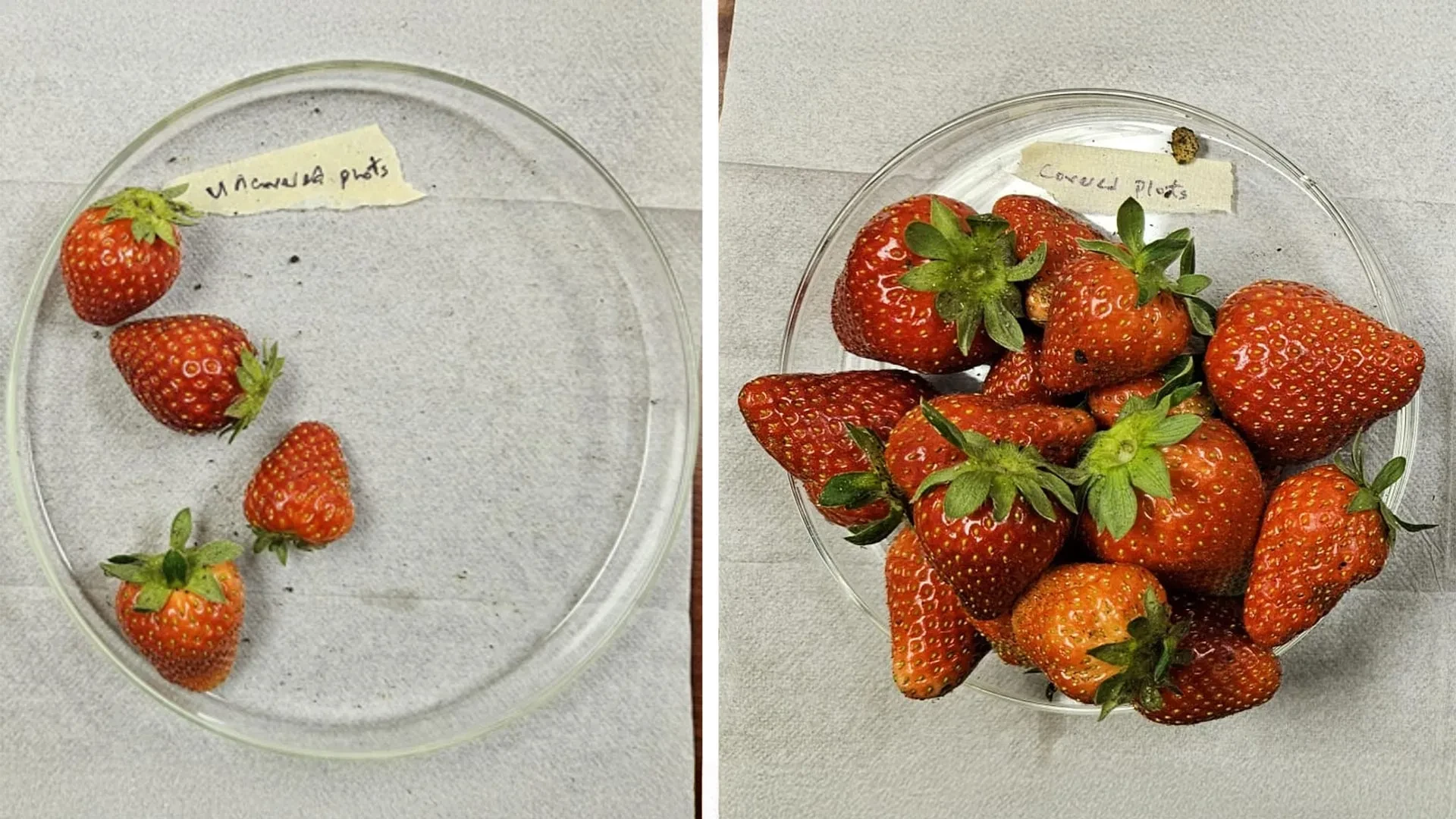
A groundbreaking advancement in agricultural technology, originally born from military research, is poised to revolutionize strawberry production. Researchers at North Carolina State University have developed a specialized textile covering that has demonstrated the ability to more than triple fruit yields in tunnel field trials, all while maintaining plant health and potentially reducing the agricultural sector’s reliance on chemical pesticides and heavy water consumption.
The textile, branded as "Plant Armor," is a sophisticated, three-dimensional fabric engineered to be draped directly over strawberry crops. Its unique structural design serves a dual purpose: it creates a robust physical barrier that prevents insects from accessing and damaging the plants, yet it maintains a porous, layered architecture that permits essential sunlight, rain, and airflow to reach the vegetation.
The results of the recent field tests, conducted in tunnel settings, have been remarkable. Strawberries shielded by Plant Armor saw their yields soar, producing up to 3.56 times more fruit than their uncovered counterparts. Perhaps most critically for agricultural efficiency, the material achieved these results without impeding the plants’ access to light or creating adverse shifts in the microclimate, such as fluctuations in relative humidity that could lead to disease.
A Fabric That Protects Without Blocking Sunlight
For many researchers, the prospect of covering delicate crops with a fabric typically raises concerns about light deprivation. In the plant kingdom, sunlight is the primary engine for energy production. Gabriel Olawuyi, a graduate research assistant at North Carolina State University and the lead author of the paper detailing the findings, noted that the research team initially approached the trial with a degree of skepticism.
"To produce fruit, plants need sunlight," Olawuyi explained. "We expected that Plant Armor’s seemingly opaque fabric would lead to an increase in vegetative biomass at the expense of fruiting—because reduced sunlight would trigger a ‘shade-avoidance’ response, making the plant divert energy toward stem and leaf growth rather than fruit production."
In nature, plants undergoing a shade-avoidance response will often stretch their stems and prioritize foliage to reach higher light levels, often at the cost of reproductive output. However, the data from the study revealed that the fabric did not impede light access at all. Instead of diverting energy into leaves and stems, the plants maintained a healthy, productive cycle, leading to a significant increase in the volume of fruit harvested.
Beyond the preservation of light, the textile provided an unexpected benefit: a consistent warming effect. Over the course of three growing seasons, the researchers observed that the fabric consistently raised the temperature within the canopy. According to Olawuyi, this supplemental warmth was a critical factor in accelerating the plant’s life cycle.
"Plants require a certain amount of accumulated heat, calculated as ‘growing degree-days,’ to progress through developmental stages including fruiting," Olawuyi stated. "Our plant cover has proven to enhance these. The plants were in a condition whereby the warmth they need to go through each phenological stage to their production was given to them optimally, and they produced far more than the uncovered plants."
By effectively shortening the time required to reach the fruiting stage, the technology provides a clear advantage for growers looking to maximize their seasonal output. Furthermore, because the physical barrier of the fabric prevents insects from landing on or feeding upon the strawberries, the need for conventional chemical pesticides is drastically reduced. This integration of passive protection—rather than active chemical intervention—offers a more sustainable path forward for large-scale berry farming.
From Military Textiles to Strawberry Fields
The genesis of Plant Armor is a striking example of the unpredictable nature of scientific inquiry. The technology did not emerge from a traditional agricultural laboratory or a seed-breeding facility. Instead, it was born from research aimed at military applications, specifically the development of high-performance textiles for soldiers.
The original objective of the research team was to design more comfortable, protective clothing for military personnel, with a specific focus on creating uniforms that could resist mosquito bites and provide greater comfort for soldiers wearing heavy body armor in challenging environments. The transition from designing gear for the battlefield to protecting produce in a greenhouse is a testament to the versatility of materials science and the importance of cross-disciplinary collaboration.
R. Michael Roe, a William Neal Reynolds Distinguished Professor at NC State and co-author of the study, emphasized that this unconventional journey highlights why investment in basic research is so vital.
"The path to Plant Armor started with trying to make a cloth to go on a soldier’s chest to make body armor more comfortable," Roe said. "Then, through trial and error, we arrive at a product which could triple the output of strawberry farms here in North Carolina."
For the research team, the discovery was a triumph of persistence and the scientific method. "We couldn’t have predicted that when we started," Roe added. "Without all these people here doing research and following the science, we wouldn’t have arrived at this product."
Study Details and Support
The comprehensive findings of the research, titled "Knitted 3-D, Porous Textile Cover to Enhance Strawberry Fruit Production and Prevent Insect Feeding," were recently published in the journal Agriculture. The study represents a significant collaborative effort across several disciplines at North Carolina State University.
The research team included a diverse group of experts, with co-authors James Clothier, Matthew Bertone, Grayson Cave, Reuben Garshong, Andre West, Loganathan Ponnusamy, and Clyde Sorenson contributing their expertise to the project. Their work was supported by a grant from the North Carolina Agricultural Foundation (grant number AG00463770), alongside funding from the U.S. Department of Agriculture’s National Institute of Food and Agriculture, under the Research Capacity Fund (HATCH) project award no. 02853.
The innovation has already moved beyond the laboratory phase. The Plant Armor Gen 2 fabric utilized in this study is patented by North Carolina State University (US Patent No. 11,582,968 B2; 21 February 2023) and has been licensed for commercial development by the university. This development represents a successful synergy between the NC State College of Natural Resources, the Wilson College of Textiles, and the College of Agriculture and Life Sciences.
As the agricultural industry faces increasing pressure to produce more food with fewer resources, the success of Plant Armor serves as a promising blueprint. By leveraging the protective qualities of advanced textiles, growers may soon have access to a passive, highly efficient, and environmentally friendly tool that not only safeguards their crops but fundamentally enhances their productivity. The transition from protecting soldiers to protecting food supplies underscores the transformative potential of interdisciplinary science, offering a future where agriculture is less dependent on chemical inputs and more reliant on the clever application of engineering.