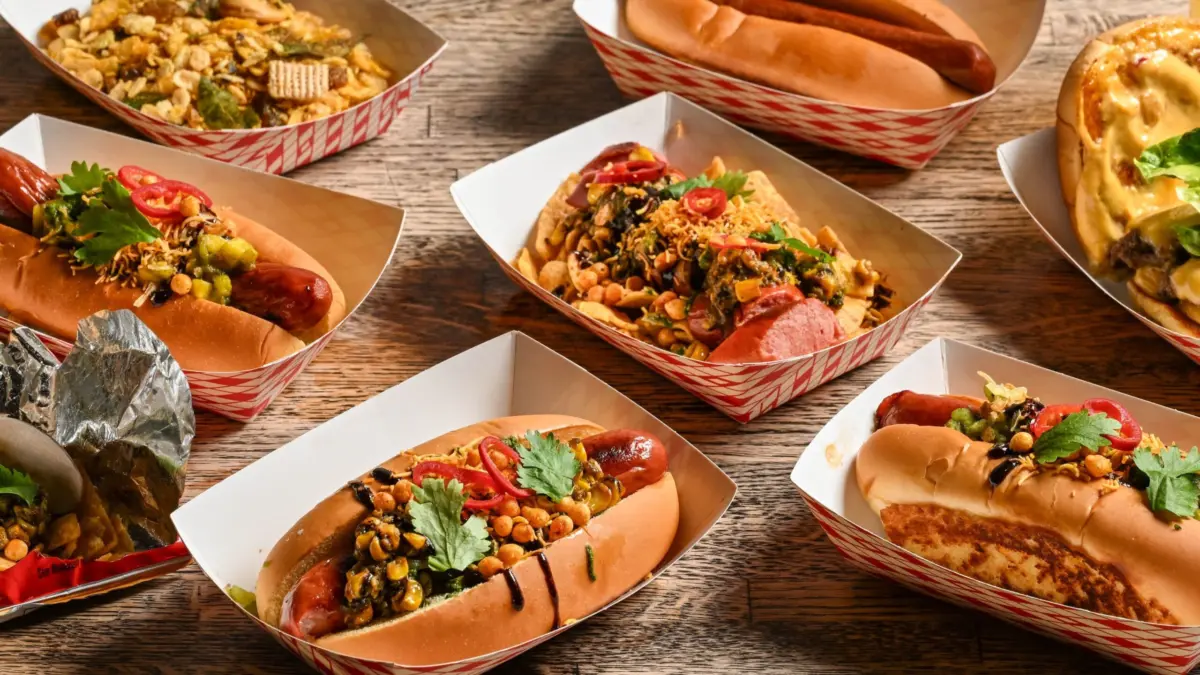
In the summer of 2017, journalist and chef Pervaiz Shallwani and his wife, Laena McCarthy, decided to host a hot dog cook-off for a friend’s birthday celebration. They wanted to bring something unique to the table, and they landed on a concept that seemed daring at the time: a hot dog topped with bhel puri. This popular South Asian street food snack, composed of crispy puffed rice, vibrant diced red onions, tomatoes, and a complex interplay of tangy and spicy chutneys, created an unexpected harmony. The result—a collision of a Chicago-style hot dog with the spirited flavors of Karachi street food—was more than just a successful party dish; it was a happy accident that served as a precursor to a larger, burgeoning culinary movement.
This cultural synthesis, while spontaneous for Shallwani, reflects a deeper shift in the Pakistani-American culinary landscape. To understand this evolution, one must look back to the origins of the diaspora. Shallwani’s father migrated from Karachi to the United States in 1971, part of a steady wave of Pakistani immigrants who began establishing roots in major American urban centers during the 1970s and 80s. These early arrivals gravitated toward cities like New York, Chicago, Los Angeles, Washington, D.C., and Houston.

In those early decades, the culinary footprint of the community was often obscured. The few Pakistani restaurants that managed to open in these immigrant hubs typically operated under the broader umbrella of "Indo-Pak" or "Indian" labels. This was largely a pragmatic decision; the American public had already developed an affinity for takeout staples like butter chicken and chana masala, and these labels provided a shortcut to mainstream acceptance. Other restaurants were more insular, catering almost exclusively to the Pakistani populations concentrated in specific enclaves, such as Houston’s Hillcroft, Chicago’s Devon Avenue, or the Little Pakistan neighborhood of Coney Island.
For a long time, the Pakistani dining experience lived in the shadow of the much larger Indian-American community, which stands as the second-largest immigrant group in the United States. While there were exceptions—such as the wildly popular Aga’s in Houston, recently noted as the busiest single-location restaurant on Uber Eats, and the James Beard Award-nominated Zareen’s Kitchen in Palo Alto—these establishments were the outliers. However, the demographic landscape has changed significantly. From a modest population of 32,600 in 1980, the Pakistani diaspora has grown to nearly 680,000 today. With this expansion, the community’s restaurants are finally moving out of the shadows and into the spotlight.
%2520everything%2520on%2520the%2520menu%2520is%2520halal.%2520Thanks%2520yall!.jpg)
The shift has become particularly pronounced in the years following the COVID-19 pandemic. The current movement is not defined by the fine-dining contemporary restaurants seen in the rise of West African cuisine or the Filipino food boom of the 2010s. Instead, it is characterized by something far more agile: a scrappy, fast-casual approach that introduces bold, authentic Pakistani flavors through distinctly American culinary vehicles. We are seeing a new era of the Pakistani-American kitchen, where hot dogs are crowned with spicy chaat, New York-style chopped cheese sandwiches are reinvented with chapli kebab, and buttermilk-brined hot chicken is elevated with a medley of South Asian spices.
In Fort Worth, Texas, pitmaster Zain Shafi found his entry point through the unlikely medium of barbecue. Growing up in Texas, Shafi had rarely eaten barbecue due to the scarcity of halal options. When he finally did, the experience was transformative. While balancing his time with his family’s furniture business, Shafi became obsessed with the craft, eventually training at the acclaimed Goldee’s before launching his own venture, a food truck called Sabar. From 2023 to 2025, Sabar offered halal, Pakistani-inspired barbecue, featuring creations like sausages seasoned with seekh kebab spices and smoked tandoori turkey, paired with traditional sides like raita, lentils, and fresh naan. For Shafi, the food was a bridge. In the face of rising Islamophobia in Texas, he found that food served as an effective "icebreaker," allowing him to introduce his culture to a broader audience on their own terms.

This strategy of remixing familiar favorites has become a cornerstone of the trend. Usman Chaudhry, an accountant who moved to the U.S. from Pakistan in the early 2000s, saw an opportunity during the pandemic. In the fall of 2020, he and his brother launched Namkeen in Chatham, New Jersey, with the goal of bringing high-quality halal hot chicken to the Tri-State area. Their menu was a calculated blend of American comfort and Pakistani spice: the Clucking Waffle Sandwich, featuring fried chicken between jalapeño-and-cheddar Belgian waffles; the Tikkaville Sandwich, layered with tikka sauce, coleslaw, and mint chutney; and a Chicken Tikka Mac & Cheese.
Despite opening during the height of the pandemic, Namkeen found immediate success. Its takeout-friendly model was perfectly suited for the era, and its replicable menu allowed for rapid expansion. Today, Namkeen has grown to 10 locations across three states and Canada, and the Chaudhry brothers have since branched out into a second concept, Ori’s Cheesesteaks, which serves premium halal ribeye cheesesteaks.
%2520(1).JPG)
In New York City’s East Village, Zeeshan Bakhrani is applying a similar logic to the city’s most iconic bodega staple: the chopped cheese. At his 600-square-foot counter, Nishaan, he serves a Pakistani-inspired version of the sandwich, using heavily seasoned chapli kebab chopped on a griddle with peppers and onions, topped with a bright lime-cilantro sauce and tamarind chutney. The menu is a reflection of his own journey, also including bihari barbacoa tacos and elote chaat—a nod to the Mexican influences of his childhood in Chicago—alongside Pakola soft-serve.
Bakhrani’s path to the restaurant business was unconventional. After being laid off from his IT product management job in 2024, he began experimenting with food content and mashups. He eventually secured a spot at Smorgasburg and later competed on Season 18 of Food Network’s The Great Food Truck Race in 2025. His team won the $50,000 prize, marking the first time an all-Halal food truck had taken the top spot in the competition. For Bakhrani, the show was a "fun bootcamp" that provided the proof of concept he needed to open his first brick-and-mortar location. He has since become a vocal advocate for the community, hosting Pakistan Day block parties and using his platform to champion Pakistani flavors in the city. When asked if leading with a explicitly "Pakistani" label might be a risk in the competitive food industry, his answer was defiant and optimistic: "It won’t hurt me either."
.jpeg)
This newfound pride in identity represents a significant departure from the practices of the previous generation. Saud Khan, the founder of Kaafi, a Pakistani chai café in Harlem, grew up helping in his father’s restaurant in upstate New York. While he initially had no intention of following in his family’s footsteps, a moment of reflection in a café led him to wonder why a similar space couldn’t exist for Pakistani chai and snacks. After opening two locations in upstate New York, he brought the concept to Harlem in 2024. He believes the current climate in New York City is uniquely ripe for South Asian restaurateurs. "We are having a moment right now," Khan says. "We just need to lock in."
This new generation of restaurateurs stands on the shoulders of pioneers like Sibte Hassan, who founded BK Jani in Brooklyn in 2015. A creative arts professional with no hospitality background, Hassan was motivated by a sense of disappointment in the quality of the Pakistani food available in New York at the time. Most existing options were designed to be cheap and functional for the city’s taxi drivers, rather than focused on premium ingredients. Through trial and error, and after a transformative review from the New York Times, Hassan turned BK Jani into a destination for high-quality halal burgers rooted in the flavors of Lahore. Like the newcomers of today, he chose the fast-casual format for its simplicity, which allowed him to keep his focus strictly on the food.

Back in 2017, the reception to Pervaiz Shallwani’s bhel puri dog was the spark that eventually led to his own pop-up, Chaat Dog, launched in 2022. He initially worried about how the South Asian community would perceive such a radical mashup, but he found that the response was overwhelmingly positive. "They felt seen," he says. Chaat Dog has since established a permanent home inside the Time Out Market in Brooklyn, offering items like chaat salt fries and desi poutine.
Ultimately, Shallwani views this phenomenon not merely as fusion, but as the continuation of a long-standing American tradition. "You know what you know, you take what you can find, and you adapt it over time," he says. "Every immigrant group that comes here makes American food their own. That’s what defines American food." As the latest chapter in this narrative, the Pakistani-American kitchen is no longer just finding its place; it is helping to define what the future of American dining looks like.