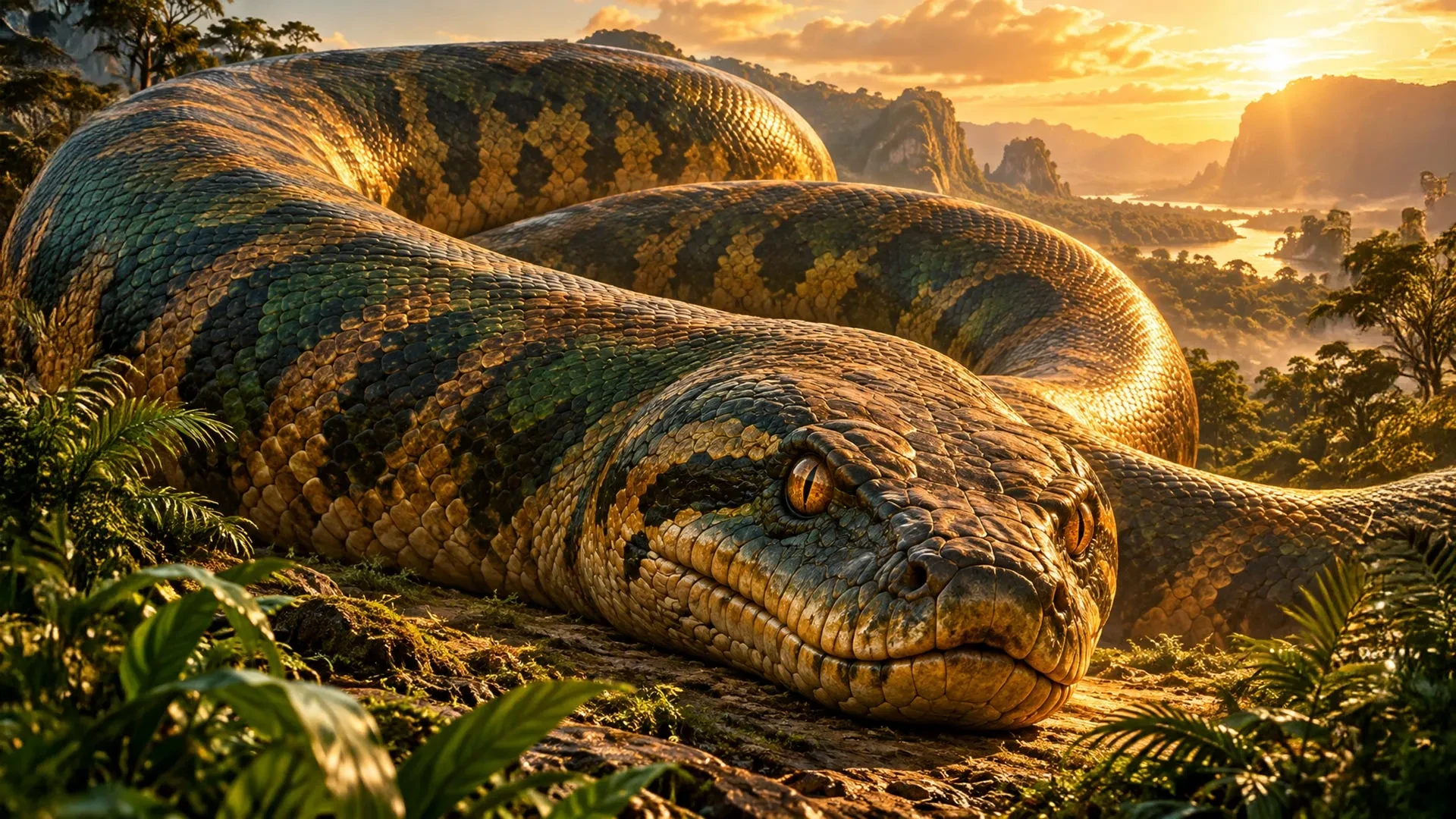
Deep within the fossil-rich strata of the Panandhro Lignite Mine in Kutch, Gujarat, paleontologists have unearthed the remains of a creature that pushes the known limits of reptilian biology. Approximately 47 million years ago, a colossal snake—now named Vasuki indicus—slithered through the warm, tropical marshes of what is now western India. With an estimated length reaching up to 15.2 meters (50 feet), this ancient reptile challenges our understanding of prehistoric gigantism and invites comparisons to Titanoboa, the legendary giant snake long held as the record-holder for the largest serpent to ever exist.
The discovery, formally described in 2024 in the journal Scientific Reports, represents a significant milestone in vertebrate paleontology. Led by researchers Debajit Datta and Sunil Bajpai of the Indian Institute of Technology Roorkee, the study identified the species from 27 exceptionally well-preserved vertebrae. These fossils date back to the Middle Eocene, an epoch characterized by a global climate significantly warmer than the present day, providing the ideal thermal conditions for ectothermic giants to thrive.
Unearthing a Mythic Predator
The name Vasuki indicus is deeply rooted in both cultural and scientific significance. It honors Vasuki, the mythical serpent king from Hindu tradition often depicted coiled around the neck of the deity Shiva, while the second part of the name serves as a geographical identifier for its home on the Indian subcontinent. The recovery of the fossils, some of which were found still articulated in their original anatomical arrangement, allowed the team to conclude that these bones belonged to a fully mature individual of gargantuan proportions.
While the skeleton is far from complete, the sheer scale of the recovered vertebrae offers a compelling blueprint of the animal’s anatomy. The individual bones measure between 37.5 and 62.7 millimeters in length, with widths spanning from 62.4 to 111.4 millimeters. This broad, robust architecture is indicative of a creature that possessed a thick, heavy, and cylindrical body—an essential adaptation for supporting a frame that may have weighed several tons.
To approximate the total body length of Vasuki, researchers employed comparative morphometric analysis, measuring the fossilized remains against the vertebrae of extant snake species with well-documented dimensions. Depending on the statistical method applied, the estimates placed the snake between 10.9 and 12.2 meters (36 to 40 feet) on the conservative end, and an astounding 14.5 to 15.2 meters (48 to 50 feet) on the upper bound. Even at the lower estimates, Vasuki stands among the largest snakes ever identified, rivaling Titanoboa, which inhabited the Colombian tropics roughly 60 million years ago and is widely cited at approximately 13 meters (43 feet) in length.
However, the scientific community remains cautious. The researchers emphasize that reconstructing the exact size of an extinct animal from an incomplete vertebral column carries inherent uncertainties. Because different statistical models yield varying results, it is currently impossible to definitively claim that Vasuki surpassed Titanoboa in total length. Regardless of the exact record, the presence of such a massive snake in the Eocene fossil record confirms that the Indian subcontinent was home to apex predators of unprecedented size.
Biology and Behavior in the Eocene Landscape
Despite its fearsome appearance, Vasuki was likely not a high-speed pursuit hunter. Its immense mass and the structural design of its spine suggest a creature that favored slow, methodical movement. Paleontologists hypothesize that Vasuki was an ambush predator, a strategy mirrored by modern giants like the green anaconda or the reticulated python. By remaining perfectly still in the shallow, marshy wetlands that dominated the Indian landscape 47 million years ago, it would have waited for prey to wander into striking distance.
Once a target was secured, Vasuki would have relied on its sheer muscular power to constrict its prey, a method that interrupts circulation and leads to rapid death. While the fossil record cannot reveal the specific dietary habits of this snake, its environment—a mosaic of swamps, marshes, and humid forests—would have been teeming with potential prey. The anatomical evidence suggests a semi-aquatic lifestyle, where the snake could effectively support its colossal weight in the buoyant, soft-sediment environments of the Kutch region.
The presence of such a massive reptile also provides a window into the climatic drivers of gigantism. Because snakes are ectotherms, their metabolic processes, growth rates, and activity levels are intrinsically linked to ambient temperatures. The Middle Eocene was a period of intense global warmth, with average temperatures in the region estimated at roughly 28 degrees Celsius (82 degrees Fahrenheit). This heat likely facilitated the metabolic demands of a creature as large as Vasuki, allowing it to sustain such extreme body mass. Yet, the researchers note that temperature is only one piece of the puzzle; food abundance, the absence of apex competitors, and specific evolutionary pressures all played roles in allowing such giants to evolve.
A Legacy of Evolutionary Gigantism
Beyond the headlines regarding its size, Vasuki provides critical insights into the Madtsoiidae, an extinct family of snakes that roamed the Earth for roughly 100 million years, spanning from the Late Cretaceous to the Late Pleistocene. This group was remarkably successful, occupying niches across Africa, Europe, South America, and Australia.
Vasuki represents a distinct evolutionary lineage within this family, with close relatives identified in both the Indian and African fossil records, such as Madtsoia pisdurensis and the North African Gigantophis garstini. These connections suggest that the Madtsoiidae originated on the Indian subcontinent before embarking on a long-distance migration. As India drifted northward and began its tectonic collision with the Asian plate around 50 million years ago, shifting land bridges likely allowed these giant serpents to disperse into southern Eurasia and eventually into Africa.
The Broader Context of Ancient India’s Ecosystems
Newer research continues to flesh out the world that Vasuki inhabited. A 2025 study published in the Journal of Paleontology by Datta and Bajpai expanded the scope of their findings, identifying a surprisingly diverse assembly of snakes in the same Eocene deposits. Among these was Pterosphenus rannensis, an aquatic species that further illustrates the ecological complexity of ancient India. The identification of other madtsoiid snakes sharing the same marshy habitat suggests that Vasuki was not an evolutionary anomaly, but rather the apex member of a thriving community of serpents, each occupying different ecological roles.
Furthermore, our understanding of snake gigantism was bolstered by a separate 2025 study in the Journal of Vertebrate Paleontology, which examined fossilized anaconda vertebrae from Venezuela. That study found that large-bodied anacondas had already evolved by 12.4 million years ago, reaching lengths of up to 5.2 meters. This discovery proves that extreme size was a recurring theme in snake evolution, persisting even as global climates cooled and ecosystems underwent significant transformations.
For now, the full story of Vasuki indicus remains a work in progress. While the scientific community continues to refine its estimates of the snake’s dimensions and behavior, the fossils found in Gujarat have already done the heavy lifting of challenging our perceptions of natural history. Vasuki stands as a testament to a forgotten era, a time when the landscapes of India were dominated by reptilian titans, and the limits of biology were pushed to their absolute maximum. As paleontologists continue to sift through the lignite mines of Kutch, the recovery of such specimens promises to further clarify the evolutionary path that led to these magnificent, gargantuan creatures.