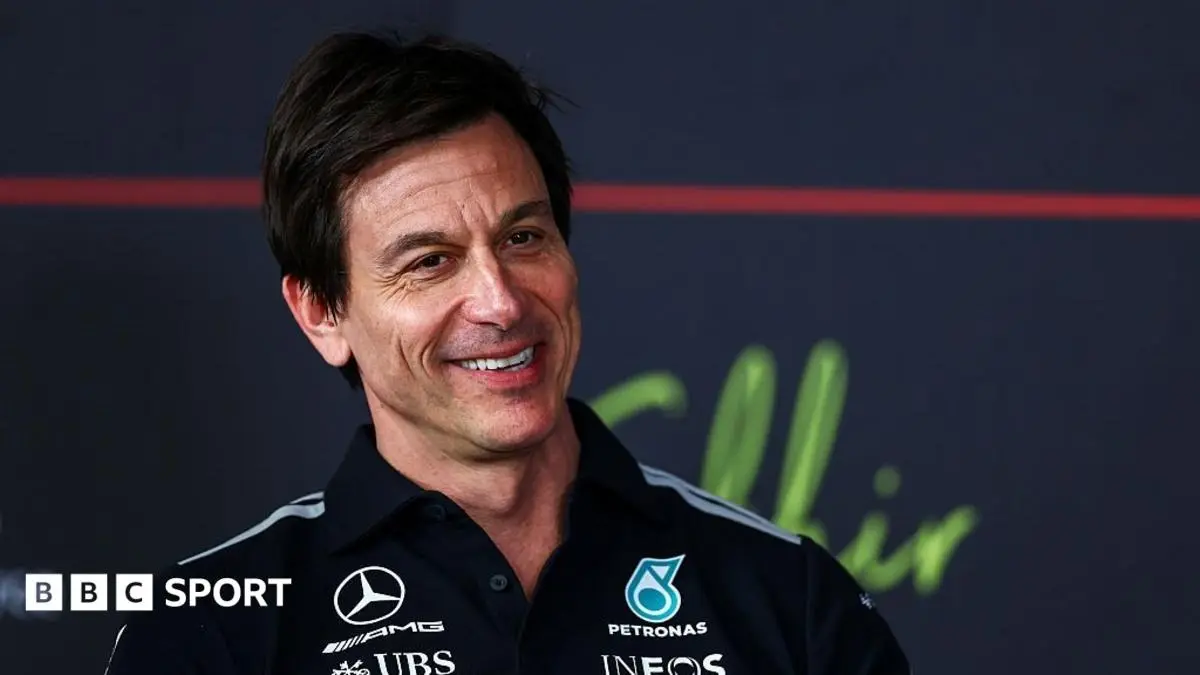
Mercedes Formula 1 team principal Toto Wolff has launched a fierce defense of his team’s internal operations, labeling critics who accuse the outfit of harboring bias against George Russell as "brainless." The sharp rebuke comes at a testing time for the Silver Arrows, as they navigate a challenging period for the British driver, whose championship aspirations have been severely hampered by technical misfortune.
The controversy stems from the fallout of last Sunday’s Malaysian Grand Prix, where Russell, running in a strong third position, suffered a catastrophic engine failure that effectively extinguished his hopes of securing the world title this year. With Russell now trailing his teammate, Kimi Antonelli, by a staggering 86 points heading into this weekend’s Singapore Grand Prix, the disparity in their championship standings has become a lightning rod for conspiracy theories among segments of the online fanbase.
Compounding Russell’s woes is the reality of his weekend in Singapore; he is slated to start from the back of the grid due to a penalty incurred for exceeding his engine component allocation. The intersection of these misfortunes has led some spectators to allege that Mercedes is intentionally engineering results to favor Antonelli. Wolff, however, remains unmoved by the vitriol, dismissing the claims of favoritism as "completely nonsensical."
"We’ve had it in the past with Lewis (Hamilton) fans," Wolff remarked, referencing the intense scrutiny that often follows the Mercedes camp. "I mean, literally, I don’t know what’s going on. Do they think I have a button that says, ‘George engine failure now,’ or that I am actively disadvantaging one driver against the other when we are fighting for a Constructors’ Championship? When we have always had the mindset of providing everybody equal material?"
Wolff’s frustration is rooted in the broader modern phenomenon of social media toxicity, where anonymity provides a shield for aggressive rhetoric. "I guess this is maybe where social media goes today," he added. "People hide behind their screens and then they lash out. There’s a lot of polarization going on, and sometimes I read what people write. I find it hilarious. These people really contribute to my own entertainment when they are abusing the team or myself. I’m Satan, I’ve heard."
Since assuming leadership of the Mercedes F1 program in 2013, Wolff has consistently maintained that equality is the bedrock of the team’s success. He points to his personal history with both drivers as evidence of the absurdity of the claims. Both Russell and Antonelli have been part of the Mercedes ecosystem for years, benefiting from direct mentorship from the team principal himself.
"We have had Kimi since he was 11," Wolff explained, underscoring the deep-seated relationship between the team and the young driver. "He is an integral part of the team. It is very nice to see him grow, be in a position now that he is fighting for a championship at such a young age, the talent he has. And then on the other side, George, who has been with us since he was 17, someone that I feel a lot of, how can I say, emotions for and compassion. We are very close."
The relationship between Wolff and Russell extends well beyond the professional confines of the paddock. Wolff noted that he and his wife, Susie Wolff, maintain a genuine friendship with Russell and his fiancée, Carmen Montero Mundt. The group frequently socializes away from the pressures of the racetrack, sharing gym sessions and coffee outings—a level of intimacy that makes the accusations of systematic bias particularly galling for the team principal.
"We are spending time with Carmen and Susie off the track with each other," Wolff said. "If people would see that we’re traveling together, we’re having coffee in the same coffee shop, we’re going to the gym. That’s why it’s pretty annoying to have some lunatics that have no understanding really about how relationships work coming up with these kinds of accusations. So, I don’t pay any attention to this. Most important is that George knows how the team is and Kimi knows, and we will always try to give them equal opportunity."
To reinforce his point regarding equal treatment, Wolff highlighted the team’s strategic approach to the current Singapore Grand Prix. Following an upgrade package introduced in Malaysia that failed to deliver the expected performance gains, Mercedes has taken the bold step of splitting the car specifications at Marina Bay. By running Russell in the previous-spec car while equipping Antonelli with the new, updated version, the team is seeking to gather essential data to resolve their current performance plateau.
"We don’t know which one is going to be quicker," Wolff admitted. The team is currently in a state of evaluation, as the initial feedback suggests that the updated car presents a more complex set of handling challenges. "The new car seems to be a little more tricky to drive—not saying it’s necessarily slower, because there will be goodness in it, but maybe we haven’t just found a way of putting it all together and tuning it. The older car is a bit more stable, grippy, but that is really just one data point. That is one free practice session, and it will be needing more time to really come to more conclusive information."
This technical dilemma carries implications that extend far beyond the weekend in Singapore. As the team evaluates the success—or failure—of these recent design changes, they are essentially laying the groundwork for their 2027 campaign. The current struggles are not just about finding pace for the next race, but about calibrating the team’s long-term design philosophy.
"We’ve put a few months of upgrades into the car, clearly pointing in a direction that we think is advantageous," Wolff explained. "Maybe we just need to calibrate it a little bit in order to find the right way forward for 2027."
As Mercedes continues to work through these technical hurdles, the atmosphere within the team remains one of unity, according to Wolff. While the digital discourse may be filled with accusations and vitriol, the team principal insists that the internal environment remains focused on the only metric that matters: the collective performance of the cars on the track. For Wolff, the noise from the periphery is merely a distraction—a byproduct of a digital age that he refuses to let dictate his management style or his relationship with his drivers. As the grid prepares for the lights to go out in Singapore, the focus for Mercedes remains on resolving their technical inconsistencies and supporting both drivers in their pursuit of the best possible result, regardless of the narratives spinning in the shadows of the internet.