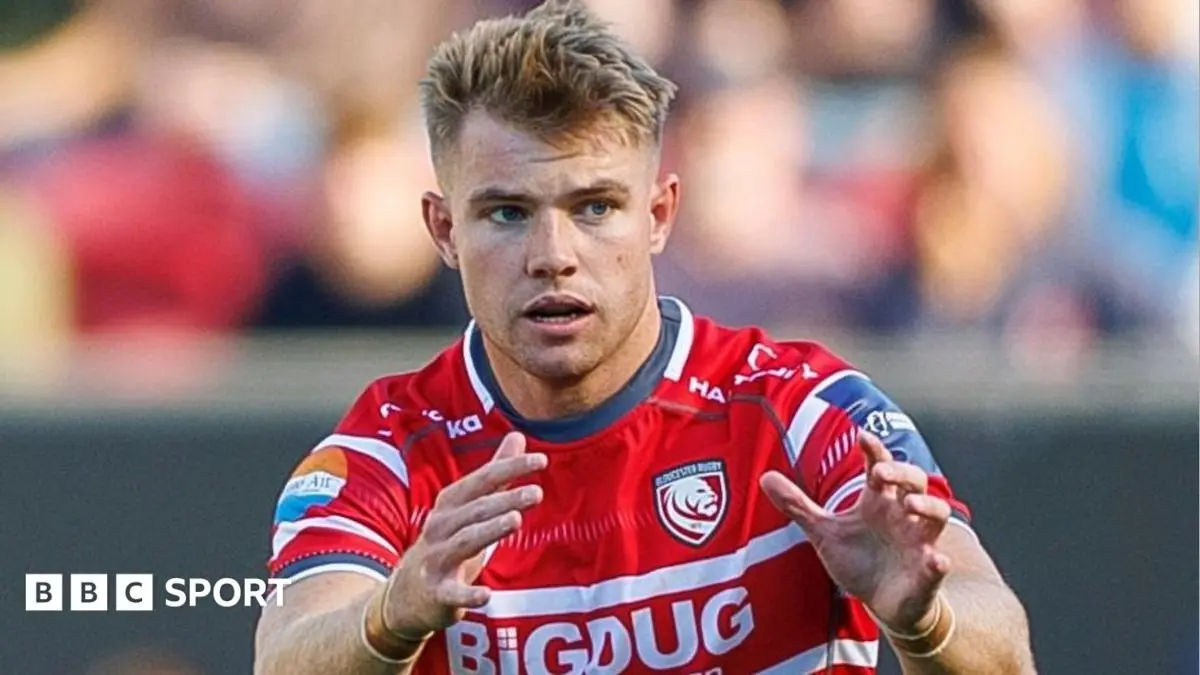
Charlie Atkinson can see the funny side of his introduction to professional rugby now. It is a moment that would have shattered the confidence of many teenagers, but for the Gloucester fly-half, it has become a defining anecdote—a surreal footnote in a career defined by rapid, often turbulent, evolution.
"I mean, I met my hero," he says with a wry smile.
Atkinson is casting his mind back to September 2020. He was just 18 years old, a prospect thrust into the deep end of Premiership rugby as clubs scrambled to navigate the condensed, high-pressure fixture lists that followed the COVID-19 lockdown. It was only his second appearance in the top flight, a day that was supposed to be a milestone. Instead, it became infamous.
Having come off the bench against Saracens, Atkinson fielded a kick deep in his own half. As he looked to recycle the ball, he was blindsided by a reckless, high tackle from England star Owen Farrell. The force of the impact left Atkinson unconscious on the Stonex Stadium turf, and the subsequent red card shown to Farrell triggered an immediate, intense national debate.
Farrell, to his credit, was instantly contrite. He waited on the touchline to check on the young debutant’s condition and later sought him out in the dressing room to offer a personal apology. Looking back, Atkinson views the incident with a level of pragmatism that defies his age.
"It definitely put my name out there," he reflects. "It was obviously accidental, but as it was a concussion, I was sent home for the week and I didn’t play again that season. In hindsight, it was probably a good thing. It forced me to slow down so that at 18, I could just focus on training and getting used to the physical demands of men’s rugby."
That ability to find an upside has become a survival trait for Atkinson. His journey since that afternoon in North London has been a masterclass in resilience, marked by professional upheaval that would test the resolve of even the most seasoned veterans.
The Collapse of a Childhood Dream
The defining trauma of Atkinson’s early career occurred in October 2022. Only three days after celebrating his 21st birthday, and having firmly established himself as the first-choice fly-half at Wasps—his boyhood club—he unwittingly played in the team’s final competitive fixture. It was a dramatic 40-36 defeat to Northampton Saints, a match that provided a thrilling spectacle but masked the rot consuming the club behind the scenes.
"We’d seen a few rumors on Twitter that week, but nothing major," Atkinson recalls. "We hadn’t heard anything from the owner or the CEO, so we just kept thinking, ‘We’ll be alright.’ It wasn’t even really in the back of my mind."
The reality hit with devastating speed the following Tuesday. The news broke that the club had gone into administration and the playing squad’s contracts were effectively terminated. "It was obviously very sad," he says quietly. "It was the only club I ever knew."
In the immediate aftermath of the collapse, the scramble for employment began. Atkinson was a player in demand, with both Gloucester and Harlequins making formal approaches to secure his services. However, he was eventually swayed by a sit-down meeting with Steve Borthwick, who had recently steered Leicester Tigers to the Premiership title. The promise of a stable, long-term deal at Welford Road felt like the security he desperately needed.
Yet, the instability of the Premiership followed him. Within two months of his arrival at Leicester, Borthwick and his assistant Kevin Sinfield were headhunted by the Rugby Football Union to lead the England national team. Under the stewardship of new head coach Dan McKellar, Atkinson found himself on the fringes of the matchday squad, enduring a difficult year of limited opportunities and shifting tactical demands.
Finding a Home at Kingsholm
The narrative of Atkinson’s career took another sharp turn when he had just finished the process of purchasing a house in Leicester. Only a week later, his agent informed him that a deal had been struck for him to move to Gloucester. While the timing was chaotic, the destination proved to be exactly what he needed.
"I’m just forever grateful to Gloucester for coming in then because who knows where I could have ended up if I’d stayed at the Tigers," he admits. "I love coming in here every day. There is a great, young core of guys, we made some great signings in the summer, and everyone is mates with everyone. It’s just a great feeling at the minute."
The transformation at Kingsholm has been palpable. After finishing eighth last season, Gloucester have entered the new campaign with renewed vigor. The arrival of high-caliber recruits such as Jac Morgan, Dewi Lake, and Jean Kleyn has bolstered the pack, providing a physical platform for a backline that has shown both flair and clinical efficiency.
The early results have been staggering. After an opening-day victory over Premiership finalists Exeter Chiefs, Gloucester dismantled Harlequins 48-0 in front of a capacity, raucous crowd at Kingsholm. The Cherry and Whites currently sit at the summit of the Premiership table, a position that feels both unfamiliar and richly deserved given their form.
Looking Ahead to Leicester and Beyond
This Friday night, the schedule brings a sense of circularity for Atkinson. He returns to Mattioli Woods Welford Road, the home of his former employers. It will be a poignant evening, as he intends to meet up with old friends such as Jack van Poortvliet and Freddie Steward—bonds forged during his time at Leicester that remain intact despite the professional separation.
Beyond the club level, Atkinson is once again knocking on the door of the international stage. His solitary England cap came in July 2025, when he appeared for the final 18 minutes of a 40-5 victory over the United States. Since then, he has been a consistent presence in the England A setup, hovering on the periphery of the senior squad under the guidance of Borthwick—the very man who first brought him to Leicester.
The path to the England 10 jersey is notoriously difficult, and Atkinson is well aware of the internal competition. "There are three main 10s at the minute in Fin Smith, George Ford, and Marcus Smith, so it is a very good level of competition," he notes. "I’m just focusing on how much I can help Gloucester and how consistent and effective my performances can be. But obviously, that’s always going to be in the back of my mind—how I can get another cap or get back into a camp. But right now, it’s all about continuing this momentum."
For now, the focus is entirely on the present. Atkinson believes he is currently playing the best rugby of his life, a statement supported by his influence on Gloucester’s recent winning streak.
Interestingly, his history with Twickenham’s Allianz Stadium is one of youthful ambition rather than professional conquest. As a child, he twice played at the stadium as part of the half-time entertainment for the Premiership’s London double-header fixtures. His father’s shaky touchline camera work still exists, capturing a young, energetic Atkinson showcasing the same burst of speed and footwork that now characterizes his Premiership displays.
It has been a long road from those half-time exhibition matches to his current role as a lead playmaker in the league. Even Gloucester’s last Premiership play-off appearance at Twickenham—a 44-16 defeat to Leicester in the 2007 final—feels like a relic of a bygone era.
As he prepares to face his former club under the lights on Friday, Atkinson carries the weight of those early lessons with him. Whether it is the shock of his debut, the heartbreak of a club collapse, or the challenge of breaking into a world-class international setup, he has learned that perspective is the most valuable asset a player can possess. He is, by all accounts, exactly where he is meant to be.