By Teklemariam Bekit, Editor, BBC Tigrinya, and Jack Burgess
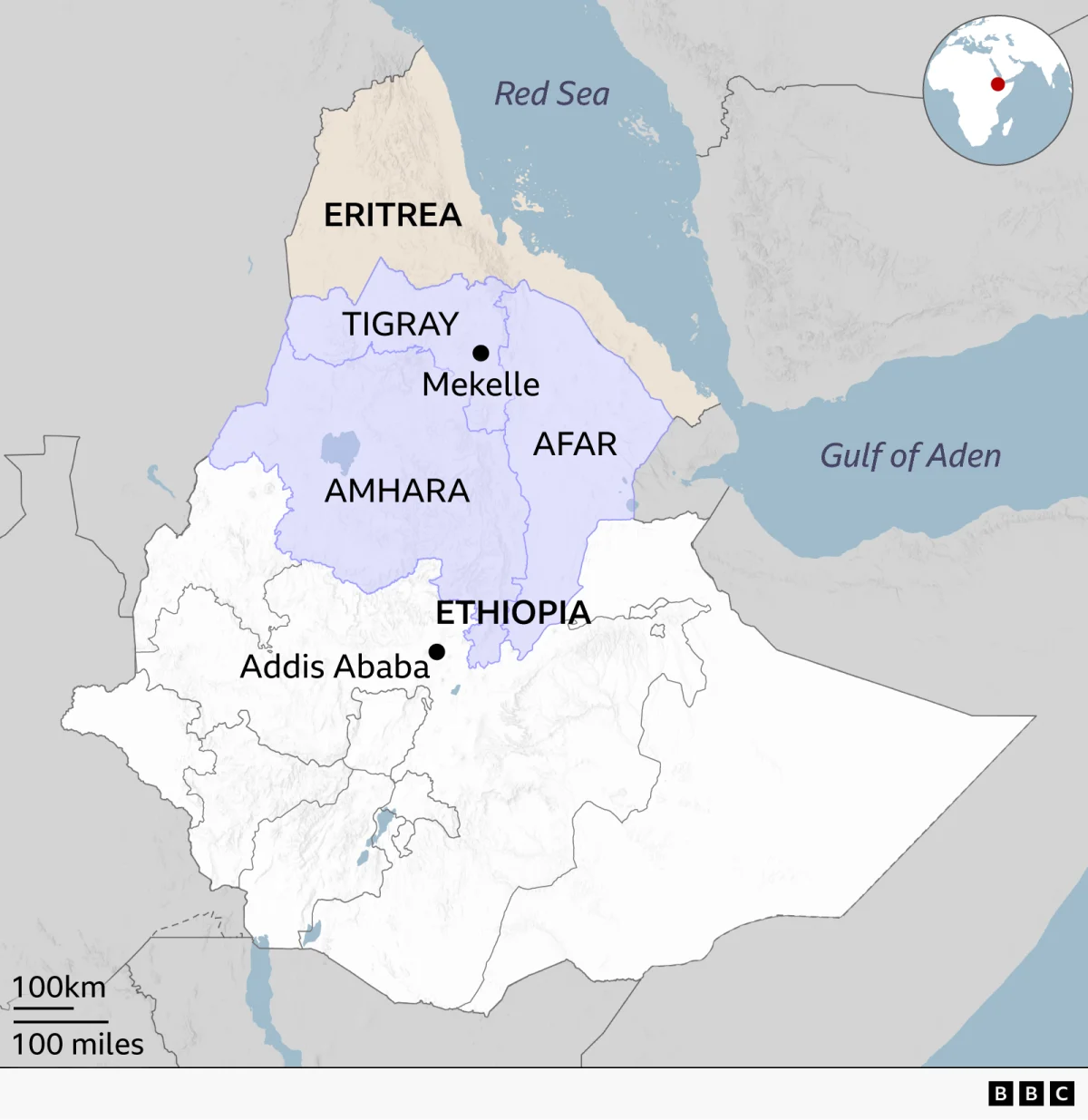
Rebel forces operating in Ethiopia’s northern Tigray region have announced a temporary withdrawal from the regional capital, Mekelle. The decision, confirmed by the Tigray People’s Liberation Front (TPLF), comes as heavy fighting between regional insurgents and the Ethiopian national army reaches the outskirts of the city, marking a significant and worrying escalation in the country’s renewed cycle of violence.
The TPLF, which has governed the Tigray region for years, stated that the decision to relocate their fighters was a tactical maneuver taken primarily to mitigate risks to the civilian population. The group, which has been locked in a power struggle with the central government in Addis Ababa, indicated that by removing its primary military presence from the urban center, it hoped to avoid the devastating collateral damage that often accompanies street-to-street combat.
Residents remaining in Mekelle have described a city in a state of flux. Two individuals who spoke to the BBC on condition of anonymity confirmed that pro-government forces have now established control over the city, effectively replacing the TPLF administration. According to these accounts, the TPLF fighters abandoned their positions, leaving behind a power vacuum that was quickly filled by the national army and its allies. One resident noted that, amid the transition, there were signs of basic infrastructure returning to functionality, reporting that mobile phone services—which had been severed during the height of the recent clashes—have begun to resume in certain parts of the city.
This development follows weeks of intensifying military engagements between the TPLF and a loose coalition of allied groups on one side, and the Ethiopian government on the other. The fighting has rippled across the northern landscape, impacting not only Tigray but also the neighboring regions of Afar and Amhara. This escalation represents a sharp departure from the tentative stability that had begun to take root in the region following the cessation of the brutal two-year civil war that concluded in 2022.
The resurgence of conflict has triggered alarm among international observers, who fear that the situation could spiral into a wider regional crisis. The proximity of the fighting to neighboring nations, combined with the complex web of cross-border alliances and historical grievances, has raised concerns that the conflict could destabilize the already fragile Horn of Africa, potentially drawing in outside actors and complicating the path to peace.

Diplomatic Tensions and Regional Stakes
The international community has reacted with urgent calls for de-escalation. The United States Department of State issued a formal statement urging all parties involved in the fighting to exercise maximum restraint and to prioritize a return to diplomatic dialogue. This appeal for calm arrived just ahead of a pivotal diplomatic summit held on Sunday in the Egyptian coastal city of El-Alamein. The meeting, which brought together the leadership of Egypt, Eritrea, Somalia, and Sudan, served as a forum to address the volatility in Ethiopia.
The meeting highlighted the increasingly polarized nature of the region. The participating presidents emphasized the necessity of respecting the sovereignty, unity, and territorial integrity of all states, urging that any disputes be resolved through peaceful, diplomatic means. However, the diplomatic landscape is heavily clouded by mutual suspicion. The Ethiopian government has repeatedly accused Egypt, Eritrea, and Sudan of providing material support to the Tigrayan rebels—a charge that all three nations have consistently and vehemently denied.
The situation is further complicated by a history of strained relations. Ethiopia and Eritrea, for instance, recently severed diplomatic ties following Addis Ababa’s formal accusation that Asmara was actively supporting the new rebel alliance. Simultaneously, a diplomatic row with Egypt has resulted in the expulsion of an Egyptian diplomat from Ethiopia, a move that prompted Cairo to order an Ethiopian embassy official to depart Egypt in a retaliatory measure.
The Shadow of the Pretoria Agreement
The current instability stands in stark contrast to the hope surrounding the 2022 Pretoria Agreement. That accord, brokered by the African Union, was intended to end a civil war that had claimed approximately 600,000 lives and pushed millions to the brink of mass famine. For many in Tigray, the last two years have been a grueling period of recovery, characterized by attempts to rebuild shattered infrastructure and restart local economies.
However, the fragile peace began to erode over the past six months as accusations of non-compliance mounted on both sides. The government in Addis Ababa claimed the TPLF was failing to fully disarm, while the TPLF argued that the federal government was failing to provide promised security guarantees and aid.
The situation reached a breaking point last month when the TPLF took the dramatic step of joining forces with six other armed movements. This new, broader alliance includes the Fano militia—an armed group based in the Amhara region—with the explicitly stated objective of removing the government of Prime Minister Abiy Ahmed from power. The formation of this coalition suggests that the current conflict is no longer merely a regional dispute over Tigrayan autonomy, but a direct challenge to the authority of the federal government itself.

Humanitarian and Geopolitical Consequences
The United Nations has issued a stark warning regarding the deteriorating security situation. Humanitarian agencies, which have been struggling to provide food, medicine, and shelter to a population still reeling from the previous war, report that the new fighting is causing catastrophic disruptions to aid delivery. The UN has called upon all warring parties to ensure safe, unhindered access to those in need, emphasizing that the civilian population remains the primary victim of these political failures.
Beyond the immediate human toll, the conflict is inextricably linked to the broader, long-standing dispute over the Grand Ethiopian Renaissance Dam (GERD). The dam, a massive hydroelectric project on the River Nile, remains a point of intense contention between Ethiopia and Egypt. Cairo fears that the dam will drastically reduce its share of the Nile’s water, which is vital for its own survival.
During the summit in El-Alamein, the regional leaders reiterated their commitment to international law regarding the usage of Nile waters. In a joint statement, they explicitly rejected “unilateral measures” that could potentially harm downstream nations—a thinly veiled reference to Ethiopia’s continued operation and filling of the dam. As the internal conflict in Ethiopia deepens, the external pressures from its neighbors continue to mount, leaving the region in a state of profound uncertainty.
The withdrawal of TPLF forces from Mekelle is not an end to the hostilities, but rather a pivot point in an evolving crisis. With the Ethiopian national army now occupying the capital and a new, militant alliance determined to confront the central government, the prospect of a swift return to the conditions of the Pretoria Agreement seems increasingly distant. The eyes of the international community remain fixed on the Horn of Africa, waiting to see whether the current military trajectory can be redirected toward a political solution, or if the region is destined to slide back into the cycle of violence that has defined so much of its recent history. As the situation remains fluid, the safety of the civilian population remains the most urgent concern for aid organizations and global observers alike.