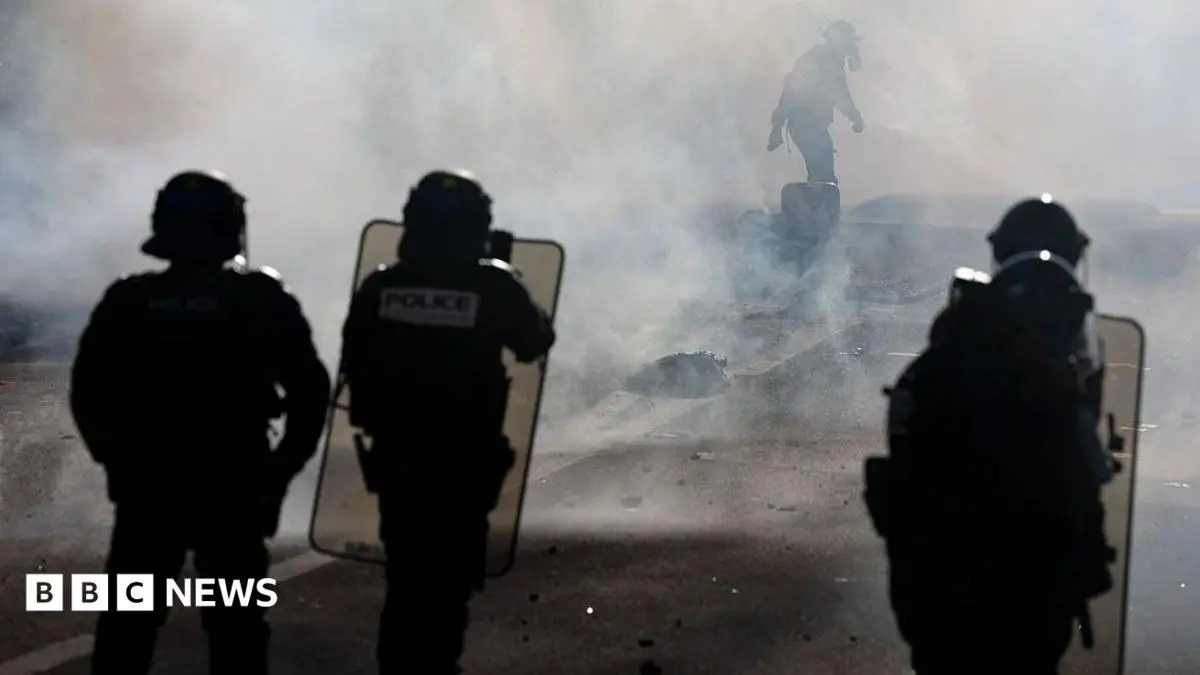
A 15-year-old student has suffered a catastrophic injury, losing his hand during a violent confrontation between police and demonstrators outside a high school in the north-eastern French city of Lens. The incident, which has sent shockwaves through the local community and renewed national debate over police tactics, occurred on Monday morning as a wave of student protests continues to ripple across France.
The “very serious incident,” as described by local authorities, took place near the Auguste Béhal high school. François-Xavier Lauch, the prefect of Pas-de-Calais, confirmed the teenager’s injury, stating that while the student’s condition is critical in terms of the trauma sustained, his life is not in immediate danger. The youth was transported to a nearby hospital with extreme urgency following the explosion.
The backdrop to this tragedy is a broader movement of student unrest that has seen approximately 500 schools partially or fully shuttered across the country. Students are mobilizing to voice deep-seated grievances regarding the deteriorating condition of educational infrastructure and systemic staffing shortages. These demonstrations, initially intended as peaceful expressions of student concern, have increasingly devolved into clashes with security forces, raising urgent questions about the methods used to contain teenage protesters.
Conflicting Accounts of the Incident
The exact sequence of events leading to the teenager’s injury remains a subject of intense dispute, with contradictory narratives emerging from official sources, eyewitnesses, and local media.
According to an AFP report citing a source within a police union, the student allegedly attempted to pick up a "sting-ball" grenade—a crowd-control device deployed by riot police—which subsequently detonated in his hand. If accurate, this version of events suggests an accidental engagement with hazardous police ordnance amidst the chaos of the protest.
However, this account has been flatly contradicted by students who were present at the scene. The regional newspaper La Voix Du Nord interviewed a witness who was in the immediate vicinity of the teenager at the time of the explosion. The witness insisted that the boy did not touch or attempt to retrieve the device. “He didn’t pick it up. I was there, I saw it. He didn’t pick it up, he didn’t catch it,” the girl stated, directly challenging the police union’s version of the incident.
The lack of clarity has prompted a cautious response from local leadership. Lens Mayor Sylvain Robert admitted that the circumstances surrounding the injury remain murky and require a thorough, transparent investigation. “Like you, and like many others, I have seen some videos showing the aftermath. But I did not see how the operation was organised, either by the police or by the students,” he told French media outlets, emphasizing the need for an objective review of the facts.
In response to the mounting pressure for accountability, a regional prosecutor has announced that the General Inspection of the National Police (IGPN)—the official police watchdog—will conduct a formal investigation. The mandate of the inquiry is to shed light on exactly what transpired and determine if the protocols for maintaining order were adhered to during the morning’s confrontation.
Escalation of Student Unrest
Prefect Lauch provided context regarding the morning’s events, noting that the gathering at the Auguste Béhal high school was significantly larger than those observed in previous days. He asserted that the situation turned volatile early in the morning when groups of students began targeting local police officers with various projectiles, including stones, fireworks, and mortars.
“Instructions were given by the interdepartmental director of the National Police, naturally with my approval, to deploy a company of riot police (CRS) here to maintain order, and it was in this context that this event occurred,” Lauch explained. The decision to escalate the police presence from local units to specialized riot squads highlights the increasing tension between the state and the student body.
The impact of the incident on the school community was immediate. By Monday morning, the Auguste Béhal high school issued a formal statement announcing that it would shift to distance learning to ensure the safety of students and staff. Furthermore, recognizing the psychological trauma caused by the event, the administration established a listening and support unit to provide counseling and assistance to those affected by the violence.
A Pattern of Violence Against Students
The injury in Lens is not an isolated incident; it follows a distressing trend of serious injuries sustained by young protesters during the recent wave of demonstrations across France. Concerns regarding the use of force against minors have been amplified by the case of 14-year-old Eden, who was gravely injured in Saint-Ouen-l’Aumône just last week.
Reports indicate that Eden was struck in the head by a tear-gas grenade fired by security forces. The trauma resulted in a double jaw fracture, requiring the teenager to undergo what his legal counsel described as “extremely major surgery.” The gravity of his condition remains a point of national concern.
During a news conference on Monday, Eden’s mother spoke with raw emotion about the state of her son, describing her heart as “shattered.” She provided a harrowing update on his recovery: “His jaw is wired shut. He can’t eat except through a straw and only liquids.”
Reflecting the outrage felt by many parents and observers, she condemned the violence directed at students. “It’s shameful, it’s appalling, it’s violent, it’s horrific,” she stated, speaking to BFMTV. “This should not happen. They are dealing with children who are asking for better conditions in which to study.”
The injury to the student in Lens has served to further inflame these tensions. As the IGPN begins its investigation, the incident has reignited the national conversation regarding the use of riot control munitions in proximity to school zones and the broader implications of how the French state handles student-led dissent. With hundreds of schools still facing disruptions and thousands of students expressing frustration over educational conditions, the atmosphere in France remains volatile.
For now, the focus in Lens remains on the recovery of the 15-year-old victim and the urgent need for a definitive account of how a morning protest escalated into a life-altering medical emergency. As the authorities gather evidence and witnesses continue to speak out, the case stands as a stark reminder of the risks inherent in the current cycle of protest and policing, and the profound human cost being paid by the youth of France. The coming days are expected to bring further scrutiny of police methods, as both the public and political leaders demand answers about the safety of students exercising their right to protest.