By Laura Bicker, China Correspondent
Reporting from Shenzhen
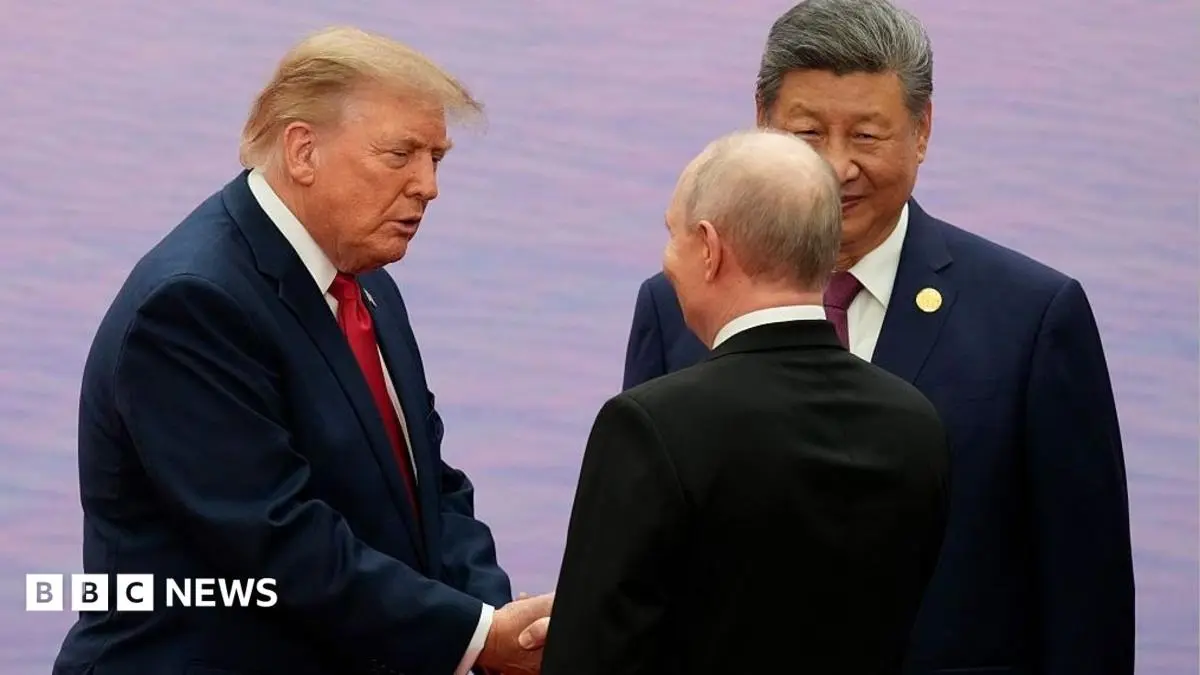
Xi Jinping will believe he has achieved something no other world leader could in securing a historic, high-stakes summit with Vladimir Putin and Donald Trump in the futuristic hub of Shenzhen. For decades, the global order was effectively dictated by Washington and its Western allies. Yet, as the world watches, it is China that has orchestrated the remarkable diplomatic spectacle of three of the world’s most powerful and influential protagonists sitting around the same table.
The setting itself—Shenzhen—is a statement of intent. As the three leaders convene, the city serves as a backdrop of rapid, relentless modernization. Outside the summit venue, driverless cars navigate the streets with clinical precision, surveillance drones hover in the skyline, and robots perform choreographed displays in the public squares. This is the China that Xi Jinping wants the world to see: a nation that has transitioned from a global factory floor into a technological superpower that sits at the very heart of the international conversation.
Ostensibly, this is an economic summit for Asia-Pacific leaders, but for Xi, the meeting is a potent demonstration of China’s deepening grip on the mechanisms of global politics. The era in which Beijing merely reacted to policies formulated in Washington, London, or Brussels is, in his view, firmly in the past. Today, China is a central architect of the international order. However, while the optics of the meeting are a triumph of soft power, the substance is fraught with complexities. Xi must navigate a minefield of conflicting interests, as there are several pressing issues he would prefer to keep off the table during his interactions with Putin and Trump.

Ukraine: The Delicate Balancing Act
Perhaps the most significant shadow looming over the summit is the war in Ukraine. Now well into its fifth year, the conflict has claimed hundreds of thousands of lives and remains the primary point of friction between the gathered powers. For Xi, the war presents a grueling, delicate balancing act. He is acutely aware that his close relationship with Vladimir Putin—a strategic partner in opposition to Western dominance—carries a high political cost. It risks alienating the European Union, a critical market that is vital for China’s export-led economy, particularly as Beijing struggles to reignite its own growth.
Simultaneously, however, Xi is wary of a resolution to the conflict that might lead to the destabilization of Russia. A weakened or collapsed Russia would not only deprive China of a key geopolitical ally but could also create a volatile power vacuum on its northern border. Consequently, Beijing has clung to a carefully curated position of neutrality. It consistently calls for negotiations and a political settlement to the fighting, all while carefully avoiding any explicit condemnation of Russia’s full-scale invasion.
This ambiguity has failed to satisfy Western leaders. The United States, under both the previous Biden administration and the current political climate, along with European powers, has repeatedly accused China of providing Russia with critical dual-use components that bolster its war machine. Furthermore, Beijing’s continued appetite for Russian oil and gas acts as an economic lifeline for Moscow, cushioning the impact of international sanctions. Xi wants to keep Putin close, but he is wary of being dragged into the direct consequences of Russia’s military failures. He must walk a narrow line, ensuring that Russia remains a viable partner without allowing Moscow’s deepening isolation to become a direct burden on China’s own foreign policy objectives.
The Challenge of a Growing Nuclear Arsenal
Beyond the regional theater of war, the summit brings the global issue of nuclear non-proliferation to the forefront. Donald Trump has signaled a clear intent to move the conversation toward limiting the world’s supply of nuclear weapons, a prospect that directly impacts China’s recent trajectory. The United States and Russia still possess the world’s largest stockpiles of nuclear warheads, but China’s rapid, modernizing expansion of its own nuclear capabilities has begun to trigger alarm bells in Washington.

The geopolitical landscape regarding arms control shifted significantly when the last major U.S.-Russian treaty, New START, expired in February. The expiration of this agreement, which had long served as a guardrail for the two largest nuclear powers, has stoked fears of an unconstrained, multi-polar arms race. Trump is expected to push for China’s inclusion in any future successor to such treaties.
Beijing, however, has been steadfast in its resistance. Xi’s argument—and the stance of his diplomatic corps—is that China’s arsenal remains significantly smaller than those of Washington and Moscow. From Beijing’s perspective, it would be fundamentally inequitable for China to be bound by the same caps and restrictions as the world’s two long-standing nuclear superpowers. China maintains that it requires the freedom to modernize and develop its own capabilities to ensure its national security.
This friction creates a significant hurdle for Xi’s broader ambition: to have China recognized as a fully mature and responsible global leader. The United States is likely to argue that true great-power status comes with the burden of acting as a responsible steward of global stability, including transparency and restraint in nuclear development. For Xi, this debate is not just about security; it is about status.
Controlling the Narrative: Will They Stick to the Script?
Xi Jinping is a leader who values control. Chinese officials are well-known for their meticulous preparation, often spending weeks or months finalizing agendas, talking points, and the choreography of official speeches to ensure that the message delivered is precisely the one intended. However, this summit is unprecedented in its unpredictability. Sharing a table with Donald Trump and Vladimir Putin means managing two leaders who are notoriously prone to discarding established scripts in favor of their own agendas.

There is a tangible risk that the meeting becomes a stage for the personalities of the American and Russian presidents, leaving Xi in the role of a passive host rather than the architect of a new diplomatic era. Yet, it is possible that Xi has accounted for this volatility. A more chaotic or unscripted meeting might actually play into his hands.
As a leader who has consistently projected an image of stability and methodical long-term planning, Xi is flanked at this summit by two men who are arguably defined by the intractable wars they are currently prosecuting. In this context, any display of temper or lack of discipline from his guests might only serve to highlight Xi’s own image as a composed, senior statesman. By appearing as the calm center of a storm, he may reinforce his preferred narrative: that while the West and Russia are caught in cycles of conflict and instability, China represents a reliable, consistent force on the world stage.
Domestic Pressures and the Road Ahead
For all the international attention, it is unlikely that this summit will yield any breakthrough agreements or immediate solutions to the crises currently gripping the world. However, the optics of the event are vital for Xi’s domestic agenda. He is currently moving toward next year’s Communist Party Congress, where he is expected to secure a historic fourth term. In the eyes of the domestic audience, this summit is intended to be a visual validation of his leadership.
China is currently grappling with a series of daunting domestic challenges. A country-wide property crisis has severely dented consumer confidence, and local governments are struggling under the weight of mounting debt. Manufacturing growth has slowed, and a significant portion of the workforce is finding itself relegated to the gig economy, lacking access to pension funds or social security. Perhaps most concerning for the leadership is the plight of the youth; with one in five young people reportedly struggling to find employment, frustration and anxiety are becoming increasingly pervasive in public discourse.

While Xi does not face the pressure of periodic elections, and the country has not seen significant, widespread protests in decades, he is undoubtedly sensitive to the mood within the party elite. As domestic economic pressures mount, the party’s legitimacy remains tied to its ability to deliver prosperity and status.
In this light, a photo-op with the leaders of the United States and Russia serves a specific purpose. It offers a powerful rebuttal to the domestic anxiety surrounding the economy. It allows Xi to argue that the “century of humiliation” is truly behind China. By positioning himself as an equal at the table with the world’s other great powers, he can make the case that China is no longer merely a rising power waiting for its turn, but an established leader that is actively writing the rules of a new era. Whether the summit results in policy change or not, for Xi, the image of his nation at the center of the table is a victory in itself.