For fans of Netflix’s hit political thriller The Diplomat, the series offers more than just high-stakes geopolitical maneuvering and rapid-fire dialogue; it provides an immersive, albeit fleeting, look into the corridors of power. As the show’s characters navigate volatile international crises, they move through spaces that are as imposing as they are historically significant. However, as production designer Curt Beech explains, the series takes a unique approach to its setting. Unlike many dramas that use domestic spaces to offer intimate portraits of character history, The Diplomat focuses on the transient nature of global power. The characters are rarely "at home"; they are constant visitors in grand, institutional, and often cold environments.
The fourth season of The Diplomat, which contains major spoilers, ups the ante both in narrative intensity and geographic scope. The season opens with a shocking assassination attempt on US President Grace Penn (Allison Janney) outside the gates of Windsor Castle. The aftermath of this event sends shockwaves through the administration, forcing the President’s husband, Todd (Bradley Whitford), Vice President Hal Wyler (Rufus Sewell), and US Ambassador to the UK Kate Wyler (Keri Russell) into a state of precarious unpredictability. The narrative trajectory stretches from the historic grounds of England to the political heart of Washington, D.C., eventually concluding with a tense, high-stakes cliffhanger at a G7 summit in Lucca, Italy.

"The places may be historical, but they’re almost never personal," Beech notes, describing the design philosophy behind the show’s fourth outing. "That is what’s so different about this show from a design standpoint. Usually, we’re creating someone’s bedroom or their house, and we dig into their family history and who they are and what they like. We don’t get any of that here because the spaces that they inhabit are not theirs. They are almost always visitors." To achieve this, Beech and his team relied on a mix of established sets at Steiner Studios in New York and a wide array of new, carefully curated locations.
Windsor Castle and the Architecture of History
The season’s explosive opening at Windsor Castle serves as a masterclass in production design geography. To capture the scale and gravitas of the royal residence, Beech did not rely on a single location. Instead, the production stitched together nine distinct sites to construct the illusion of the castle. The exterior shots and the bustling inner courtyards were filmed at the stately Burghley House. For the opulent interiors, the team utilized the historic grandeur of Belvoir Castle, Lancaster House, and the British Foreign Office.

The complexity of the shoot extended across the Atlantic. In the United States, filming took place at the Woolworth Estate, the St. Josaphat Monastery Library, and the Sleepy Hollow Country Club. Perhaps most memorable is the scene in which Kate and Hal are locked down in a fortified panic room following the shooting. That sequence was filmed within the crypt of a church on Manhattan’s Upper West Side.
"It’s a lot of different architectural styles, but that is typical of these houses," Beech says of the architectural medley. "Windsor has a bunch of things going on because these houses are very, very old, and they’ve been built during different centuries with different people in charge of the construction. We embraced that. We also have a mix of things that are accurate to Windsor Castle and things that aren’t."

Marine One and the Logistics of Luxury
Following the assassination attempt, President Penn is airlifted via Marine One to a docked aircraft carrier to undergo emergency surgery. Translating the tight, high-tech confines of a presidential helicopter to the screen presented a logistical hurdle. The production used the parking lot at Steiner Studios for the helicopter takeoffs and landings, ensuring the footage felt authentic.
The interior of the helicopter, however, required a different approach. A Marine training facility in New York City was repurposed to serve as the interior set. "We did real takeoffs and landings with the helicopter," Beech recalls. "While it was on the ground, we dressed the interior because Marine One feels like a private jet inside. It’s very luxurious and well appointed. But you can’t add weight to a helicopter like that without going through a lot of different FAA approvals, so we couldn’t keep it dressed while flying."

The Enduring Presence of Winfield House and the Embassy
Winfield House, the official residence of the US Ambassador in London, remains a focal point of the series. The exterior continues to be represented by the sprawling Wrotham Park in Hertfordshire. Inside, the production maintains a careful balance between location shooting and stage work. Beech highlights the coordination required to maintain visual continuity across disparate sets.
"There’s a blue room, a library, and a red room in the real building," Beech says. "The foyer is also there. The green room, the Wedgewood hallway, and the blue study are on stage in New York. It takes a lot of coordination to keep track. The actors are incredible because they’re able to tap back into whatever they were doing at that moment two months ago, and make it feel like they just turned the corner and are walking into a room."

Similarly, the US Embassy in Nine Elms, London, maintains its presence in the season. Having been built on a soundstage in London for earlier seasons and subsequently shipped to Steiner Studios for the third season, the set remained largely unchanged for the fourth installment. The production team focused on subtle adjustments, such as rearranging furniture to optimize lighting, rather than structural overhauls. A brief scene featuring CIA station chief Eidra Park and deputy chief Stuart Hayford was filmed in the Nine Elms area, providing a rare and authentic connection to the real embassy building.
The Private and Public Spaces of Washington
As the characters navigate their professional lives, the setting occasionally shifts to reflect their personal stakes. Eidra’s apartment in Tribeca serves as one of the few instances where the set design hints at a character’s interior life. However, even here, the design reflects the transience of the intelligence world. "We told the story that she moves a lot for the safety of her position," Beech notes. "She’s never in the same place for very long. So it’s very stark and doesn’t have a lot of personality."

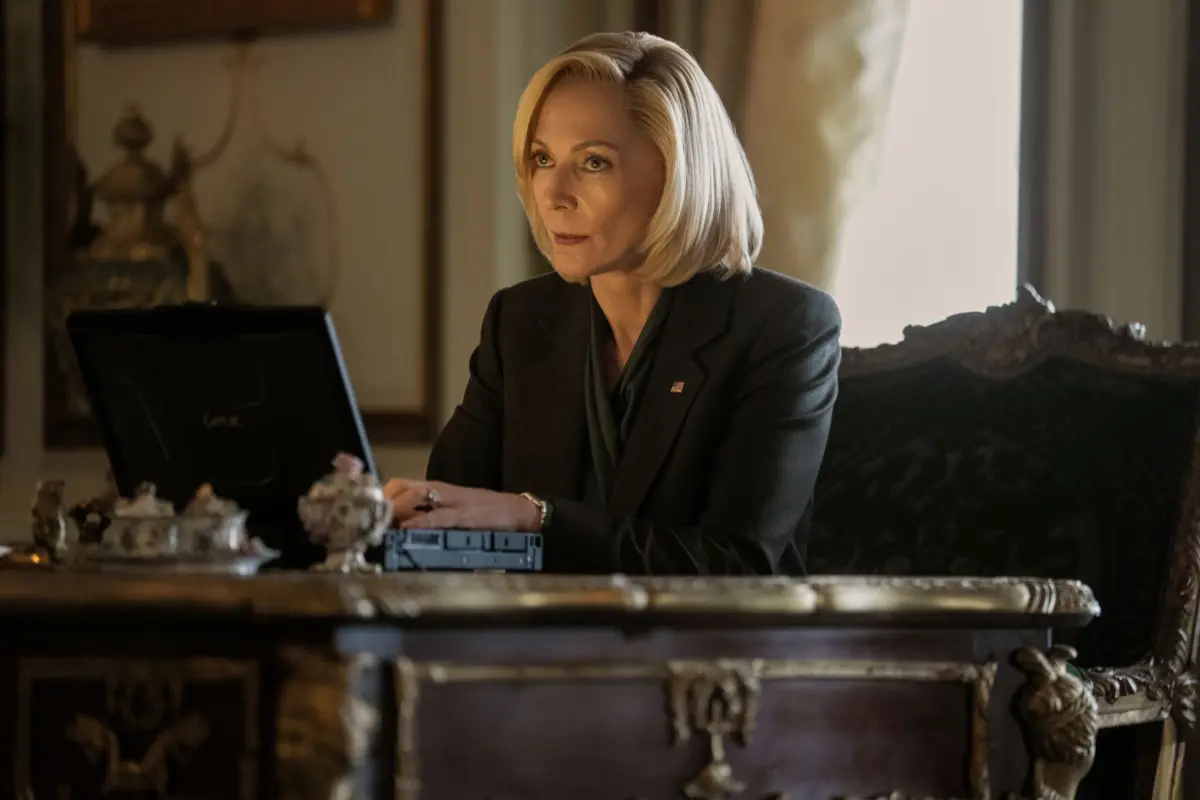
In contrast, the White House set saw a deliberate evolution. For the fourth season, Beech moved away from the familiar Oval Office, choosing instead to focus on the President’s private study. The design of this room—a spacious, three-zoned environment encompassing a work area, a meeting space, and a power center—is a deliberate fabrication. "The president typically does have a study, and it’s right off the Oval Office, but it’s very small," Beech says. "We made a very large study for her that has three separate zones… That does not exist in the real White House, but it does in our White House."
The production also recreated a piece of presidential history that no longer exists: the White House pool. Used for a scene in which Todd Penn swims laps, the set was built in the basement of the Woolworth Building. The design drew inspiration from archival photographs of the original White House pool, which was eventually paved over to create the current press briefing room.

Political Shifts at 10 Downing Street
The depiction of 10 Downing Street underwent a significant change this season. Because the previous location used for the iconic residence was no longer available, the team reconstructed the interior on a soundstage. They also utilized the Steinway Mansion in New York to capture the building’s famous staircase.
When a new prime minister assumes power, the set design reflects the shift in authority. "It got a bit more sparse, indicating that she had just gotten there," Beech explains. "They had moved him out; she hadn’t completely moved in yet. So some pictures are off the walls, and the lamp on his desk changed. It’s small stuff." The exterior, meanwhile, was achieved through a blend of on-location shooting in London and a green-screen build in a Brooklyn parking lot, effectively merging the two worlds to maintain the illusion of the seat of British government.

The Climax in Lucca
The season culminates in Italy, where the production spent six weeks filming across eight different locations in Lucca. These included the historic Villa Viesca and the resort of Dimora Ghirlandaio in Tuscany. The G7 summit meetings were filmed at prestigious sites such as Villa Reale di Marlia, Villa Medici in Poggio a Caiano, and Villa Medicea La Petraia.
"We were going to play Florence for Lucca, but we leaned into Lucca as Lucca, and it felt better and more authentic," Beech says. "We decided to make it very classical. We embraced the vibe of this incredible room with floor-to-ceiling frescoes, and we built custom desks that had little fresco elements that matched the walls."

By blending historical authenticity with the bespoke needs of a high-stakes political drama, The Diplomat continues to ground its narrative in a world that feels expansive, grand, and perpetually out of reach for the very people tasked with running it. As the season ends on a cliffhanger, the deliberate, cold elegance of these global settings remains as central to the story as the characters themselves.