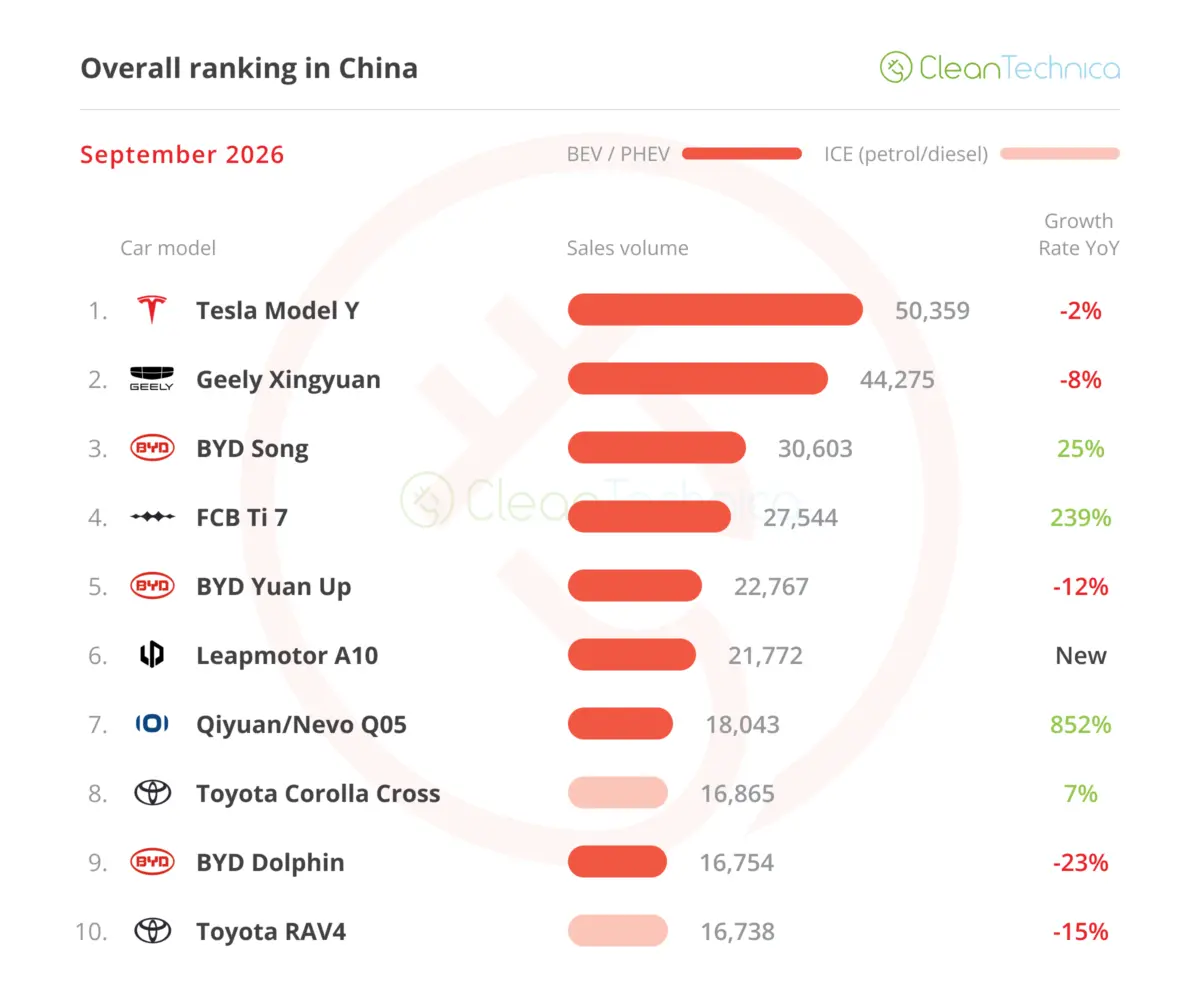
The transformation of the world’s largest automotive market reached a dramatic new milestone in September, as plug-in electric vehicles captured a record-shattering 67% of total market share in China. While previous record-breaking months were largely defined by the relentless upward trajectory of strong EV adoption, the September figures tell a dual story driven heavily by a severe collapse in internal combustion engine (ICE) vehicle sales.
The overall Chinese automotive market contracted significantly during the month, dropping 28% year-over-year to approximately 1.6 million total vehicle sales. Within this shrinking landscape, plug-in vehicle sales experienced a modest 17% year-over-year decline, but traditional pure ICE sales suffered a catastrophic 49% crash. Combined with high domestic gas prices and a seemingly endless wave of new battery-electric vehicle (BEV) and plug-in hybrid vehicle (PHEV) market entries, this steep drop in gas-powered vehicle demand pushed the overall plugin share to nearly two-thirds of the market.
Pure battery-electric vehicles accounted for 45% of September’s total sales, while plug-in hybrids captured a 22% share. Industry analysts tracking the trajectory point out that if these structural trends persist, the Chinese passenger vehicle market could achieve full electrification well before the end of the decade, with pure BEVs dominating entirely prior to 2035.
This exceptional month lifted the cumulative market share for the year 2026 up to 58% through September, already sitting four percentage points higher than the final full-year result recorded in 2025. BEVs alone climbed to a 39% YTD share, up from 33% the previous year. Industry projections now anticipate that the final tally for 2026 will surpass 60% total electrification, with pure battery-powered vehicles crossing the 40% threshold. When a market of China’s immense global scale shifts this decisively away from fossil fuels, the traditional internal combustion engine industry faces an existential crisis.
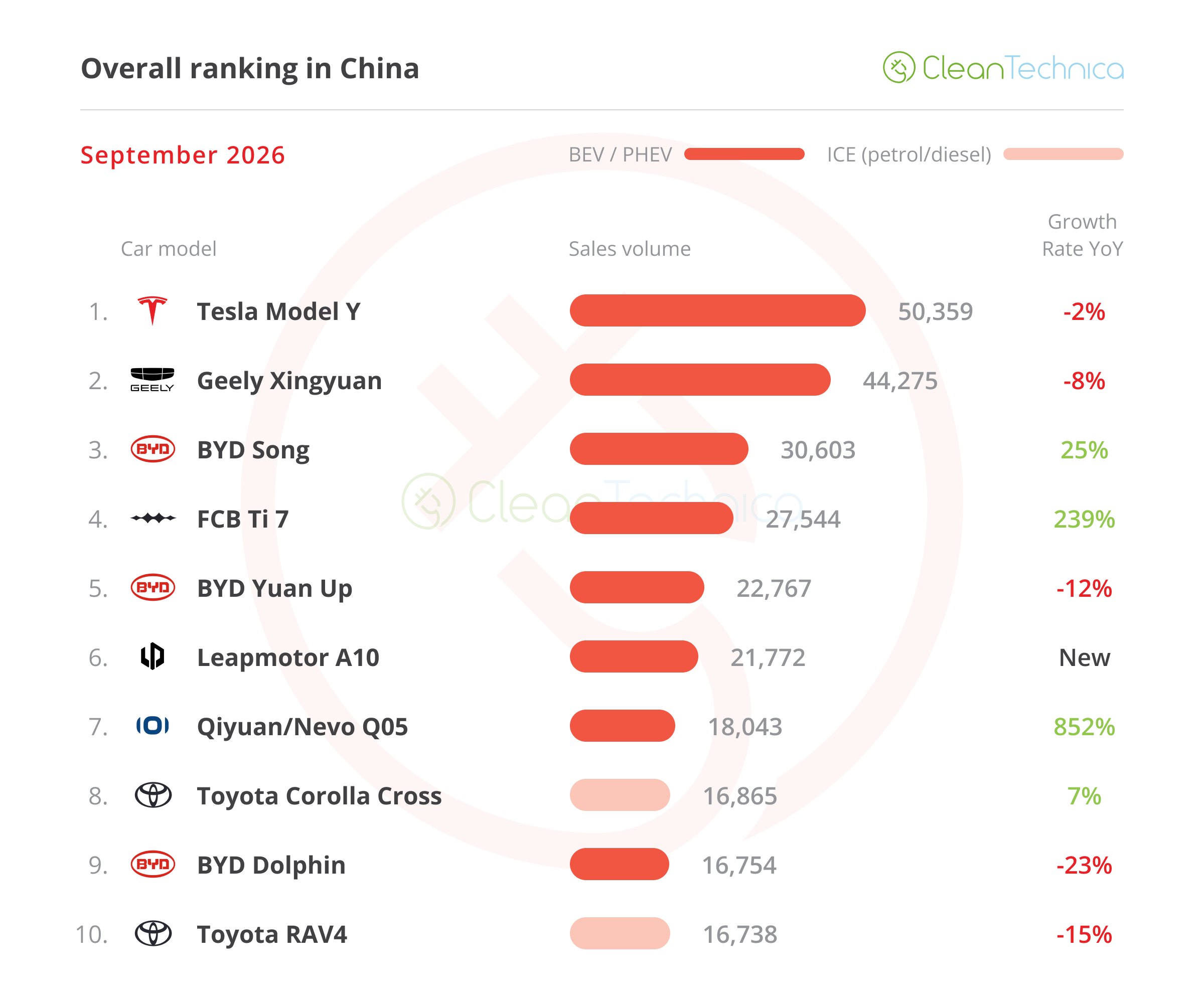
The accelerating extinction of the ICE vehicle class is increasingly evident across overall market rankings, though September did witness a rare appearance by traditional fuel vehicles within the top ten. Two internal combustion models managed to break into the overall top ten best-sellers, both originating from Toyota: the Corolla Cross secured the eighth position, while the RAV4 landed in tenth place.
While the presence of gas-powered vehicles in the top tier might seem counterintuitive given the broader market trends, it highlights how far the market has shifted. In recent months, an entirely plug-in vehicle top ten had become the standard baseline in China. Consequently, the temporary return of a couple of ICE models qualifies as notable news precisely because it represents a departure from the new normal.
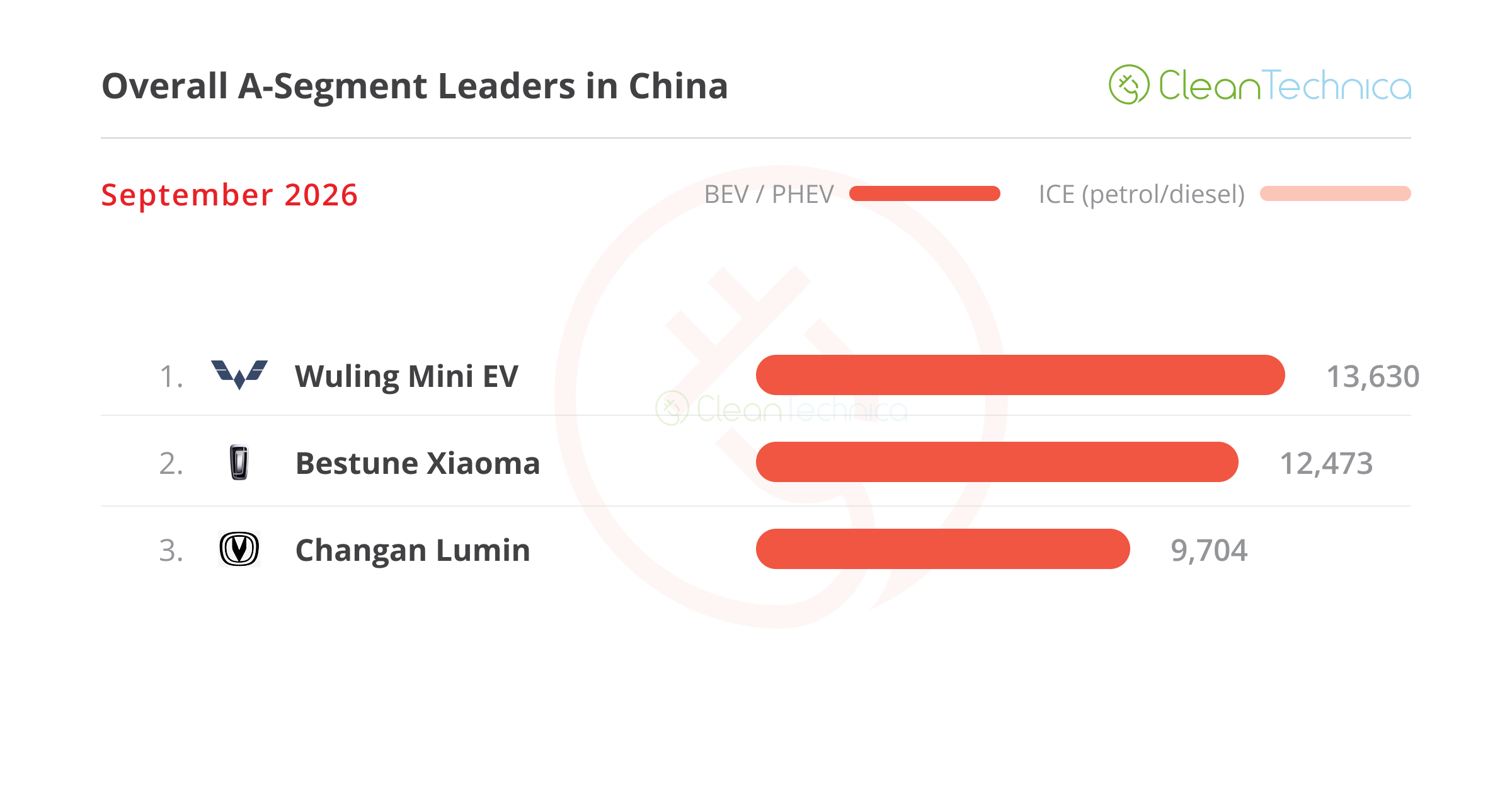
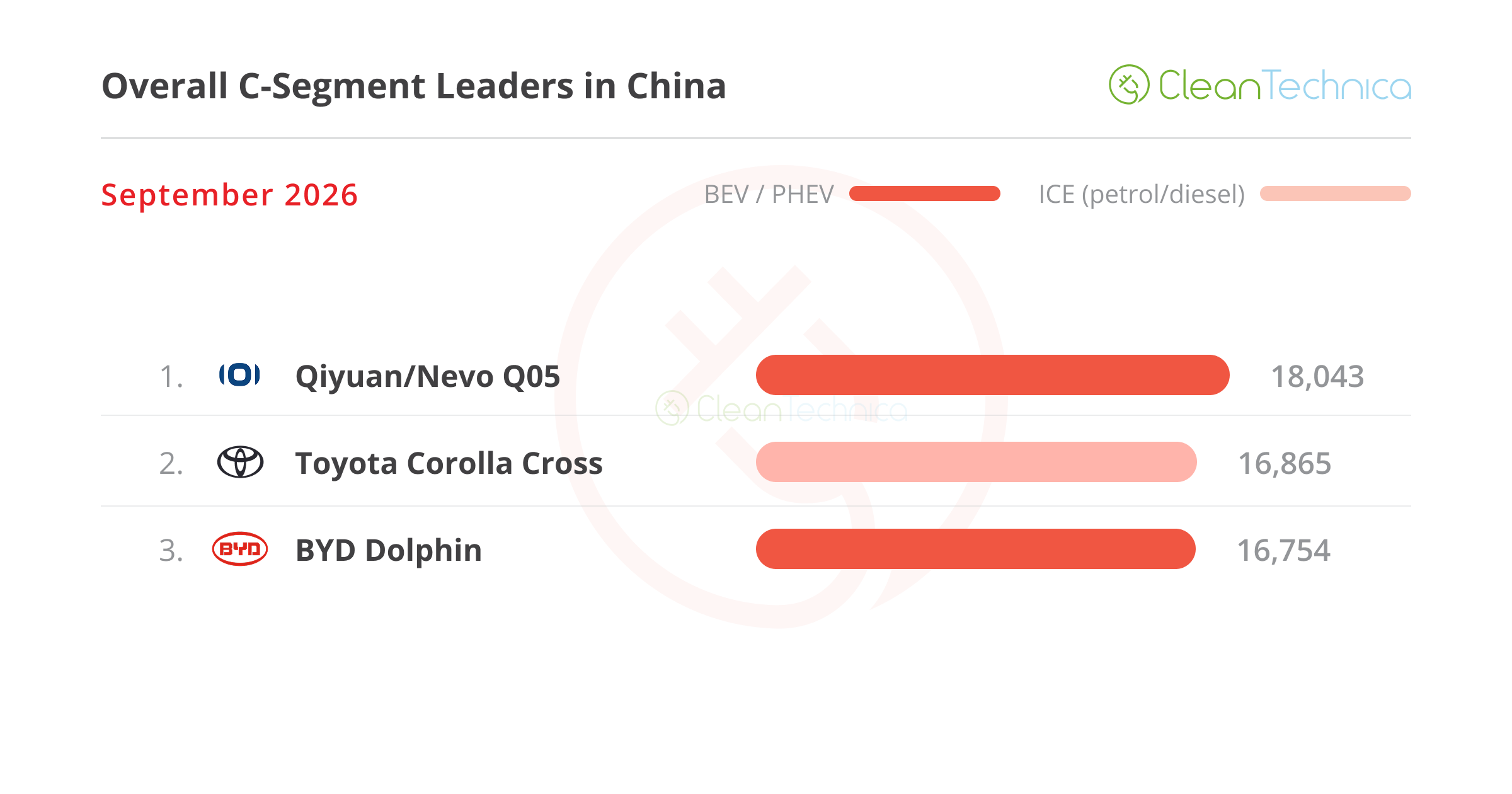
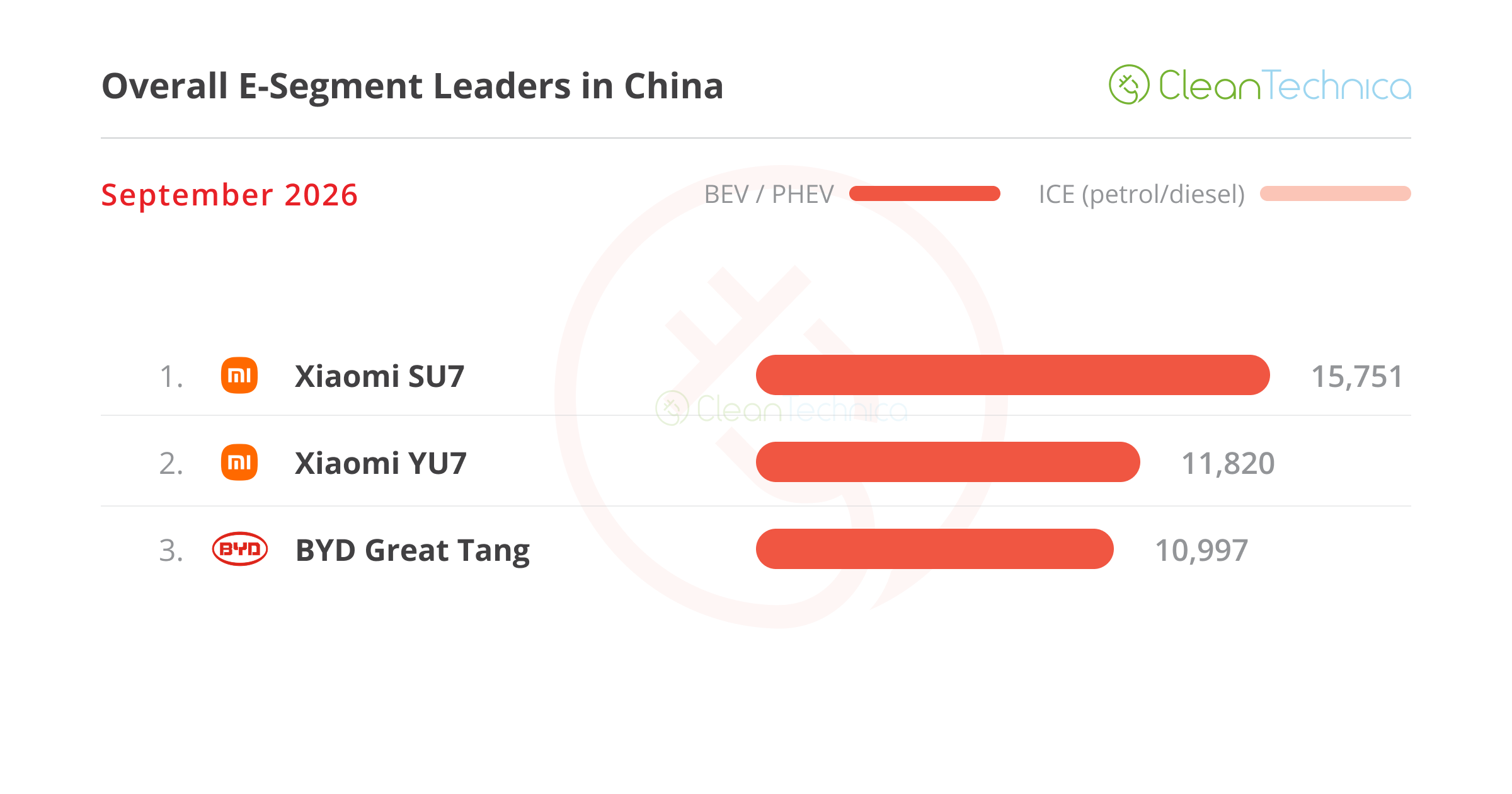
Looking across various vehicle size segments, the erosion of internal combustion dominance remains starkly visible. The compact or C-segment category serves as the primary exception, where the Toyota Corolla Cross claimed second place behind the category-leading Nevo Q05 and just ahead of the BYD Dolphin. Smaller vehicle segments are currently enjoying a notable resurgence in sales volume, with the diminutive Bestune Xiaoma making a surprising surge into second place within its respective category. Meanwhile, the upper tiers saw major developments, highlighted by BYD’s new flagship SUV, the Great Tang, claiming third place on the podium behind Xiaomi’s popular BEV offerings.
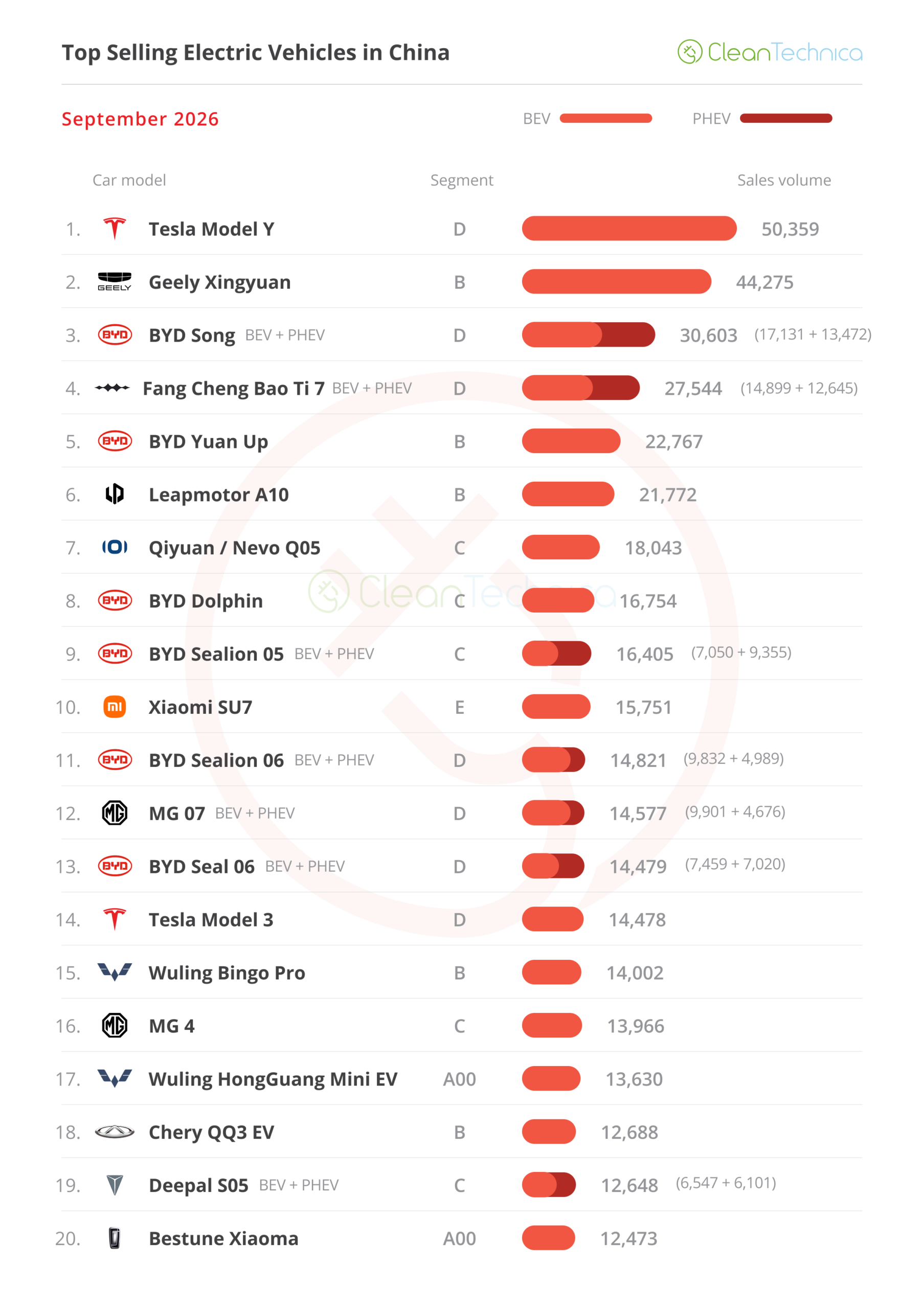
Top-Selling Electric Models in September
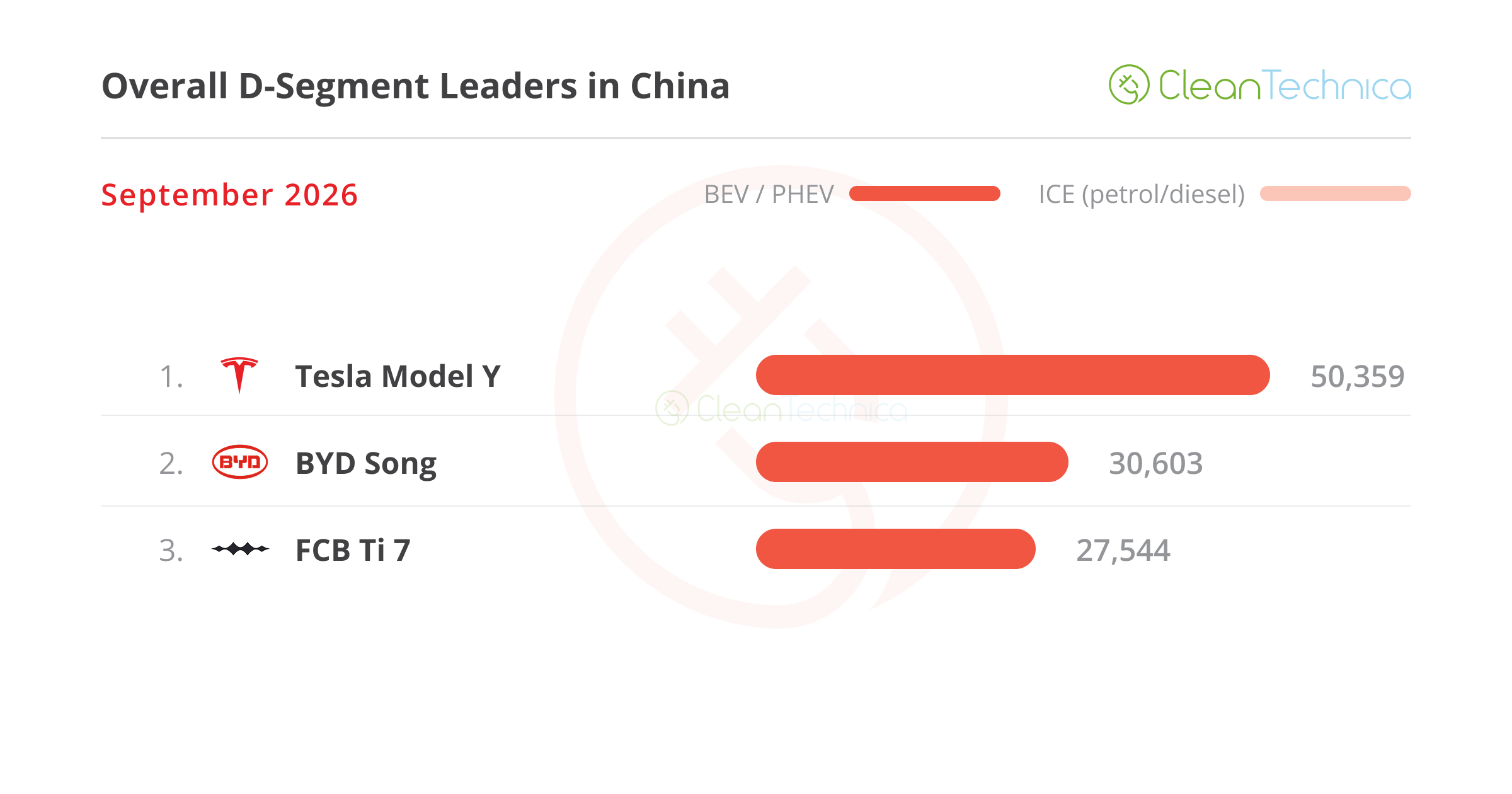
The Tesla Model Y retained its familiar position at the top of the monthly sales charts, bolstered by the introduction of its extended-wheelbase “L” variant in China. Deliveries reached 50,359 units during September, securing the monthly best-seller title. However, deliveries slipped 2% compared to the same period in 2025. While the long-wheelbase variant has successfully sustained domestic demand for the American crossover, analysts note that new variants have limitations. As direct competitors transition to advanced 800-volt architectures and integrate next-generation software features, the six-year-old Model Y architecture is beginning to show its age. While robust demand guarantees a strong podium finish for the year, maintaining top dominance moving forward faces growing headwinds.
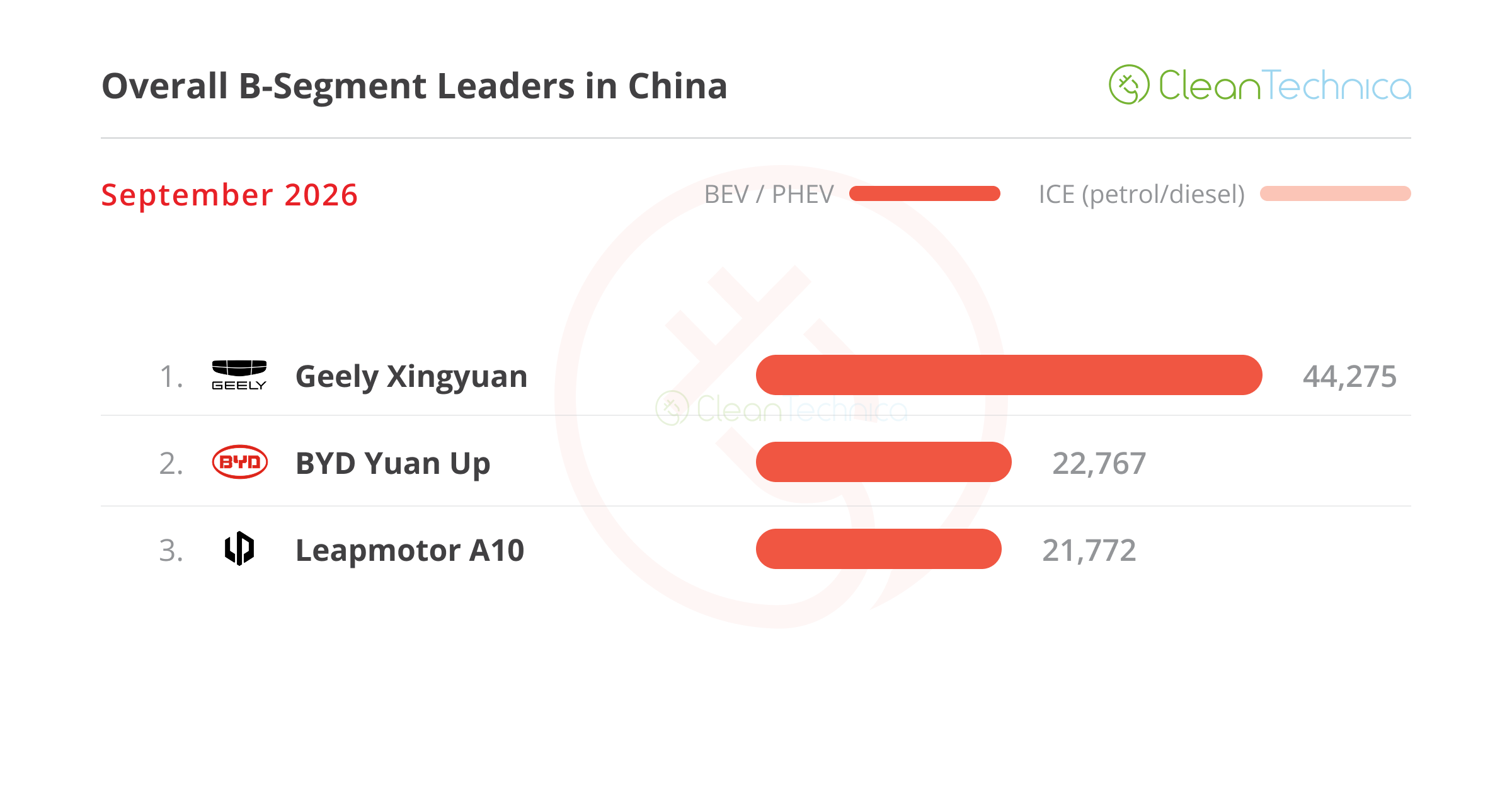
Geely’s star hatchback, the Xingyuan, secured the second spot with 44,275 registrations, though sales experienced an 8% year-over-year decline. Developed under the internal design ethos of offering “a BYD Dolphin for BYD Seagull money,” the model faces an increasingly hyper-competitive landscape. Geely’s hatchback now contends with Leapmotor’s new B-segment contenders like the A10 and A05, a next-generation Wuling Bingo, Chery’s updated QQ3, BYD’s Yuan Up, and a newly redesigned BYD Seagull explicitly aiming to capture the market’s entry-level crown.
BYD’s high-volume midsize SUV, the Song, captured third place with 30,603 registrations, marking a 25% year-over-year increase. Driven by the production ramp-up of its new Ultra body generation, the Song integrates advanced features such as LiDAR and 1,500 kW DC fast-charging capabilities. Priced competitively between 152,000 yuan ($22,000) and 180,000 yuan ($26,000) depending on battery capacity—compared to the Tesla Model Y’s starting price of 259,000 yuan ($38,250)—the Song is positioned for strong growth as production scales further.
Rounding out the top positions, BYD’s premium brand offering, the Fang Cheng Bao Tai 7, achieved a year-best performance with 27,544 registrations. Often described as a rugged, boxy alternative in the large SUV class, the model recently introduced pure battery-electric variants featuring advanced flash-charging technology. The combination of distinctive styling, robust specifications, and competitive pricing has made it a strong competitor against traditional legacy luxury SUVs and heavy-duty combustion off-roaders. Meanwhile, the economical BYD Yuan Up claimed fifth place with 22,767 registrations, continuing to perform strongly on the back of high value-for-money metrics starting near the $11,000 mark.
Broader Market Shifts and New Debuts
Further down the sales charts, several fresh entries made significant commercial impacts during their debut month. The newly launched MG 07 fastback arrived with 14,577 registrations, combining a sporty aesthetic reminiscent of European performance fastbacks with both plug-in hybrid and pure electric powertrains. The vehicle enters a crowded field alongside the Xiaomi SU7, BYD Seal 06, and Tesla Model 3, backed by a substantial backlog of pre-orders.
In the smaller vehicle category, Chery’s new QQ3 EV achieved a record 12,688 registrations to finish eighteenth, while FAW’s Bestune Xiaoma secured twentieth place with approximately 12,500 units. Just outside the top twenty, Xpeng’s new Mona L03 and the Leapmotor A05 both hovered around the 12,000-unit mark, signaling imminent entries into the top tier. Additional noteworthy debuts included Xiaomi’s Sky Nomad twin SUVs, the Geely Galaxy TT, and Volkswagen’s ID.ERA 5S, reflecting traditional foreign joint ventures’ ongoing efforts to recalibrate their product strategies.
The year-to-date standings through September show minimal change at the top, with Geely’s small hatchback maintaining its lead ahead of the Tesla Model Y in second and the BYD Song reclaiming third place. Further down the YTD table, the Fang Cheng Bao Tai 7 climbed to fourth, supported by consistent monthly gains, while the BYD Yuan Up and Leapmotor A10 secured sixth and seventh places, respectively. The cumulative table reflects a heavy concentration of BYD models, with seven distinct entries occupying spots in the top twenty, underscoring the manufacturer’s breadth of offerings.
Manufacturer and Brand Rankings
The broader manufacturer and brand landscape highlights a stark divergence between traditional legacy operations and specialized electric vehicle brands. Established legacy brands and major automotive groups continue to navigate steep year-over-year sales contractions in their legacy ICE portfolios. Even prominent EV leaders like Tesla and Xiaomi experienced relatively mild shifts compared to traditional competitors suffering contractions exceeding 20%.
Amidst the broader contraction, Hangzhou-based startup Leapmotor demonstrated significant momentum, posting a 31% year-over-year increase with roughly 78,000 registrations for the month. Bolstered by expanding production lines for the A10, A05, and upcoming flagship platforms, Leapmotor continues to pressure legacy foreign manufacturers like Volkswagen and Toyota while challenging established domestic giants like Geely for market share positioning.
At the brand level, BYD maintained its firm market leadership with a 17.2% share, supported by the commercial traction of its Fang Cheng Bao and Denza divisions. Geely held the second position at 7.1% share, though it faces mounting pressure from Leapmotor, which closed the month closely behind at 6.5%. Tesla maintained fourth place with a 4.9% share, slightly outpacing Wuling at 4.6%.
Within the automotive group and OEM rankings, BYD extended its leading share to 21.8%, while Geely held second place at 11.8%. SAIC maintained its position on the podium with an 8% share, while Leapmotor’s rapid growth allowed it to eclipse Changan and secure a prominent spot among the industry’s top manufacturers as the Chinese market continues its accelerated transition toward full electrification.