For over half a century, Charles Schulz’s Peanuts has occupied a unique space in American culture, blending gentle childhood innocence with an astonishingly sophisticated, often bleak, and deeply relatable philosophical outlook. Among the vast catalog of memorable lines, philosophical musings, and iconic strips produced over the comic’s historic run, fans and literary critics alike have frequently debated which quote best defines the overarching ethos of the strip’s central figure, Charlie Brown.
While the series is famously peppered with moments of accidental brilliance—where characters utter profound truths about the human condition without ever realizing the weight of their own words—the absolute best line belonging to Charlie Brown stands apart. It is a quote that requires complete self-awareness, offering a masterclass in how a character can articulate their own personal philosophy on life while remaining entirely true to their enduring, albeit tragicomic, nature.
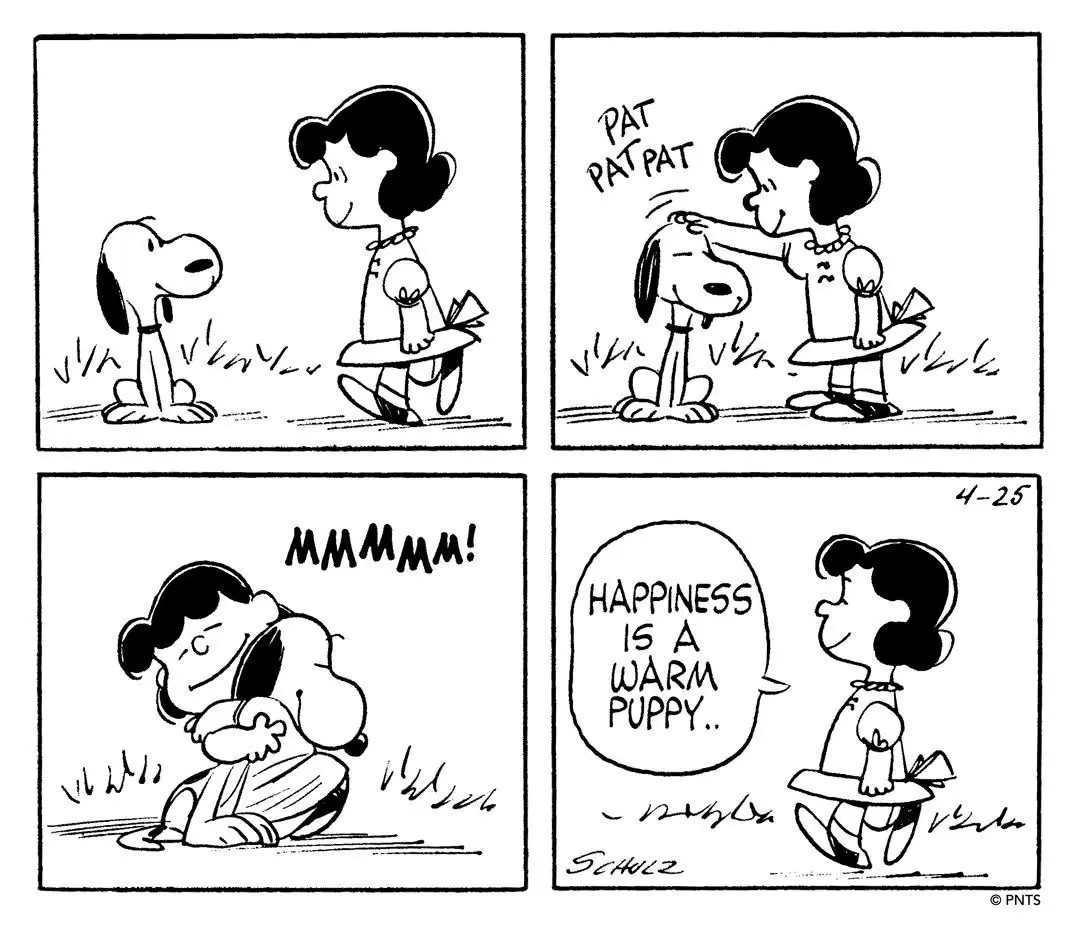
To understand the distinction between a brilliant Charlie Brown quote and a brilliant Charles Schulz quote, one must look at how dialogue functions across the strip. Many of the most celebrated lines in Peanuts involve characters stumbling blindly into poetry. For instance, Lucy’s iconic observation that "Happiness is a warm puppy" touches upon life’s simple, unadorned joys on a profoundly deep level. Similarly, the series contains arguably the definitive literary take on heartbreak: "Nothing takes the taste out of peanut butter like unrequited love!" That line perfectly captures the hollow, apathetic physiological sensation associated with romantic rejection. Yet, when Charlie Brown utters that line, he is simply reacting to the immediate sting of emotional pain without any grand, intellectual design. He is merely enduring the moment, unaware that he is summarizing a universal human heartbreak.

Determining the single greatest quote ever spoken by Charlie Brown himself requires a different lens entirely. It cannot be an accidental pearl of wisdom. Instead, it needs to be something that Charlie Brown understands just as clearly as the audience does—a moment where he looks squarely at his station in life and defines it with open eyes. It demands a moment of complete clarity regarding his personal philosophy.
To find that ideal quote, one must first confront the core identity of Charlie Brown. While he is unfailingly loyal to his small circle of friends and serves as a remarkably dedicated, caring owner to Snoopy, the stark reality at the heart of the character is that Charlie Brown is, by almost every traditional metric, a loser. While that descriptor might sound harsh out of context, it is the foundational engine of the entire comic strip. Charlie Brown is perpetually unlucky in romance, struggles academically as a thoroughly mediocre student, and almost never achieves a definitive "win."
This very streak of unmitigated misfortune is precisely what makes him so enduringly relatable to millions of readers. A vast portion of the population secretly—or openly—feels that they are not quite winning at life. Charlie Brown is the literary embodiment of that sensation; he is forever the kid who watches the football get yanked away at the absolute last microsecond just as he is winding up for a triumphant kick.
Yet, the genius of Charlie Brown—and the reason audiences continue to root for him decade after decade—lies in his stubborn, unyielding persistence. He falls for the football gag repeatedly, driven each time by the quiet, dangerous conviction that "This time I’ll get it." There is an indomitable element of hope woven into his character, even when that optimism is entirely unwarranted and systematically unrewarded. He is a sad sack, certainly, but he is an endearingly hopeful one.

Charlie Brown’s definitive philosophy on life, therefore, needs to successfully capture both halves of this internal dichotomy: his bleak, unvarnished outlook on his endless string of misfortunes, paired with the gritty, dogged persistence that keeps him getting back up to face another day. It must articulate his worldview without relying on accidental irony.
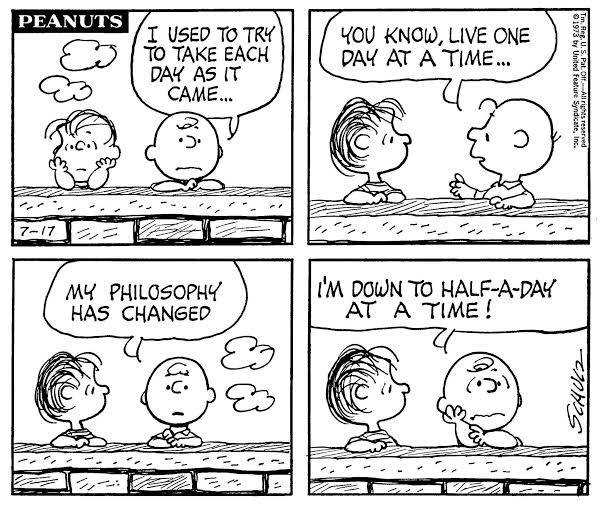
An early contender for this title appeared in a strip published in 1973. In this particular installment, Charlie Brown is leaning dejectedly against a familiar brick wall alongside his philosophical confidant, Linus van Pelt. Looking out at the world with quiet resignation, Charlie Brown remarks, "I used to try to take each day as it came… You know, live one day at a time… My philosophy has changed. I’m down to half-a-day at a time!" While this line brilliantly underscores his escalating anxiety and shrinking temporal horizons, it carries a slight risk of misinterpretation. Read out of context, stripped of the palpable misery etched onto Charlie Brown’s face, it could almost be mistaken for an ironically upbeat, mindfulness-oriented "live life to the fullest" mantra.
For an unambiguous expression of his worldview, one must look slightly further back to a remarkably similar exchange that took place against that very same brick wall in 1966.
In this strip, Linus opens the conversation by addressing the elephant in the room with characteristic bluntness: "Life is difficult, isn’t it, Charlie Brown?"

Without hesitation, Charlie Brown replies, "Yes, it is."
It is right there, following that simple affirmation, that Charlie Brown delivers what is arguably his finest line across the entire fifty-year publication history of the strip:
"But I’ve developed a new philosophy… I only dread one day at a time."
Those ten words capture the absolute essence of Charlie Brown. The statement unmistakably lays bare his bleak, defensive posture toward a world that constantly seems designed to trip him up, yet it retains that unmistakable tinge of stubborn persistence. Much like his doomed relationship with Lucy’s football, Charlie Brown expects the absolute worst from the universe—and his expectations are usually met—but he is not surrendering. He is still waking up, still standing by the wall, and still taking life’s ongoing trials strictly one day at a time.
The profound resonance of this line did not escape its creator. The quote made such an impression that Charles Schulz deliberately carried it over into the 1969 animated feature film A Boy Named Charlie Brown. In the movie, Charlie Brown and Linus share the exact same conversation by that exact same iconic brick wall. Because the feature film was written entirely by Schulz himself three years after the original newspaper strip ran, it proves that the sentiment had firmly rooted itself in the creator’s mind long after it was first published on the comic page. Just as it lingered in Schulz’s creative consciousness, it continues to resonate with generations of readers who share Charlie Brown’s weary, clear-eyed, yet infinitely enduring approach to navigating the trials of daily existence.