The inaugural interim director of the state-mandated civics center at the University of Iowa, who was left off the shortlist of finalists for the permanent role, is making a last-ditch plea to halt the search entirely. The Iowa Board of Regents is scheduled to vote on Tuesday to select the permanent leader for the Center for Intellectual Freedom, but outgoing interim head Luciano I. de Castro is urging officials to hit the brakes, even though he has stated he would no longer want the job under newly implemented operational rules approved by the board last month.
De Castro, who maintained his position as a tenured economics professor at the university during his turbulent tenure leading the center, outlined his grievances in a comprehensive, roughly 400-page report released last week. The voluminous document serves as the culmination of a yearlong feud involving university officials, board members, and the board office regarding administrative control over the center.
"Any director, however capable, will operate under close, case-by-case control by the Board, whose decisions have consistently followed the preferences of the University administration," de Castro wrote in the report.
The mounting tensions reached a boiling point last month when nearly half of the center’s 26-member Advisory Council—including several vocal, conservative-leaning faculty members—resigned following a push for a complete operational reset. De Castro’s report details a series of alleged administrative roadblocks, claiming that higher-ups wrongfully prevented him from hiring faculty, approving routine travel expenses, and managing day-to-day operations. Among the specific incidents cited is a dispute over five computer monitors provided to the center that executive director of the Board of Regents, Mark Braun, claimed were unaccounted for—an allegation de Castro attributes to an internal miscount by information technology staff.
The central finding of de Castro’s exhaustive document is that University of Iowa administrators have leveraged their influence over the Board of Regents to obstruct the center’s development at nearly every turn. Among his primary concerns is the fact that the finalists vying to replace him met earlier this month with the university president, the provost, and the Faculty Senate president. De Castro argues these meetings establish a concerning precedent, opening a direct pathway for the university administration to influence the choice of a director for a center that was explicitly designed to operate independently of it.
"If the Center is to continue, it must be given the independence [the law that created the center] intended; otherwise, it should be discontinued," de Castro wrote. "Either course is preferable to sustaining a pretense of reform, which is cheap for those who pretend but costly for the people of Iowa."
He added that appointing a permanent director under the current governance structure would lock the center into a compromised framework for years to come, arriving at a critical juncture when curriculum development must accelerate. "A permanent appointment should be made only once the Center’s governance has been settled in a way that allows it to carry out its statutory mission," de Castro noted.
The controversy surrounds House File 2800, a piece of legislation passed by Republican state lawmakers earlier this year. The law mandates that beginning in the fall of 2028, almost all undergraduate students at the University of Iowa must successfully complete one course in American history and one course in American government. Under the statutory guidelines, only the Center for Intellectual Freedom is authorized to offer these specific courses. However, as the university enters the fall semester with a student body of more than 23,400 undergraduates, the center currently employs no permanent faculty members other than de Castro.
The job posting for the permanent director position offers a lucrative salary range between $200,000 and $450,000. For comparison, de Castro reported earning just over $300,000 during his time in the interim role, a figure that included his underlying faculty compensation.
The ongoing power struggles at the University of Iowa reflect a broader, nationwide phenomenon of political friction surrounding public higher education. Across several red states, Republican legislatures and governing boards have established specialized civics centers on prominent university campuses. Although housed within these institutions, these centers are typically designed to possess a high degree of autonomy from traditional academic departments and university administration. This unique structural setup is intended to allow the centers to recruit and hire conservative-leaning faculty members without facing resistance or being overruled by existing university departments.
Yet, this very autonomy has frequently generated friction, triggering fierce disputes over operational boundaries, institutional oversight, and the extent to which surrounding universities should assist with administrative logistics. Even de Castro initially advocated for center faculty to hold traditional tenure within the university system as a protective measure should the civics center ever face dissolution. The stakes governing these centers have escalated significantly as lawmakers in states like Iowa and Utah mandate that only these newly established entities can fulfill specific general education requirements.
A Long Dispute
Clashing with administrators and regents is familiar territory for de Castro. He maintained his role as a tenured economics professor throughout his stint as interim director and frequently emphasizes that he was the sole professor at the University of Iowa who publicly advocated for the creation of the center, openly breaking with university administrators who backed alternative approaches and urging lawmakers to establish the entity.
Since the summer of 2025, when Republican Governor Kim Reynolds signed the legislation establishing the center and the board appointed him as its first interim leader, de Castro has been locked in disputes with university personnel, board staff, and board members. He has consistently alleged that these parties sought to sideline his leadership. His new report reiterates these claims, cataloging numerous instances of alleged institutional interference.
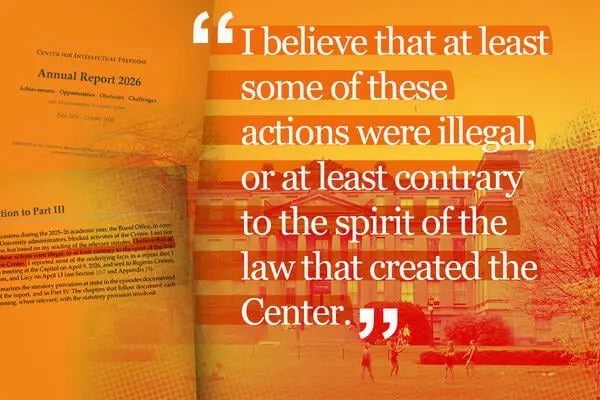
"On multiple occasions during the 2025–2026 academic year, the Board Office, in coordination with University administrators, blocked activities of the Center," de Castro stated. "I am not an expert in law, but based on my reading of the relevant statutes, I believe that at least some of these actions were illegal, or at least contrary to the spirit of the law that created the Center."
Board President Robert Cramer offered a starkly different perspective when contacted by Inside Higher Ed.
"We definitely deny that anything illegal is going on," Cramer said, confirming that the board has no intention of suspending the search for a permanent director and intends to move forward with Tuesday’s scheduled vote.
Cramer pointed directly to the looming fall 2028 deadline for the center to deliver the mandatory history and government coursework. "I’m looking for a director who will work with the university to pull off what has been mandated by the Legislature," Cramer said. "This cannot be done on an island—we’ve got to work together."
Christine Hensley, a board member who chairs the committee overseeing the center, also addressed the situation via an emailed statement. "We have received [de Castro’s] report and are currently reviewing it," she said, confirming that the search process will continue uninterrupted.
"We will continue to provide support to the Center to help meet its goals of providing scholarship on the intellectual foundation of free societies, as well as the principles, ideals and institutions of the American constitutional order, and the foundations of responsible leadership and informed citizenship," Hensley added.
The final stages of the permanent director search follow the late-September resignations of nearly half of the center’s advisory council, a group comprised entirely of out-of-state faculty members. Among those who stepped down was the former chair of the search committee, Richard Lowery, an associate professor at the University of Texas at Austin. Following these departures, only two faculty members remain on the council.
In his report, de Castro points to these departures as a turning point in his exclusion from the finalist pool. He notes that early in September, with the backing of the full advisory board executive committee, he was selected as one of 11 applicants—out of an initial pool of 62—to advance for further consideration. "The decision not to advance my application was thus made only after most of the committee members who had supported it had resigned," de Castro wrote.
Furthermore, de Castro revealed that he has formally asked the Iowa Public Information Board to investigate whether the advisory council’s executive committee—which includes Hensley and ultimately determined the shortlist of finalists—violated state open meetings laws throughout the recruitment process. The public information board did not make representatives available for an interview or respond to written inquiries.
Despite the ongoing controversy and the scathing nature of the newly released report, Cramer expressed appreciation for de Castro’s contributions during a difficult transitional period.
"We appreciate Professor de Castro taking on this role through this year, and he went through a lot of tumult to get through it," Cramer said. "And we appreciate his time and effort. I disagree with a lot of what’s in the report, and the new director will have a chance to have a reset and change things going forward."