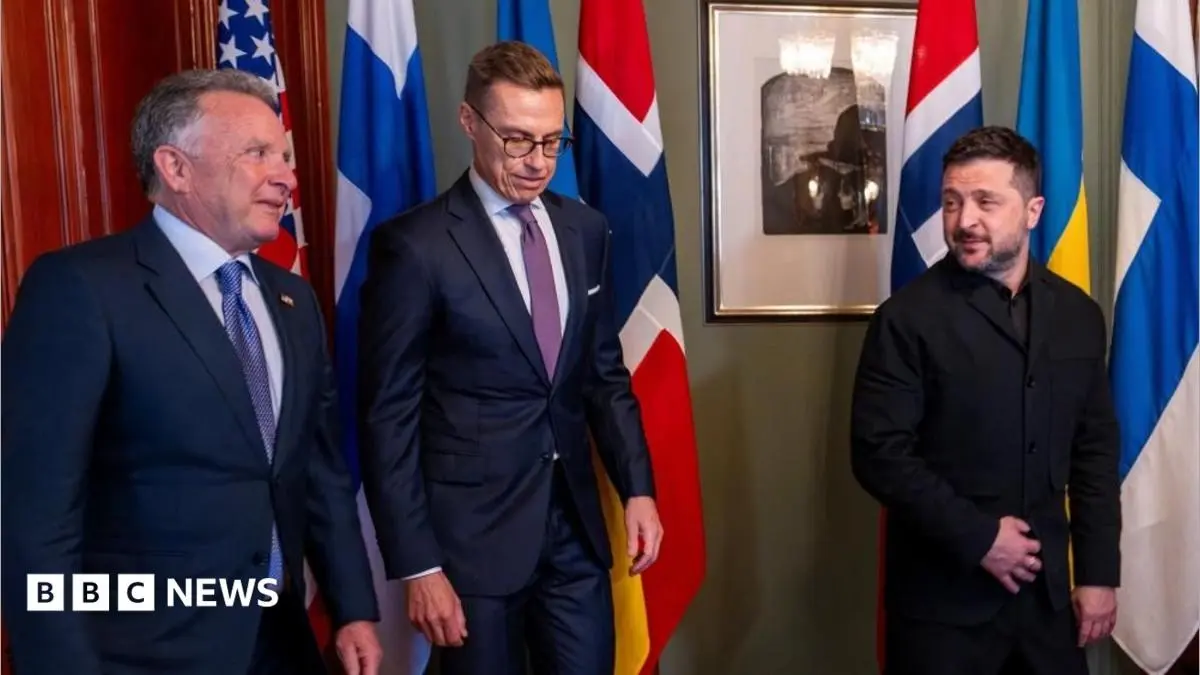
OSLO – Ukrainian President Volodymyr Zelensky has announced that the critical flow of US intelligence regarding Russian missile strikes has been restored and is now functioning effectively. The development follows a high-level diplomatic summit in Oslo, which brought together Ukrainian leadership, European allies, and key representatives from the administration of US President Donald Trump.
The breakthrough comes after a period of intense friction between Kyiv and Washington, during which Ukrainian officials publicly accused the US of withholding vital intelligence data—a charge that US Secretary of State Marco Rubio had previously dismissed as “scandalous.”
The meeting in the Norwegian capital was aimed at stabilizing the partnership between the two nations and laying the groundwork for a potential path toward ending the conflict. Finnish President Alexander Stubb, who participated in the discussions, characterized the session as a step toward "genuine progress." While Stubb remained cautious, emphasizing that the path to peace would require significant patience, his assessment provided a rare note of optimism amid the ongoing hostilities.
The Path to St. Petersburg
The primary takeaway from the Oslo summit is a set of proposed peace initiatives that are now set to be tested on the diplomatic front. Following the talks, President Zelensky and his European counterparts stated that the onus now shifts to Moscow. Steve Witkoff, President Trump’s special envoy, is scheduled to arrive in St. Petersburg on Wednesday to present these proposals to Russian President Vladimir Putin.
While Witkoff was notably absent from the joint press conference held in Oslo on Tuesday, the administration’s presence was maintained through Jared Kushner, who joined the deliberations via a secure video link. A US official briefed on the meeting described the proceedings as "very productive and constructive," noting that there was a "strong alignment at the working level" among the United States, Ukraine, and their European partners regarding the "next steps" for the conflict.
The Kremlin’s response remains the great unknown. While President Putin has yet to offer a public statement on the specific proposals, Russian Foreign Minister Sergei Lavrov signaled earlier that Moscow would be willing to listen to what Witkoff brings to the table. However, Lavrov was quick to set boundaries, explicitly ruling out "any political concessions," a stance that underscores the monumental challenge facing negotiators.
Tensions and Shifting Dynamics
The atmosphere surrounding these negotiations is colored by a recent, sharp deterioration in relations between Kyiv and the Trump administration. In recent weeks, President Trump has openly questioned the leadership in Ukraine, suggesting that the nation requires a new president and even proposing that "somebody else" should negotiate on behalf of Kyiv.
Furthermore, as the United States approaches next month’s midterm elections, domestic political pressures have begun to weigh heavily on foreign policy. President Trump has repeatedly criticized Ukraine’s tactical strikes on Russian oil refineries, linking them to rising fuel prices in the US—a concern that has become a flashpoint for American voters, particularly given the global economic volatility exacerbated by the US-led war on Iran.
Despite these tensions, the urgency of the conflict remains undeniable. Putin’s full-scale invasion, launched in 2022, has resulted in Russia maintaining control over approximately 20% of Ukrainian territory. The human cost of this occupation continues to mount daily; on Tuesday, as diplomats met in Oslo, Russian drone attacks claimed the lives of at least 10 people, including four in the capital region of Kyiv, four in the eastern Donetsk region, and two in the central city of Dnipro.
Restoring Critical Intelligence
For President Zelensky, the restoration of intelligence sharing is not merely a diplomatic win—it is a matter of immediate survival for the Ukrainian populace. Addressing reporters after the Oslo summit, Zelensky expressed palpable relief regarding the renewed flow of data.
"I am thankful that intelligence works now," Zelensky said. "Speaking about early warning, which is very important for our people, our children, adults, civilians because we can hear when ballistics is coming—so we are thankful to the American side, now it works, it’s great."
The Ukrainian leader also touched upon the necessity of maintaining access to SpaceX’s Starlink satellite network. The military’s reliance on the platform for coordination and drone strikes has faced complications recently, with reports of speed restrictions that have hindered operations. Zelensky noted that he hoped for a positive resolution on this front as well, following what he described as a "constructive discussion" with Secretary of State Rubio regarding the broader needs for early warnings, missile interceptors, and technological support.
The concern over Starlink is not unique to the Ukrainian military. Last week, a bipartisan group of US senators formally called for an urgent investigation into the reported speed limitations imposed on the network in Ukraine, reflecting the growing anxiety among American lawmakers about the reliability of critical infrastructure in the theater of war.
Security Guarantees and the European Role
While the diplomatic focus remains on ending the war, Zelensky reiterated that Ukraine is "ready for negotiations," provided the conditions are right. "Of course, we are not losing this war, but we are losing people because Russia attacks," he stated, emphasizing the humanitarian imperative behind the push for a ceasefire.
The Oslo discussions also encompassed the development of "strong" security guarantees for Ukraine and proposals for an energy-focused ceasefire. Norwegian Prime Minister Jonas Gahr Støre, a key host of the summit, underscored the necessity of European inclusion in the process. He emphasized that Europe "needs to be at the table" during any negotiations, reflecting the continent’s role as both a primary donor and a party directly affected by the security fallout of the conflict.
The question of military hardware, particularly the Patriot missile interceptor systems, remains a point of contention. While unconfirmed reports on Tuesday suggested that the transfer of additional Patriot systems had not yet received final approval, Secretary of State Rubio offered a nuanced response while on a diplomatic visit to India. He acknowledged that the interceptors might not have reached Ukraine yet, but stressed that the US had not intentionally denied any requests to Kyiv.
Divergent Perspectives on the Alliance
The complexity of the US-Ukraine relationship was further highlighted by recent comments from US Vice-President JD Vance. In an interview on Monday, Vance articulated a perspective that contrasted with the "strong alignment" suggested by other officials, questioning the very nature of the partnership.
"I think they should stop bombing Russian energy," Vance said, echoing the administration’s concerns regarding fuel prices. "We don’t have a formal alliance as far as I know with Ukraine. They’re not in NATO, I don’t think they should be in NATO… we’re gonna work together on some things, but also we’re going to be opposite on some things too."
This sentiment of "divergent interests" has created a sense of uncertainty among European leaders. German Chancellor Friedrich Merz, speaking on Bloomberg TV, described the current international landscape as characterized by "mixed pictures and messages." Merz stressed that he is working to convince the American government that the conflict is a shared responsibility.
"It’s really a big effort for our budgets, it’s really a big thing for the European Union, but we are doing that and we are trying to keep on doing that until this terrible war ends," Merz said.
As the diplomatic caravan prepares for the next phase of the mission—the high-stakes meeting between Steve Witkoff and President Putin in St. Petersburg—the international community remains in a state of watchful waiting. The progress made in Oslo offers a sliver of hope that the conflict might shift from the battlefield to the negotiating table, yet the deep-seated divisions and the tragic daily reality of the war serve as a stark reminder of how far the parties remain from a definitive resolution.