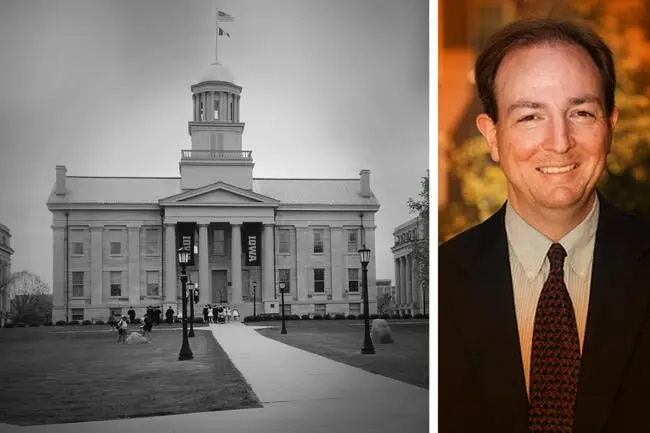
The Iowa Board of Regents voted unanimously on Tuesday to hire the first permanent director for the prominent civics center at the University of Iowa, moving forward despite sharp opposition and a public call from the center’s interim leader to suspend the search entirely.
The board offered the high-profile position leading the University of Iowa’s Center for Intellectual Freedom to Carson Holloway, who currently serves as the chair of the political science department and interim chair of the philosophy department at the University of Nebraska at Omaha. Holloway’s appointment marks a pivotal turning point for the academic center, which has experienced a turbulent launch characterized by high-profile faculty resignations, fierce governance disputes, and administrative friction.
Holloway brings a substantial academic background to the role, having authored or co-edited several notable books focusing on American political thought and founding figures, including studies on Alexander Hamilton, Thomas Jefferson, and George Washington. Beyond his traditional academic appointments, Holloway has also cultivated deep ties to prominent conservative institutions and intellectual networks. He previously served as a William E. Simon Visiting Fellow in Religion and Public Life at the James Madison Program in American Ideals and Institutions at Princeton University—an initiative that has heavily influenced the development of similar civics centers established by Republican lawmakers and university governing boards at prominent public universities across conservative-leaning states.
In addition to his time at Princeton, Holloway has held fellowships with other major conservative think tanks. He served as a Visiting Fellow in American Political Thought at the B. Kenneth Simon Center for Principles and Politics at the Heritage Foundation, and he is listed by the Claremont Institute as a Washington Fellow at its Center for the American Way of Life.
Most recently, Holloway authored a book published this year by the conservative publisher Encounter Books titled No Liberty to Libel: The Constitutional Case Against New York Times v. Sullivan. In the volume, Holloway argues that the Supreme Court should overturn the landmark decision, which historically provided journalists with critical legal defenses against defamation lawsuits.
Board Leadership Defends the Selection
Iowa Board President Robert Cramer defended the board’s decision during an interview following Tuesday’s vote, emphasizing that the governing body sought an administrator with a proven track record, solid academic credentials, and a dedicated interest in history and civics.
"We are looking for somebody who’s going to be student-focused," Cramer told Inside Higher Ed, highlighting the qualities the board prioritized during the months-long search. "We feel very optimistic that he is the right guy for a reset. And that will mean he has a real partnering attitude, but also understands the requirements and goals of the center."
The vote to offer Holloway the position followed nearly five hours of closed-door deliberations by the board on Tuesday. The regents emerged briefly at the conclusion of the executive session to approve the hire unanimously and address ongoing public criticisms.
Cramer specifically pushed back against a recent critical report issued by the center’s outgoing interim director, Luciano I. de Castro. De Castro, who was among the 11 finalists considered for the permanent directorship, released a scathing document accusing the board, its administrative office, and the university of improperly sidelining him and undermining his leadership.

"The legislation creating the Center for Intellectual Freedom clearly states that the director of the center reports to the Board of Regents," Cramer said, addressing de Castro’s grievances. "As Professor de Castro is one of the proponents of the legislation, he should’ve understood that the board takes an active role in the institutions that it governs."
Cramer added that friction arose because a subset of the center’s advisory council and the interim leadership resisted ordinary oversight regarding public funding and institutional compliance. "There was a small subset of the advisory council on the center and the interim director that appeared they did not want any oversight of the center and its use of taxpayer dollars by following the university policies or board advice and counsel," Cramer said. "This subset of the advisory council that wanted no oversight resigned."
A Tumultuous Beginning and Mass Resignations
The appointment of a permanent director comes after a tumultuous startup period for the Center for Intellectual Freedom. Late last month, nearly half of the center’s 26-member advisory council—including several vocal, conservative-leaning faculty members—tendered their resignations. Notably, every single faculty member who departed was from an out-of-state institution, leaving just two faculty members remaining on the advisory body. Furthermore, the center currently employs no full-time faculty beyond de Castro, whose tenure as interim director concludes as he departs his position.
Despite the staffing vacuum, the center faces a strict legislative mandate requiring it to begin offering specialized American history and American government courses by the fall of 2028. These courses will be mandatory for all undergraduate students at the University of Iowa, an institution serving more than 23,400 undergraduates this fall.
Following the mass departures of the advisory council, Mark Bauerlein—an Emory University professor emeritus whom Florida Republican Governor Ron DeSantis previously appointed as a trustee for the New College of Florida—stepped in to serve as the faculty leader of the search, according to Iowa board member Christine Hensley. Meanwhile, the board has begun formal contract negotiations with Holloway. The anticipated salary range listed for the directorship position falls between $200,000 and $450,000.
Sharp Criticism From Departing Academics
The board’s heavy-handed approach to governance and oversight has drawn intense condemnation from the academics who chose to walk away from the project. Richard Lowery, an associate professor at the University of Texas at Austin and a former advisory council member who previously chaired the search committee, offered a blistering assessment of the regents’ management style.
Lowery asserted that the board under Cramer’s leadership has failed to provide anything resembling reasonable oversight of the university. He called it absurd that an official like Cramer should hold governing authority over an academic institution, claiming that "all the serious academics on the advisory board" ultimately chose to resign in protest.
"Everything on governance of universities says regents should be reviewing budgets and hiring the apex executive," Lowery said, criticizing the board’s operational interference. "And the day-to-day decisions about what goes on, who gets invited to speak, who gets hired—that belongs with whoever is put in charge of the academic unit. It doesn’t belong at the board… This particular board certainly shouldn’t be involved in running an academic unit."