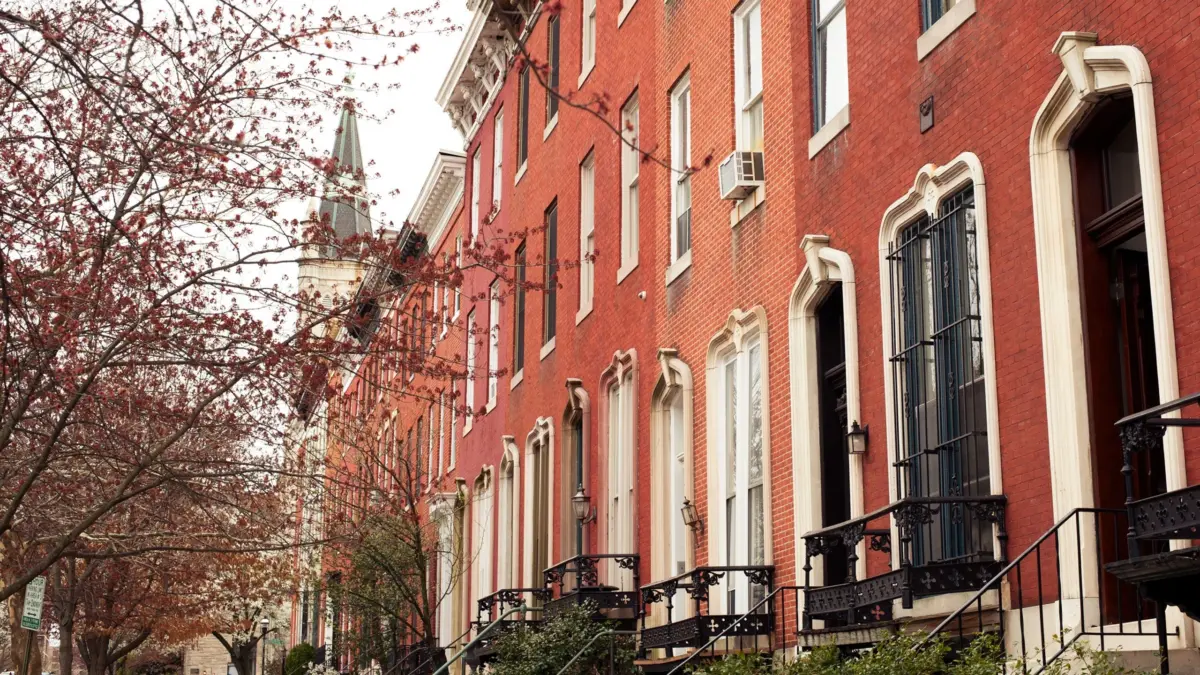
Drive through Baltimore’s vibrant and historic city center, and you will immediately encounter street after street of enduring row homes, many of them standing proud after more than a century of history. Roughly half of the city’s estimated 300,000 housing units consist of these decades-old historical row houses, though their current structural integrity, maintenance, and overall market quality vary dramatically from block to block.
Baltimore has long remained a city defined by striking contradictions. It pulses with rich American history and distinct East Coast charm, yet it continues to grapple with deep-seated economic challenges, particularly housing affordability. Approximately 20% of the city’s 577,000 residents live below the official federal poverty line, cementing Baltimore’s status as one of the poorest major urban centers in the entire United States.
These vulnerable socioeconomic conditions have historically made the local housing market exceptionally susceptible to bad actors, opportunistic speculators, and predatory practices. For decades, the municipality has struggled with a persistent epidemic of negligent slumlords who allow thousands of residential properties to languish in states of severe disrepair and prolonged vacancy. Local policy research estimates that these vacant properties cost Baltimore roughly $200 million annually in combined lost property tax revenues and increased public service expenditures for emergency and municipal management.
Beyond structural abandonment, Baltimore has also contended with waves of real estate fraudsters who view the fragile local market—where much of the population lacks the personal financial resources or legal safety nets to easily defend against sophisticated white-collar crime—as fertile ground for rapid, illicit enrichment.
The scope of this vulnerability came into sharper public focus when a comprehensive journalistic investigation by the Baltimore Banner targeted Eluzer Gold and Benjamin Eidlisz, two New York-based real estate investors who acquired more than 700 residential properties across the broader Baltimore metropolitan area. The investigative reporting published mounting evidence suggesting that the pair had masterminded an elaborate, multi-layered scheme designed to systematically profit off distressed real estate in the city, concentrating heavily within historically Black neighborhoods.
Now, two major civil lawsuits filed in federal court have significantly ratcheted up pressure on local, state, and federal law enforcement officials to expand their investigations. The newly filed legal complaints allege that Gold, Eidlisz, and a network of co-conspirators directly violated federal Racketeer Influenced and Corrupt Organizations (RICO) statutes, ultimately defrauding private institutional lenders out of more than $24 million. According to the court filings, the defendants executed this sophisticated enterprise by rapidly reselling distressed homes back and forth between corporate entities they entirely controlled, purposefully defaulting on the underlying mortgages, pocketing millions of dollars in liquid profits, and triggering a cascade of devastating property foreclosures across dozens of Baltimore neighborhoods.
While court records indicate that an ongoing FBI investigation has been examining Gold, Eidlisz, and their alleged co-conspirators, federal law enforcement officials have maintained standard agency policy by declining to officially confirm or deny the existence of an active probe.
How the Alleged Fraud Worked
The mechanics of the alleged multi-million-dollar mortgage fraud ring were laid bare in court documents filed in Maryland District Court. On Sept. 9, Ameritrust Mortgage Corp. filed an expansive 60-page lawsuit naming Gold, Eidlisz, and a third individual, Shraga Chaim Lerner, as key orchestrators of an extensive real estate fraud ring. The suit alleges the group worked in concert to secure at least 90 institutional loans worth more than $14 million under false pretenses, with the clear, pre-meditated intent of defaulting on the debt obligations and absconding with the cash.
Just one week later, a second massive legal filing was submitted by RCN Capital LLC and Commercial Lender LLC. This 175-page complaint detailed strikingly similar allegations, accusing Gold, Eidlisz, and their associates of defrauding them out of an additional $10 million across a portfolio of 59 properties purchased and systematically driven into default between 2023 and 2024.
According to the civil complaints, the operation relied heavily on a network of shell companies managed by Eidlisz to acquire low-cost, severely distressed Baltimore properties. The vast majority of these initial acquisitions were purchased at rock-bottom prices, typically ranging between $40,000 and $60,000. Lenders allege that once Eidlisz secured the deeds, he immediately flipped the properties to more than a dozen distinct corporate limited liability companies operated by Gold, marking up the sale prices by three to four times the original acquisition cost. These rapid transactions frequently occurred within mere days or weeks of the initial purchase.
To secure financing and justify these extraordinary price inflations to lenders, the lawsuits claim that Eidlisz employed a dedicated group of co-conspirators to submit fraudulently inflated property appraisals. These appraisals allegedly featured doctored photographs, fabricated property descriptions, and deliberately omitted prior sales histories from the loan applications.
As the Ameritrust Mortgage complaint highlights, the property flips transpired with such velocity that the seller could not possibly have performed any meaningful renovations as represented in the paperwork. In many cases, the seller never took physical possession of the property at all, or held the title for only a brief, symbolic window.
The RCN Capital lawsuit specifically names a roster of real estate appraisers as co-defendants, arguing that their professional misconduct was essential to the enterprise’s ability to continually secure loans for three to four times what a property had sold for just days prior.
"The Lenders would not have made any of සුදුසු loans … had they received an industry compliant appraisal valuing the real property because each such appraisal materially overvalued the property and caused the Lenders’ loan to value underwriting standard to be breached," the lawsuit states.
Furthermore, investigators uncovered operational overlapping between the defendants. In certain instances, Gold allegedly submitted loan applications using Eidlisz’s personal email address, while on other occasions, Eidlisz reportedly signed Gold’s name directly onto credit applications. While the broader network acquired roughly 700 properties across the city—frequently targeting economically disadvantaged communities—the two federal lawsuits specifically focus on approximately 150 properties, the vast majority of which have already been pushed into foreclosure.
As a stark real-world example of the mechanics behind the scheme, lenders point to the history of 1829 N. Bond St. Property records show that Benjamin Eidlisz purchased the Baltimore row home in March 2023 for $43,000. Just four months later, in July 2023, he flipped the property to Levy Ventures, an LLC registered directly to Eluzer Gold, for an astounding $310,000. Despite the massive valuation jump on paper, the pair allegedly allowed the property to deteriorate further without performing structural improvements, leading to an inevitable foreclosure. When the property eventually returned to the open market showing clear signs of neglect and zero renovation work, it was listed for a mere $35,000.
Debt Service Ratio Loans Fund the Alleged Fraud
The twin federal lawsuits represent only a fraction of a much larger pool of capital, believed to involve approximately $100 million in debt service coverage ratio (DSCR) loans—a specialized form of hard-money commercial financing—that the pair allegedly leveraged to fuel their operations.
Unlike traditional residential mortgages that rely heavily on the personal income, credit scores, and employment verification of an individual buyer, debt service coverage ratio loans permit institutional real estate investors to borrow capital based primarily on the projected rental income generated by the investment property itself.
"It’s leverage at scale," explains Josh Jankelow, president and founder of Olympus Financial, a mortgage broker and lending firm specializing in DSCR financing.
"Most DSCR loans close in an LLC and don’t report to personal credit," Jankelow explains. "When that borrower applies for the next loan, the lender typically looks only at what they own personally, like a primary residence. Properties held in LLCs often never come up. That’s how one borrower can stack hundreds of loans across lenders who each see only their own file."
While Jankelow notes that DSCR loans can serve as highly effective financial tools for legitimate, experienced real estate investors working to scale portfolios, he emphasizes that the financial product is inherently vulnerable to exploitation by predatory operators.
With a traditional conventional mortgage, Jankelow points out, strict underwriting guardrails are enforced by federal regulations. These rules dictate independent appraiser selection processes and strictly limit direct communication between loan officers, buyers, and appraisers.
"If people had nefarious plans to do some sort of loan scheme, on the conventional end, there’d be a million safeguards in place. Anytime values increase like that in the short term, there’s heavy, heavy, heavy investigation," he continues. "The odds of a value inflating 300%, 400%, 500% in a few months are slim to none. Any reasonable appraiser is going to say, ‘Hold on, this thing sold three months ago for $40,000. How are we getting $250,000 right now? The market doesn’t support it.’"
Crucially, municipal records show that building permits were never pulled for the vast majority of properties acquired by Gold and Eidlisz, confirming that the substantial rehabilitation work that theoretically could have justified inflated valuations never actually occurred.
"With DSCR loans, if there is a bad guy appraiser and some bad actors, it becomes a lot easier for them all to work together," Jankelow notes. "Conventional lenders will say even if this is an investment, how many other properties does this guy own? How leveraged is he? The nature of DSCR for businesses is that they don’t look at that."
Even so, Jankelow stresses that the overwhelming majority of borrowers utilizing DSCR products are legitimate entrepreneurs striving to build sustainable real estate portfolios. At its best, he says, it functions as a functional commercial tool, though in this case, it unfortunately brewed a "perfect storm of a scam."
Baltimore’s Market Bears the Brunt
More than a year after the contours of the scheme first came to light, the fallout continues to reverberate deeply across Baltimore’s fragile housing market and directly impacts vulnerable local residents.
While many of the properties acquired by Gold, Eidlisz, and Lerner were physically vacant at the time of purchase, residential tenants occupying several of the targeted addresses expressed profound shock and distress upon discovering formal foreclosure notices pinned to their doors.
Under Maryland law, residential tenants retain the legal right to remain inside foreclosed properties until the formal expiration of their lease agreements. However, for individuals and families living on fixed or low incomes, scrambling to secure alternative housing and muster the necessary security deposits can present an insurmountable hurdle.
When initial investigative reporting regarding the market anomalies dropped in 2025, Baltimore experienced a notable 26% year-over-year surge in residential foreclosure filings. Elevated foreclosure levels have persisted in the time since. According to real estate analytics firm ATTOM, the broader Baltimore metropolitan area ranked 18th nationwide in per capita foreclosures, while Baltimore City itself climbed to fifth nationally, with roughly 1 in every 677 residential properties facing foreclosure proceedings.
Will Rapuano of Pruitt Title, a title and closing professional who oversees transactions across Maryland, Virginia, and Washington, D.C., observes that while these fraudulent foreclosures often concentrate heavily in specific urban micro-markets, the localized damage is severe.
"The damage there is real. Foreclosures pull values down on the surrounding blocks, tenants face displacement, and the private lenders who got burned have pulled back. That makes it harder for honest investors to finance the rehabs those same neighborhoods need," Rapuano says.
While the primary actions currently advancing through the legal system are civil lawsuits, potential criminal indictments may be forthcoming as the federal probe continues. An additional federal complaint filed earlier this year by Pigtown Portfolio LLC and East Baltimore Investments II LLC further alleges that Eidlisz and Gold engaged in systemic deed fraud, falsely representing managing member statuses and executing sales to Gelt Ventures LLC—an entity co-owned by the pair—using borrowed institutional funds.
Federal courts have already begun handing down convictions in parallel local real estate fraud matters. Earlier this year, a U.S. District judge sentenced Baltimore-area attorney Alexander Schultz and his legal counsel, Jacob Rappaport, to prison terms of two months and 15 months, respectively, for their roles in a closely related real estate and bank fraud scheme.
According to federal prosecutors, Schultz purchased 42 homes across Baltimore for $87,500 each in December 2021. He then collaborated with co-conspirators to artificially inflate their values, executing same-day flips that generated $6.9 million in sales and a one-day profit exceeding $3 million. Those exact properties were subsequently resold in 2023 for $9.9 million to Zahav Ventures LLC, identified by investigators as one of the numerous corporate entities backed by Gold and Eidlisz.
Today, those properties languish in foreclosure. Legal counsel representing Eidlisz and Gold has not yet formally entered appearances in the ongoing court records, and requests for comment directed to Eidlisz have not been returned.