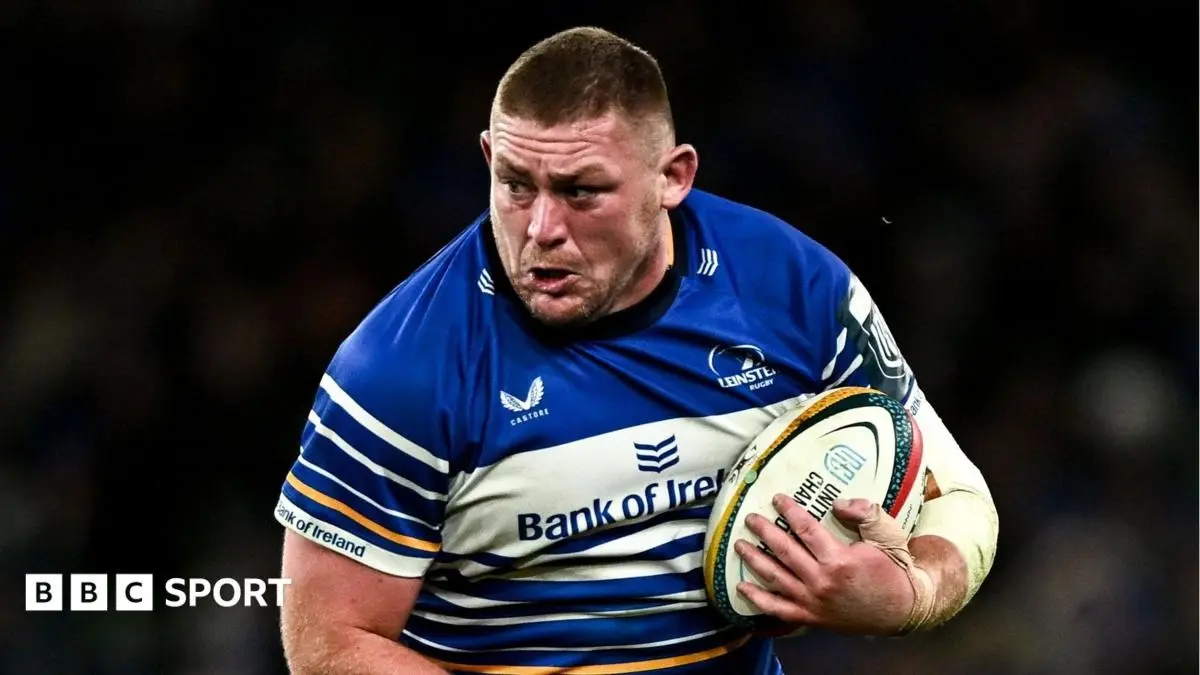
Ireland and Leinster prop Tadhg Furlong has been officially cited following an alleged incident of foul play involving a groin grab during Leinster’s hard-fought victory over Munster at the Aviva Stadium this past Saturday. The development marks a significant turn in the aftermath of the United Rugby Championship (URC) clash, casting a shadow over what was otherwise a high-stakes encounter between the two provincial rivals.
The allegation initially surfaced during the closing stages of the first half of the match. Munster back row Gavin Coombes, visibly incensed by an interaction during a breakdown, raised the complaint directly with match referee Andrew Brace. The incident occurred in the 37th minute while Munster held a lead, prompting a brief pause in play as the officials attempted to ascertain exactly what had transpired on the pitch. At the time, television match official (TMO) Colin Stanley reviewed the available camera angles, but he was unable to identify definitive video evidence to support the claim during the live broadcast. Consequently, no immediate on-field sanction was issued, allowing the match to proceed to its conclusion—a 24-18 victory for Leinster.
Despite the lack of an immediate ruling, the disciplinary wheels have since begun to turn. Furlong, a stalwart of the Irish front row and a player widely respected for his technical prowess and longevity at the highest level of the game, is now facing a formal citation under Law 9.27. This specific law is designed to uphold the integrity of the sport, explicitly stating that "a player must not do anything that is against the spirit of good sportsmanship including but not limited to grabbing, twisting or squeezing the genitals."
The URC confirmed the citation in a brief statement, noting that the "arrangements for the disciplinary process are currently in progress and will be announced in due course." This process will likely involve a hearing where Furlong will have the opportunity to contest the charge or present evidence in his defense. The outcome of this hearing carries significant implications, not only for the player himself but for the broader landscape of Irish rugby as the international season approaches.
Should the disciplinary panel find Furlong guilty of the offence, the 33-year-old faces a substantial period on the sidelines. Such a suspension would jeopardize his availability for Ireland’s upcoming Nations Championship campaign, which includes marquee fixtures against Argentina, Fiji, and South Africa at the Aviva Stadium. Furthermore, a ban would extend to the finals weekend in London, depriving the national team of one of its most influential leaders during a critical juncture in the international calendar.
The severity of the potential punishment is underscored by a recent precedent set within the same competition. In October 2025, South African front-rower Jan-Hendrik Wessels was handed a nine-match suspension for a similar offence—grabbing the genitals of Connacht’s Josh Murphy during a Bulls victory. In that instance, the disciplinary committee issued a 12-week suspension, which serves as the minimum entry-point sanction under World Rugby’s stringent guidelines for this type of foul play. Wessels’ ban was ultimately reduced by three weeks to nine matches, citing his "good conduct prior to and at the hearing and good record."
If Furlong were to face a similar disciplinary trajectory, the ramifications for Leinster would be severe. Beyond the international stage, the prop would potentially miss a critical stretch of domestic and European fixtures, including Leinster’s Investec Champions Cup pool match against Sale. Domestically, his absence would be acutely felt during the intense festive inter-provincial derbies against Ulster and Munster, matches that traditionally define the momentum of the season for the Irish provinces.
The atmosphere surrounding the incident has been characterized by firm stances from both coaching camps. Speaking in the wake of the 24-18 defeat at the Aviva Stadium, Munster head coach Clayton McMillan made his position clear, stating that he would "back our players 100% that if they make an allegation like that." The sentiment reflects the gravity with which such claims are treated in the modern professional game, where player welfare and the maintenance of on-field standards are paramount.
Leinster head coach Leo Cullen, meanwhile, adopted a more cautious tone when questioned about the incident. Cullen admitted that he did not witness the specific interaction in the 37th minute, but he did not shy away from the seriousness of the situation. "It is a serious matter," Cullen acknowledged, recognizing that the disciplinary process must be allowed to run its course without interference or speculation from the sidelines.
The incident has reignited discussions regarding the enforcement of Law 9.27 and the efficacy of TMO interventions in real-time. While modern rugby is covered by an extensive array of cameras and broadcast technology, the speed and congestion of the breakdown often leave blind spots that even the most vigilant officials can struggle to monitor. When a player makes an allegation of this nature, the burden of proof rests on the available evidence, which, as demonstrated in this instance, can be elusive during the frantic heat of a live match.
As the disciplinary process looms, the rugby community remains in a state of anticipation. For Furlong, a player who has anchored the Irish scrum for over a decade, the citation represents a rare and deeply concerning moment in an otherwise distinguished career. The outcome will be watched closely by supporters, administrators, and players alike, serving as a reminder of the strict disciplinary framework that governs the sport.
The URC’s handling of the case will be scrutinized for its consistency with previous rulings. By relying on the established framework—which categorized the Wessels incident as a significant breach of the "spirit of good sportsmanship"—the authorities have signaled that they will not tolerate behavior that falls outside the bounds of fair competition. The coming weeks will determine whether the evidence presented to the disciplinary panel is sufficient to warrant a suspension, or whether the case will reach a different conclusion.
For now, the focus shifts away from the result of the Aviva Stadium encounter and toward the hearing room. Whether Furlong remains eligible for the demanding schedule of the Nations Championship or whether he faces the prospect of an extended period away from the pitch remains an open question. The result of the citation process will undoubtedly set the tone for the remainder of the season, reinforcing the message that while rugby is a game defined by physicality, there are lines that, when crossed, trigger severe consequences for those involved.
As the disciplinary panel prepares to review the footage and hear testimony, the broader rugby world looks on, waiting for clarity on an incident that has soured the memory of a high-intensity provincial derby. The case serves as a sober reminder of the complexities inherent in policing the game’s laws, and the enduring importance of maintaining the standards of conduct that the sport prides itself upon. The upcoming announcement from the URC is expected to provide the final word on an issue that has become the dominant talking point in the Irish rugby landscape.