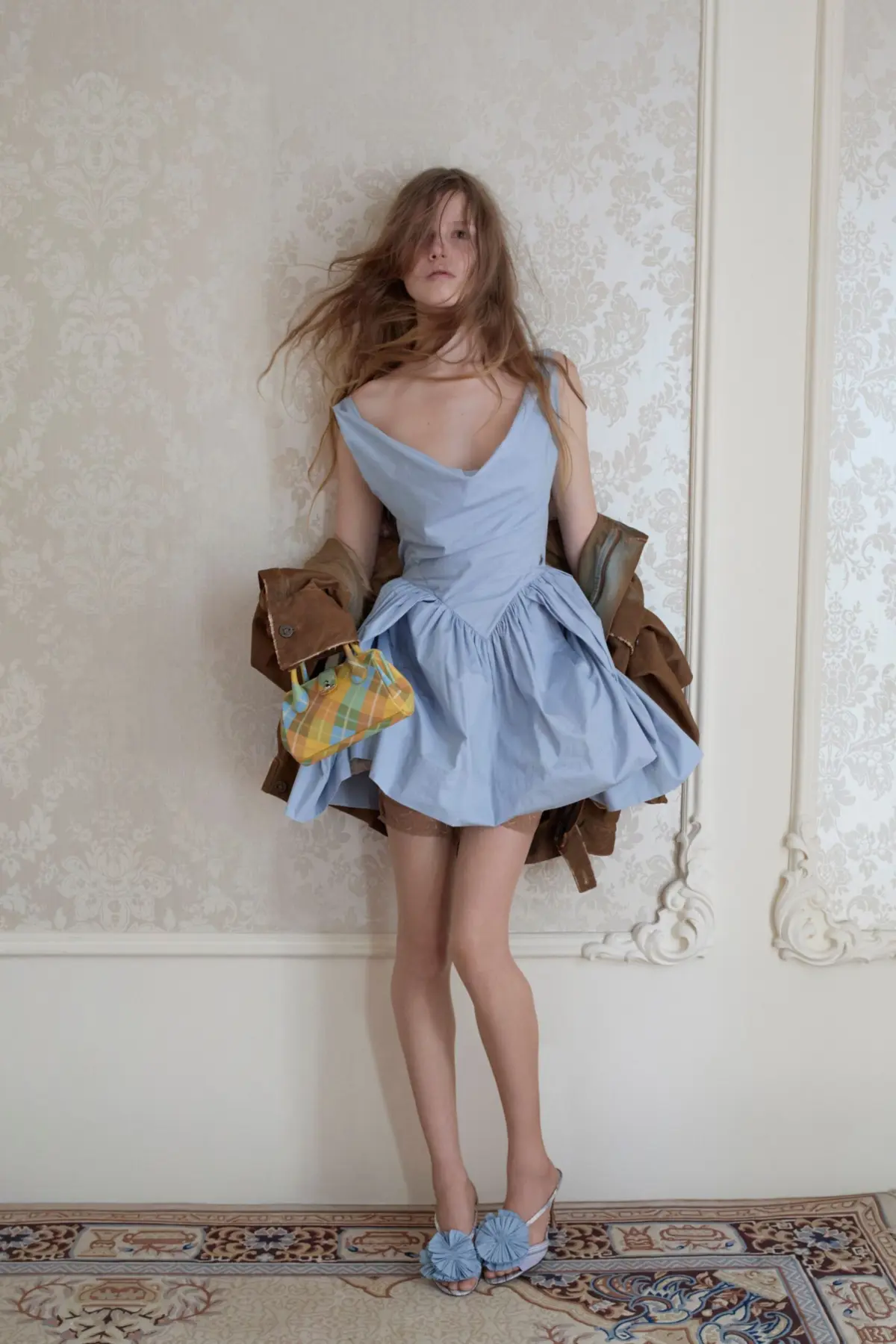
For the spring 2027 season, the Vivienne Westwood design team continued its ongoing, deeply generative dialogue with the storied house archives, finding playful, expansive, and thoroughly modern new ways to interpret its iconic standards. The primary starting point for the collection was Vive La Bagatelle, Vivienne Westwood’s famously flirty spring 1997 collection, and specifically the imagery of a prettily tied ribbon being flirtatiously undone, a motif that served as the central conceptual thread for the entire lineup. Indulging in that eternal, delicious push and pull between British propriety and theatrical provocation, the creative team drew heavily upon the central, enduring Westwoodisms that have defined the brand for decades: the fetishization of traditional Englishness, the intimate and secretive atmosphere of the boudoir, and the titillating, magnetic appeal of clothes that steadfastly refuse to behave themselves.
There was plenty for loyal followers of the house to recognize immediately, from the familiar, innocent sweep of a Sunday dress to the wonderfully off-kilter construction of "drunken" tailoring. However, these classic silhouettes were brilliantly interwoven with some thrilling and ambitious developments in garment engineering and textile manipulation. Consider, for instance, the introduction of the new Mona corset. Inspired directly by the house’s original seventeenth-century-style corset, this updated iteration introduced reworked side panels that successfully pulled in the waist even further than before, yet utilized a softer, more flexible boning that made for a surprisingly comfortable, wearable fit. The label has always thoroughly understood the exacting art of body-contouring, but this season found vastly more subversive ways to cinch, twist, and contain the human figure. Throughout the collection, ruched and knotted skirts crafted from unexpected materials like denim and fine knitwear clung tightly to the body and then released in entirely unpredictable places, leaving the wearer themselves to decide how much or how little to indulge.
Among the standout pieces of the collection was the newly developed Chi Chi dress, a deeply dramatic black taffeta gown featuring a highly sculptural bodice and an arpeggiating skirt. This striking garment successfully brought together distinct echoes of the archival Bird of Paradise silhouette alongside the youthful, punk-infused irreverence of the Wake Up, Cave Girl! collection. Black provided a remarkably strong, grounding undercurrent amid a sea of plaids rendered in delightfully off-kilter colors, appearing across luxurious cady, fluid crepe jersey, and eveningwear pieces that were visibly inspired by John Singer Sargent’s famous portrait, Madame X.
Even more fun, however, was to be had with the vibrant array of prints that populated the runway. Ripe grapes, thoughtfully revisited from that same spring 1997 collection, sprawled across a "drunken" shirt, its deliberately distorted and asymmetrical construction giving the striking optical impression of continuous movement even when the model was standing completely still. Elsewhere, delicate magnolia blossoms appeared in full bloom across voluminous skirts and substantial outerwear, while François Boucher’s classical masterpiece Mars and Venus Surprised by Vulcan brought a familiar strain of historical rococo artistry to a casual, everyday jersey t-shirt. The collection also featured meticulous micro-ginghams and broken pinstripes—a particularly Westwoodian exercise in articulating the respectable, rigid conventions of traditional English dressing while simultaneously injecting them with a potent dose of unmistakable rebel spirit.
When it came to tailoring, the design was deviously compelling at every turn. Waistcoat jackets, which proved to be a wildly popular silhouette back in the 2000s, made a triumphant return, paired expertly with louche, architecturally draped dovetail trousers. Elsewhere on the runway, classic double-breasted jackets were styled with Pirate buckle-back trousers, while relaxed Wreck jackets featured low-slung, utilitarian pockets that added an air of effortless nonchalance. One particularly killer jacket was cinched securely with multiple belts worn simultaneously low on the waist and high on the shoulders, creating a brilliant piece of sartorial, bondage-tinged badinage. Romance abounded as well, notably through the inclusion of traditional Nottinghamshire-made Cluny lace—representing a now exceptionally rare and rarified artistic practice—as well as through fine, fluid knitwear dusted subtly with sparkle, and shorter, more playful iterations of the signature Sunday dress.
Accessories smartly continued the ongoing archival conversation that defined the ready-to-wear garments. The heavily stacked Clomper sole made a dramatic return to the runway, as did the distinctive anatomical-toe slingback shoes. Furthermore, this year marks a significant milestone: the fifteenth anniversary of the house’s ongoing Made in Kenya partnership. Developed in collaboration with the Ethical Fashion Initiative and Nairobi-based social enterprise Artisan Fashion, this long-standing initiative supports local craftsmanship and empowers artisan communities in East Africa. True to this tradition, the accessories lineup featured exquisite, entirely hand-beaded and woven bags expertly crafted by Kenyan artisans, adding a vital layer of ethical craftsmanship and global community connection to the collection.
The sheer breadth of historical and cultural references utilized by the Vivienne Westwood design team is always a source of immense delight, but this season, those diverse elements were especially dexterously rearranged and reimagined. It serves as a powerful reminder that the late, great Dame’s iconic design vocabulary still has so much more to give when it is stretched, sliced, and plied with a healthy measure of creative spirit.