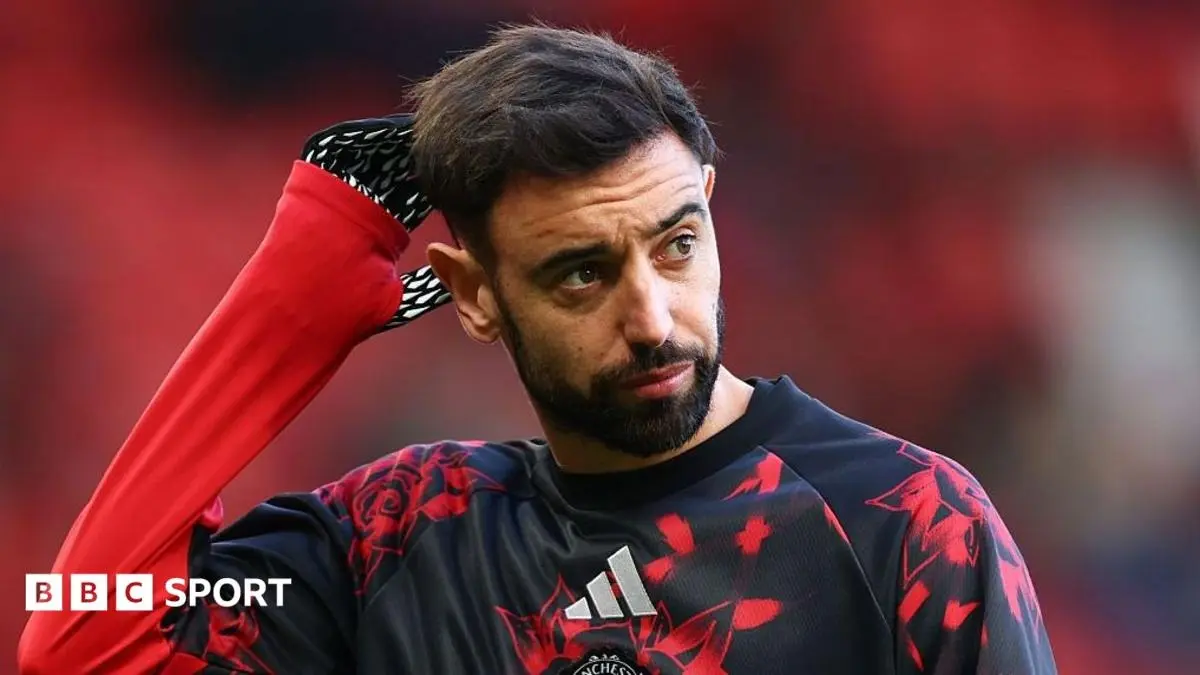
Manchester United head coach Michael Carrick has moved to extinguish speculation surrounding the future of club captain Bruno Fernandes, insisting the Portuguese playmaker remains “fully committed” to the cause despite a tumultuous week at Old Trafford. As the club navigates one of its most challenging periods in recent memory, Carrick’s public backing of his skipper serves as a critical attempt to stabilize a dressing room currently reeling from a string of poor performances and internal friction.
The controversy began in earnest following Manchester United’s chastening 4-1 Champions League defeat by Como. In the immediate aftermath of that loss, Fernandes reportedly questioned the tactical approach employed by the coaching staff—a critique that did not go unnoticed. The response from the hierarchy was swift and decisive; for Sunday’s subsequent Premier League fixture against Bournemouth, Carrick made the bold decision to bench his captain.
The gamble backfired spectacularly on the pitch, as United fell to a 3-0 defeat at home to Bournemouth. The result left the atmosphere at Old Trafford toxic and placed Carrick’s own future as head coach under intense scrutiny. However, as the dust settles, the club has confirmed that Carrick will remain in charge for this Saturday’s high-stakes trip to Stamford Bridge to face Chelsea.
Clearing the Air at Carrington
The tension between head coach and captain necessitated a face-to-face meeting. On Tuesday, Carrick and Fernandes held what have been described as “clear-the-air” talks at the club’s Carrington training complex. The objective was to address the friction caused by the Como tactical disagreement and to align the squad for the remainder of a campaign that is rapidly spiraling out of control.
Speaking to the media ahead of the Chelsea fixture, Carrick was adamant that there is no lingering rift and, crucially, no intention to strip Fernandes of the armband. When asked directly if the midfielder would remain captain, Carrick was unequivocal.
“We are clear with the situation of the team, and as a football club,” Carrick stated. “He is an important player for this group. He has been and he will be. We’ve got to make a difference and we’ve got to push things in a good direction.”
Carrick emphasized that the decision to bench Fernandes against Bournemouth was purely a tactical choice specific to that fixture, rather than a disciplinary measure intended to signal a permanent change in leadership.
“He’s fully committed to this football club; he’s fully committed to making things better. There are absolutely no issues with that,” Carrick added. “It doesn’t change for me. It was a decision for what we felt for the [Bournemouth] game. That’s it. He’s the one that’s led the team so well for many a game and many a year, and he’ll continue to do that. There are absolutely no issues with that.”
Whether Fernandes will return to the starting XI against Chelsea remains the subject of intense speculation, but the public show of unity from the manager suggests that the club is desperate to project an image of stability as they face a daunting run of fixtures.
A Historic Run of Poor Form
The pressure on Carrick is amplified by the sheer scale of Manchester United’s current struggles. The team has now gone eight consecutive matches without a win, a streak that represents the club’s worst run of results since the 2015-16 season. The crisis is reaching historical proportions; not since the 1988-89 campaign have the Red Devils endured a winless sequence of nine matches.
The weight of this statistic looms large over the trip to London. Should United fail to secure a victory at Stamford Bridge, they will equal that unwanted record from over three decades ago, further compounding the misery for a fanbase that has grown increasingly vocal in its frustration.
The delay in confirming Carrick’s status following the Bournemouth defeat provided a window into the behind-the-scenes uncertainty at the club. Nearly 40 hours passed between the final whistle on Sunday and the club providing any form of clarification on the manager’s position. During that time, high-level discussions took place involving the Glazer family, minority owner Sir Jim Ratcliffe, chief executive Omar Berrada, and director of football Jason Wilcox.
The consensus reached by the leadership group was to provide Carrick with the opportunity to steer the team out of the current malaise. While the tenure of any coach in such a position is inherently fragile, it appears that Carrick has been granted a window of grace that will likely see him remain in the dugout for the upcoming Champions League clash against Roma and the Premier League home game against Aston Villa on November 8. Following that encounter, the domestic calendar will pause for a two-week international break—a period that often serves as a natural juncture for clubs to evaluate their long-term managerial strategy.
Facing the Pressure Without Assurances
Despite the volatility surrounding his position, Carrick maintains a composed, professional demeanor. When questioned about whether he had sought or received formal assurances regarding his job security from the club’s board, the 45-year-old was dismissive of the need for such comfort.
“I don’t need any assurances from anyone,” Carrick said. “I totally get the position. I understand the job. I understand the responsibilities. I understand what comes with that. So, I really don’t need any assurances from anyone in that regard.”
Carrick’s willingness to shoulder the burden of the current results reflects his deep history with the club, though he acknowledged that the lack of results is far from the standard expected at Old Trafford. When asked if he was surprised that he remained in his post given the severity of the eight-game winless run, he was direct in his assessment.
“No. I’m here to do my job. I’m here to do the best for the team, and I’m desperate to make us better and improve things. So, I’m not surprised, no,” he replied.
For now, the focus shifts to the training pitch at Carrington, where the primary objective is to rebuild the confidence of a squad that appears paralyzed by the weight of expectations. By reaffirming Fernandes as his captain and maintaining a calm front in the face of widespread criticism, Carrick is attempting to insulate the players from the noise surrounding the club.
The path forward, however, is fraught with difficulty. The upcoming fixture list—starting with a trip to Chelsea and followed by the European test against Roma—offers little room for error. Whether the “clear-the-air” talks with Fernandes and the backing of the board will be enough to spark a turnaround remains to be seen. For Carrick, the mandate is clear: the time for explanations has passed, and the time to deliver results on the pitch is now. The history of the club, and the mounting frustration of the supporters, ensures that the margin for error has all but vanished.