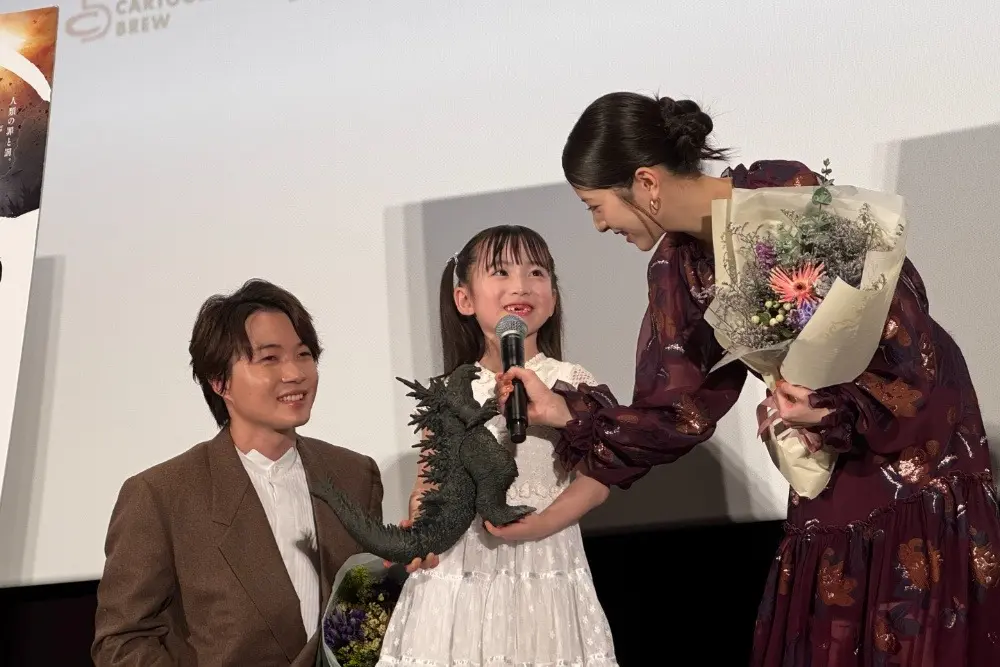
The cast of Godzilla Minus Zero brought the electric atmosphere of a Hollywood standing ovation to the 39th Tokyo International Film Festival this Sunday, just 48 hours before director Yamazaki Takashi’s highly anticipated follow-up to his Academy Award-winning Godzilla Minus One makes its official debut in Japan. The event served as a poignant homecoming for the film’s stars, Kamiki Ryunosuke and Hamabe Minami, who had only recently returned to Japanese soil following a whirlwind premiere at the historic TCL Chinese Theatre in Los Angeles.
For Kamiki, who reprises his role as the haunted protagonist Shikishima Koichi, and Hamabe, who returns as his wife, Noriko, the contrast between the raucous enthusiasm of the American audience and the disciplined anticipation of the Japanese festival crowd underscored the universal appeal of the legendary kaiju.
“The energy was simply extraordinary,” Kamiki remarked during the festival appearance, reflecting on the Los Angeles reception. “Feeling that raw enthusiasm firsthand made me realize all over again just how deeply Godzilla is loved around the world. It was an invaluable experience.”
The reception at the Los Angeles premiere was, by all accounts, overwhelming. Reports indicate that the applause within the 900-seat theater continued in an unbroken, thunderous wave. Hamabe noted that the connection with the audience extended far beyond the initial screening. At an after-party following the premiere, the cast was greeted by fans who had clearly prepared for the occasion, many sporting Godzilla-themed attire or displaying intricate pins and badges.
The fervor was not confined to the auditorium. Kamiki recounted the scene on the red carpet, which was open to the public and passersby. The sight of fans brandishing large posters and clamoring for autographs created a high-energy environment that surprised even the seasoned actors. In a moment that highlighted the director’s newfound global celebrity, the crowd began chanting Yamazaki’s first name—not with the reserved formality one might expect in a professional setting, but with a boisterous, familiar intensity.
“It wasn’t just a polite ‘Takashi,’” Kamiki recalled with a smile. “It was like: ‘TAKASHI! HEY, TAKASHI!’ It was roaring.” When the director stepped forward to engage with the fans, the crowd erupted once more. Witnessing the intensity of the adoration, Kamiki was left with a lasting impression: “Takashi of the world is truly amazing.”
The Tokyo International Film Festival event also provided a significant milestone for the production, marking the first public stage appearance of child actor Nagatani Sae, who returns to the screen as Shikishima Akiko. As she took the stage, she was accompanied by Kamiki, a gesture that highlighted the close-knit nature of the cast.
The transition from Godzilla Minus One to the new installment has been particularly significant for the young actress. In the previous film—which recently aired on Japanese television’s Friday Roadshow—Nagatani’s performance was defined by the constraints of infancy, with her dialogue limited to cries and single words like “Where?” In Godzilla Minus Zero, however, the script demands a much more complex performance.
“We were like, ‘Really? Can she do this?’” Kamiki admitted, recalling the initial apprehension of the cast and crew regarding the child’s expanded role. “But when we got on set, she had all her lines memorized perfectly and delivered them flawlessly.”
Hamabe echoed this sentiment, noting the remarkable growth she witnessed in her young co-star. During the production of the first film, Nagatani was essentially still a toddler and was often intimidated by the sheer number of adults on a professional film set. “So, reuniting on this film, I was amazed by how much of a wonderful young girl she had grown into,” Hamabe said. “She chatted with us so much, taught me various things, and was very dependable in her acting.”
For her part, Nagatani appeared poised beyond her years, stating that she felt no nerves during the filming process. She shared a touching anecdote about the support she received from her on-screen father: even after the director called “cut” on a particularly difficult scene where Akiko is required to cry, Kamiki would continue to rub her back, ensuring she felt secure. When asked by the press how she manages to be such a fine actor while still in elementary school, she turned the question back to her co-stars, seeking advice. Kamiki, ever the supportive lead, insisted that she already outshone them, adding that for someone of her age to contribute so significantly to both Minus One and Minus Zero was an “amazing achievement in itself.”
As for the narrative direction of the new film, Kamiki revealed that the story picks up approximately two years after the harrowing events of Godzilla Minus One. “I hope viewers can imagine what those two years were like for them, and see how the family stands together against what comes next,” he said. Hamabe suggested the timeline might be slightly longer, perhaps two to three years, noting that the characters had begun to find a sense of normalcy in their everyday lives before the looming threat of the kaiju surfaced once again to disrupt their peace.
When the discussion turned to the enduring legacy of the Godzilla franchise, the cast members found themselves in agreement with the common critical consensus: that each film serves as a mirror for the era in which it is produced. Yet, for Kamiki, the connection is more visceral and personal.
“Personally, when I reflect on it, take Godzilla’s existence or the theme music: I cannot even remember when I first heard it or realized, ‘Oh, this is Godzilla’s theme song,’” he said. “It has always been alongside us, which is why I personally think it has remained loved for so long.”
Hamabe provided a perspective focused on the human element of the survival stories. She noted that from the perspective of the characters, Godzilla represents an overwhelming, insurmountable force of nature. “Yet, when Godzilla appears, humans unite and stand together to face it,” she said. “I think seeing that human resolve is the first thing that moves people’s hearts.”
The stakes for Godzilla Minus Zero are high, following the historic success of its predecessor. Godzilla Minus One, the 30th live-action Japanese entry in the franchise, proved to be a global phenomenon, grossing more than JPY 7.65 billion (approximately $50 million) at the Japanese box office. Its impact was felt worldwide when it became the first Asian production to win the Academy Award for Best Visual Effects at the 96th Oscars, eventually racking up more than 50 honors globally.
Building on that technological and critical momentum, Godzilla Minus Zero arrives with the distinction of being the first Japanese film ever to be certified as “Filmed for IMAX,” signaling a new chapter in the visual ambition of the series. As the cast returns to Tokyo, the anticipation suggests that the roar of the monster, and the dedication of those who bring its human stories to life, will continue to resonate with audiences for years to come.